
How to Get Fast SEO Results in UAE (10 Proven Strategies That Work in 2026)
Search engines have become the gateway to discovery. In the United Arab Emirates, where over 98 % of residents use smartphones and 87 % consider mobile their primary internet gateway, ranking on the first page of Google isn’t optional – it’s the lifeline of modern business. But the common question persists: How can you achieve fast SEO results in the UAE? And how long does it take for SEO results to show?
The answer lies in a strategic blend of technical excellence, hyperlocal relevance, content that speaks to both English and Arabic audiences, and data‑driven iteration. This guide distils the latest research and local insights into ten proven strategies that will help you gain momentum quickly while building a foundation for long‑term success. Each strategy comes with practical actions, pro tips and a short‑term action plan so you can start seeing improvements within weeks while working toward sustainable growth.
Why SEO in the UAE is unique
A mobile‑dominated market
The UAE’s internet usage is overwhelmingly mobile. After Google’s full rollout of mobile‑first indexing on 5 July 2024, Googlebot now primarily uses a smartphone agent to crawl and rank sites. This shift coincides with local behaviour: more than 98 % of residents use smartphones, 87 % use mobile as their primary internet access, and 80 % of Dubai e‑commerce transactions happen on mobile. Globally, 96.3 % of internet users access the web via a mobile phone. Any SEO strategy that ignores mobile speed, usability and page experience is destined to fail in the UAE.
Multilingual and multicultural audience
While English is widely used, Arabic remains the mother tongue for a large part of the population. Search behaviour is bilingual, people often search in English, read reviews in Arabic and interact with voice assistants in Modern Standard Arabic. An effective SEO strategy must therefore include Arabic SEO (localised content, schema and keywords) alongside English.
Hyperlocal intent
The UAE is not a monolith. Searches like “Italian restaurant Dubai Marina” or “lawyer in Al Barsha” signal different intents. To get fast results you need to capture micro‑locations – each neighbourhood, district and even building can be a search segment.
Expectation for quick improvements
Businesses often want results immediately. However, SEO results appear gradually and typically take 3 – 6 months to become tangible. Factors like competition, site history and keyword scope influence this timeline. The strategies below are designed to produce visible improvements in weeks while aligning with the long‑term nature of search.
10 proven strategies for fast SEO results in the UAE
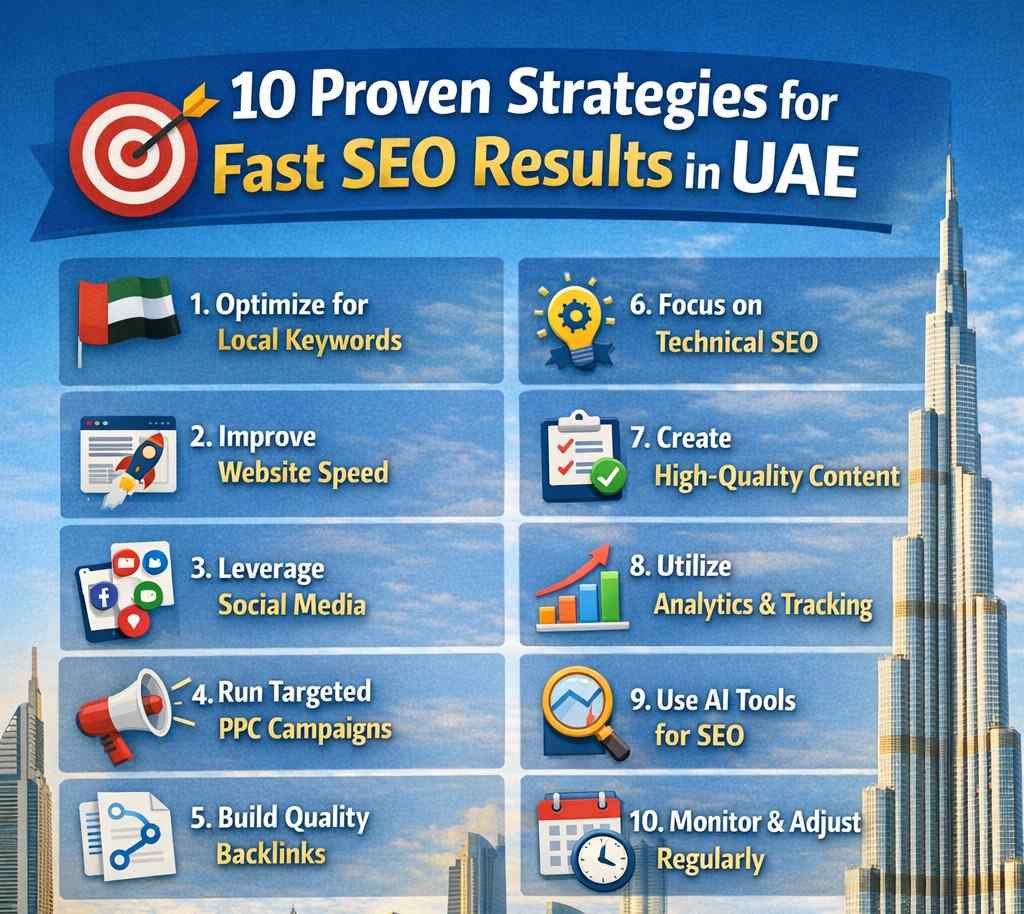
1 Build a lightning‑fast, mobile‑first website
Google’s Core Web Vitals measure how users experience loading, interactivity and visual stability. For a positive ranking signal you should achieve:
- Largest Contentful Paint (LCP) under 2.5 seconds;
- Interaction to Next Paint (INP) under 200 milliseconds;
- Cumulative Layout Shift (CLS) under 0.1.
Under mobile‑first indexing, speed and stability are direct ranking factors. A one‑second delay can increase bounce rates by 32 %. To optimise:
- Host locally: Use a UAE‑based data centre or a content‑delivery network (CDN) with GCC POPs to reduce latency.
- Compress and optimise assets: Resize images, serve them in next‑gen formats (WebP/AVIF) and lazy‑load below‑the‑fold media. Minify CSS/JS and enable server‑side caching.
Responsive design: Use a single responsive URL with the same HTML for mobile and desktop. Avoid blocking JavaScript, CSS or images. - Test on real devices: Mobile emulators aren’t enough. Check finger‑friendly button sizes and readability on devices with different screen sizes.
Pro Tip: Host your site on UAE servers and enable HTTP/2. The competitor’s advice emphasises this because local hosting dramatically reduces LCP.
2 Fix your technical SEO foundation
Fast results require that search engines crawl and understand your site efficiently. A robust technical foundation includes:
- Clean architecture: Use logical URL structures and ensure proper internal linking so bots can discover every important page.
- XML sitemaps and robots.txt: Submit sitemaps in Google Search Console. Avoid disallowing JavaScript and CSS files needed for rendering.
- HTTPS and canonical tags: Serve pages securely and avoid duplicate content via canonicalization.
- Resolve crawl errors: Use Search Console to monitor 404s and fix broken links.
- Server log analysis: Identify crawl frequency and discover wasted crawl budget.
Although technical SEO isn’t glamorous, improvements here often lead to jumping several pages in rankings because they improve crawlability and page experience.
3 Create high‑quality content tailored to the UAE
Searchers in the UAE want content that reflects their environment. Generic articles rarely resonate. Successful pages:
- Answer the question up front: Start each article with a 40–60 word direct answer.
- Reference UAE locations and events: Mention neighbourhoods like JBR, Dubai Marina, Al Barsha and events like Ramadan, the Dubai Shopping Festival or back‑to‑school seasons.
- Use scannable formatting: Short paragraphs, clear headings and bullet lists make mobile reading easier.
- Bilingual coverage: Provide parallel English and Arabic sections or integrate essential Arabic terms so bilingual readers feel at home.
- Seasonal targeting: Plan content around high‑search months (Ramadan, Eid, GITEX, Expo events). Include local weather notes and daylight hours when relevant.
Pro Tip: Write location‑specific guides rather than generic posts. “Top family‑friendly cafes near Dubai Mall” will outperform “Best cafes in Dubai” because it mirrors how residents search.
4 Optimise for voice search and conversational queries
Voice search usage is accelerating. About 40 % of online searches now happen through voice interfaces, and 58 % of consumers use voice search to find nearby businesses. To capture this market:
- Target long‑tail conversational phrases: People speak naturally (“Where can I find a family dentist in Dubai Marina?”) rather than typing keyword fragments. Use tools like AnswerThePublic to source question‑based keywords.
- Create robust FAQ sections: AI systems and voice assistants favour direct answers. Keep responses around 29 words for featured snippets. Use FAQ schema so search engines understand the Q&A format.
- Optimize for local voice intent: Include explicit location phrases (“near me”, “in Jumeirah”) in titles and meta descriptions. 58 % of voice users search for local businesses, so ensure your Google Business Profile contains accurate NAP (Name, Address, Phone) and open hours.
- Improve page speed and mobile experience: Voice results need to load quickly. Pages should render in under three seconds.
Pro Tip: Use schema.org’s “speakable” schema to mark up sections that are ideal for voice playback. This helps assistant devices know which part of your content to read aloud.
5 Dominate hyperlocal SEO and Google Business Profiles
To rank quickly in the UAE, zoom in on micro‑locations:
- Create separate landing pages for each neighbourhood or service area. Use unique content (maps, landmarks, parking tips) so that you don’t cannibalise pages.
- Optimise your Google Business Profile: Fill in local phone numbers (+971), accurate hours, photos of the location and a description that matches local search intent.
- NAP consistency: Ensure your name, address and phone number are identical across all listings and directories.
- Collect and respond to reviews: Encourage happy customers to leave reviews and respond promptly. Local pack rankings heavily factor in review quantity and quality.
- Leverage local directories: Listing your business on reputable UAE directories increases your local authority. Popular directories include Yellow Pages UAE, Dubai Chamber of Commerce Directory, Gulf Business Directory and UAE Business Directory.
Pro Tip: Use photos taken outside your storefront to show landmarks. In Dubai’s labyrinthine districts this helps Google verify your location and boosts trust.
6 Invest in bilingual and Arabic SEO
Ignoring Arabic means forfeiting half your market. A successful Arabic SEO strategy goes beyond translation:
- Hire native speakers: Natural‑sounding Arabic content requires native fluency.
- Account for formal voice search: Spoken Arabic queries often use formal language. Research differences between colloquial and Modern Standard Arabic when selecting keywords.
- Implement Arabic schema: Use @context: “https://schema.org” with Arabic @language tags. Add Arabic FAQs and LocalBusiness schema to signal multilingual support.
- Optimise right‑to‑left layouts: Ensure your site design accommodates RTL scripts on mobile and desktop.
Pro Tip: Because competition in Arabic is lower, high‑quality Arabic pages can rank within weeks and deliver excellent ROI.
7 Adopt a smart link‑building strategy
Backlinks still matter, but the 2026 landscape rewards quality over quantity. In the UAE, one link from Gulf News or Khaleej Times can outweigh dozens of directory links. Build authority through:
- Local media placements: Pitch expert commentary to journalists at Gulf News, Khaleej Times or Dubai Eye. Provide statistics or unique insights.
- Partnerships with UAE influencers: Collaborate on articles, podcasts or webinars. Co‑created content generates natural links and builds brand awareness.
- Sponsoring events and charities: Local events (food festivals, tech conferences, charity runs) often have websites that list sponsors – a great source of high‑authority backlinks.
- Relevant directories: Submit to trusted UAE directories like those mentioned above, but avoid spammy, irrelevant sites.
Pro Tip: Focus on earning links that drive referral traffic, not just PageRank. Real local exposure helps both SEO and sales.
8 Implement structured data and rich snippets
Structured data (Schema Markup) clarifies your content for search engines and voice assistants. Essential types for UAE businesses include:
- LocalBusiness schema: Add your exact address, operating hours and contact information.
- FAQ schema: Mark up question–answer sections to improve your chances of being pulled into AI overviews and voice results.
- Product/Service schema: List prices in AED, product details and availability.
- Review schema: Showcase 5‑star ratings or testimonials.
- Speakable schema: For voice assistants, mark paragraphs that are ready for text‑to‑speech.
Pro Tip: Use Google’s Rich Results Test to validate your structured data and fix errors. Plugins like Yoast and Rank Math can automate implementation.
9 Keep your content fresh and seasonal
Google values freshness. Updating existing posts with current statistics and local information can move articles from position 8 to position 2. To stay current:
- Review top‑performing pages quarterly using Search Console.
- Add new statistics: Incorporate up‑to‑date figures about smartphone adoption, e‑commerce trends or tourism.
- Expand FAQs: Answer emerging questions from customer service or sales teams.
- Synchronise languages: Update both English and Arabic versions simultaneously.
- Leverage events: Create or update content around Ramadan, Eid, Expo City exhibitions, Dubai Summer Surprises and UAE National Day.

10 Track the right SEO metrics and iterate
To know whether your efforts are producing fast results, focus on metrics that matter:
- Featured snippet placements: Position zero can drive huge traffic. Monitor new AI‑generated answers and adjust your content accordingly.
- Local pack appearances: Track how often your business shows up in Google Maps listings.
- English vs. Arabic keywords: Maintain separate keyword lists and track performance separately.
- Voice search inclusion rates: Use analytics to see if your pages are being read aloud by assistants.
- Non‑branded organic traffic and conversions: Look beyond rankings. Track leads, sign‑ups or sales generated from organic search.
Use Google Analytics, Search Console and call‑tracking software to monitor these metrics. Each month, double down on what works and refine or drop what doesn’t.
Pro Tip: Don’t chase vanity metrics. A jump from page 4 to page 2 is less important than a rise in qualified inquiries.
Also Read: Top 15 SEO Plugins for WordPress in 2026
Three‑month action plan for fast SEO gains
To put these strategies into practice, follow this 90‑day roadmap, adapted from the expert‑recommended sequence:
Weeks 1 – 2
- Conduct a full technical SEO audit: fix Core Web Vitals, ensure responsive design, implement HTTPS and canonical tags.
- Optimise your Google Business Profile: update NAP details, add photos and encourage initial reviews.
- Map out keywords for both English and Arabic, focusing on hyperlocal and conversational queries.
Weeks 3 – 6
- Publish pillar content: write comprehensive guides for your main services/products with clear FAQ sections and schema.
- Launch your Arabic content strategy: translate existing pages and create original Arabic articles tailored to local search behaviour.
- Begin building local backlinks: submit your site to major directories and pitch stories to local media.
Weeks 7 – 12
- Refresh existing content: update statistics, expand FAQs and improve readability.
- Double down on what’s working: if certain neighbourhood pages perform well, create similar pages for adjacent districts.
- Start tracking AI and voice search appearances: adjust content based on performance reports.
By the end of the third month you should see improvements in impressions and click‑through rates, and initial conversions. Full rankings typically emerge between three and six months, but this sprint accelerates your progress.
Final thoughts
Fast SEO results in the UAE are not about shortcuts or black‑hat tactics. They come from understanding local user behaviour, delivering a flawless mobile experience, creating high‑value bilingual content and continuously refining based on data. The market rewards those who respect its nuances: the 98 % smartphone penetration, the bilingual searches and the neighbourhood‑level intent. Execute these ten strategies with discipline and you’ll see quick wins that compound into long‑term dominance.
Ready to put these strategies into action? Book a free SEO audit with our experts and let’s craft a tailor‑made plan to propel your business to the top of the UAE’s search results. Contact us today to start your journey to the first page.
FAQs
Q: How long does it take for SEO results to show?
A: SEO results appear gradually. Most businesses see noticeable improvements within 3 – 6 months, depending on competition, site authority and keyword scope. Fast wins come from fixing technical issues and targeting low‑competition local queries.
Q: What is the fastest way to improve SEO in the UAE?
A: Prioritise mobile performance (achieve LCP under 2.5 seconds), optimise your Google Business Profile, and publish hyperlocal, bilingual content. Combining these moves can generate results within weeks.
Q: Do I need Arabic content if I already rank in English?
A: Yes. Arabic SEO reaches half your potential audience and has lower competition, leading to faster rankings. Native‑written content, proper schema and right‑to‑left design are critical.
Q: How important are backlinks in 2026?
A: Backlinks remain important, but quality matters more than quantity. One link from a reputable UAE publication (e.g., Gulf News) can outweigh dozens of low‑quality directory links.
Q: Should I still focus on desktop SEO?
A: Yes, but treat the desktop as a secondary priority. Google’s mobile‑first indexing means it primarily evaluates your mobile site. Ensure content parity across devices and avoid hiding elements on mobile.




One Comment