E-commerce SEO Guide 2026 for UAE Stores
Search engines drive a large share of online shopping journeys. A 2024 Statista report forecasts global retail ecommerce sales to exceed $4.3 trillion in 2025 and approach $8 trillion by 2027. Meanwhile, 81 % of consumers research products online before buying. These statistics underline why mastering SEO for ecommerce websites is no longer optional; it is the foundation for visibility, trust and sustainable sales.
This guide combines insights from leading authorities and our experience as a Dubai‑based SEO agency to create the most comprehensive 2026 resource available.
So, let’s get digging!
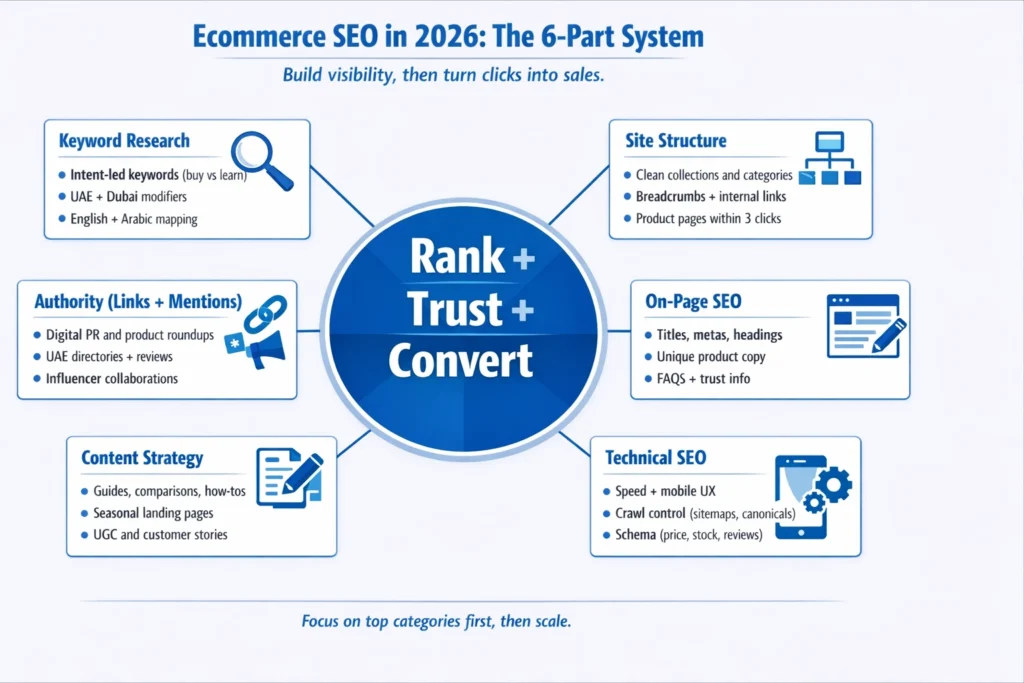
What is Ecommerce SEO and Why It Matters
Definition and Unique Challenges
Ecommerce SEO is the process of optimising an online store’s product and category pages to rank higher in search engines. Unlike standard websites, ecommerce stores must manage hundreds or thousands of products, dynamic filters and user‑generated content. Common challenges include:
- Many product pages and category pages: Each requires unique metadata and content.
- Duplicate content and thin pages: Repeating manufacturer descriptions creates duplicate content, which search engines may ignore.
- Competition with large marketplaces: Stores compete with giants like Amazon and Noon.
- User‑generated content: Reviews and Q&A play a bigger role than in other industries.
Benefits of Investing in Ecommerce SEO
Our experts note that organic traffic is free, builds trust, and continues to drive visitors long after ads stop. Optimised stores also enjoy higher conversion rates because they attract visitors who are already looking to buy. An SEO strategy reduces reliance on paid advertising, provides consistent growth and helps beat larger competitors when shoppers filter by locality (e.g., “perfume shop Dubai”).
Key Functions to Prioritise
Shopify’s experts outline three essential tasks for ecommerce SEO:
- Optimise collection/category and product pages. These are the pages shoppers land on first, so they need unique content and metadata.
- Submit product feeds to Google Merchant Centre. Without a verified feed, your products won’t appear in Google Shopping results.
- Build new collection pages for specific queries. Creating pages for trending or seasonal categories (such as “Ramadan gifts UAE”) helps capture long‑tail traffic.
Building a Solid Foundation: Keyword Research for Ecommerce
Understand Search Intent and Keyword Types
Successful ecommerce SEO starts with understanding what shoppers want and why they search. There are two main intents:
- Informational intent: Users seek answers or guides and may not be ready to purchase, e.g., “best hiking routes in Fujairah.”
- Commercial intent: Users are close to purchasing; they search for “buy men’s running shoes UAE” or “iphone 15 price Dubai”.
Aundigital further breaks ecommerce keywords into transactional, informational, branded and local categories. For a Dubai‑based perfume shop, keywords might include:
- Transactional: “buy oud perfume Dubai online,” “cashmere scent same‑day delivery.”
- Informational: “how to apply perfume oil,” “difference between oud and musk.”
- Branded: “Ajmal oud perfumes UAE” or “Swiss Arabian shop.”
- Local: “perfume store near me Dubai” or “Arabic perfumes Deira.”
Tools and Techniques
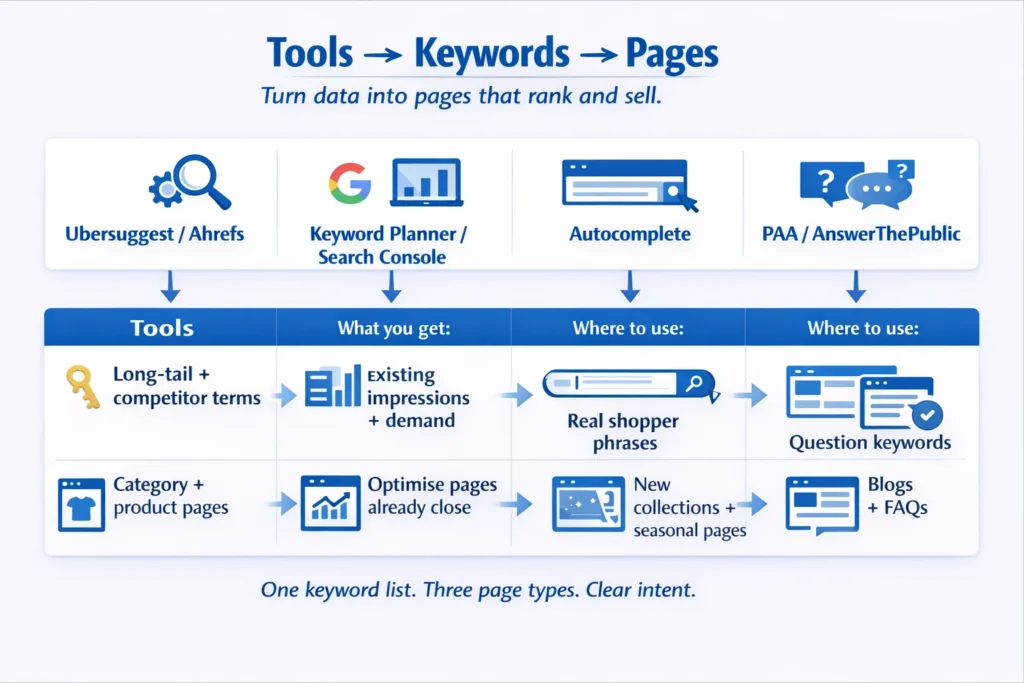
Use multiple tools to uncover profitable keywords:
- Ubersuggest or Ahrefs: Identify long‑tail, low‑competition phrases and competitor keywords.
- Google Keyword Planner & Search Console: Free tools to discover keywords that already bring impressions.
- Autocomplete predictions on Google, Amazon and Souq: Suggest long‑tail search phrases shoppers actually type.
- AnswerThePublic or People Also Ask boxes: Provide question‑based keywords for blog topics and FAQ sections.
Pro Tip: Long‑tail keywords account for 70 % of all web searches. They convert better because they’re specific. Instead of targeting “perfume,” go for “oud perfume for women Dubai cash on delivery.”
Identify Topics and Categories
Mapping keywords to your product structure is crucial. Experts recommends organising products into clear hierarchies, for example, Men’s Shoes > Running Shoes > Trail Running Shoes, and using descriptive URLs like /mens/shoes/trail-running/black-boost.
Use your keyword research to create dedicated category pages for themes such as Ramadan gift sets, Dubai shopping festival deals, or Eid clothing. Each page should target a cluster of related queries and link to relevant products.
Geo‑Targeting and Language Considerations
Dubai is multilingual. Optimise pages in English and Arabic (with hreflang tags) to reach both markets. Include location modifiers (“Dubai,” “UAE,” “Sharjah”) in titles and content. For example:
- Arabic meta title: شراء عطر العود دبي – توصيل فوري (“Buy Oud Perfume Dubai – Instant Delivery”).
- English meta title: Buy Oud Perfume in Dubai – Free Delivery.
Using the hreflang attribute signals to Google which language is intended for which region, reducing duplicate content issues and improving local rankings.
On‑Page SEO: Creating Pages That Rank and Sell
Optimising on‑page elements is one of the most controllable aspects of ecommerce SEO. Each product and category page should be a conversion machine.
Craft Compelling Titles and Meta Descriptions
Shopify advises editing title tags and meta descriptions to include keywords and persuasive modifiers like “Free Shipping,” “20 % Off” or “Same‑Day Delivery”. Our SEO experts emphasise keeping titles 60–70 characters and including the product name and key benefit. For example:
Title: Luxury Oud Perfume – Free Delivery in Dubai | Cash on Delivery Available
Description: Discover our handcrafted oud perfumes with same‑day Dubai delivery and cash on delivery. Shop authentic fragrances online.
Write Unique Product and Category Descriptions
Google uses on‑page content to determine relevance. Copying supplier descriptions creates duplicate content. Instead, write detailed descriptions that highlight benefits, features and storytelling. We recommend:
- Highlighting product benefits, not just features.
- Using keywords naturally, including synonyms and related terms.
- Adding testimonials, social proof or ratings.
Pro Tip: For high SKU counts, prioritise top‑selling or high‑margin products. Optimising a handful of pages that already rank on page 1 can deliver faster ROI.
Structure Pages with Headings and Internal Links
Use heading tags (<h1>–<h3>) to organise content clearly and include target keywords. Aundigital suggests adding an FAQ section with common buyer questions, delivery times, size guides, return policies to reduce bounce rates and improve user experience. Internally link to related products, categories and blog posts to keep visitors engaged. This also signals to Google which pages are important and helps distribute link equity.
Optimise Images for SEO and Conversions
Large, unoptimised images slow down page loads. Here’s what you can do:
- Compressing images and using modern formats (WebP).
- Including descriptive file names and alt text with keywords.
- Providing multiple angles and lifestyle photos to increase conversions.
Use Schema Markup and Rich Snippets
Implement product schema to display ratings, price and availability directly in search results. Schema markup helps products stand out and increases click‑through rates. Use the Offer, AggregateRating and Review schema to show stock status, price range and average rating. Tools like Google’s Structured Data Markup Helper can generate the code.
Implement Breadcrumbs and Descriptive URLs
Breadcrumb navigation improves user experience and helps search engines understand your site structure. Most experts advise using breadcrumbs and short, readable URLs with keywords. For example:
Home > Fragrances > Oud Collection > Amber Oud Perfume
URL: www.example.com/fragrances/oud/amber-oud-perfume
This clarity aids both shoppers and crawlers, and shorter URLs are easier to share.
Technical SEO: Ensuring Your Store Is Crawlable and Fast
Site Speed and Core Web Vitals
Page speed is a ranking factor. A Google study found that 53 % of users abandon pages that take longer than two to three seconds to load. To improve speed:
- Compress and lazy‑load images.
- Minify CSS and JavaScript files.
- Use a Content Delivery Network (CDN) to serve assets closer to users.
- Choose high‑performance hosting with data centres in the Middle East to reduce latency.
Dubai shoppers often browse on mobile devices. Optimize for Core Web Vitals metrics, Largest Contentful Paint (LCP), First Input Delay (FID) and Cumulative Layout Shift (CLS), which measure load speed, interactivity and visual stability.
Mobile Optimisation
Over 76 % of U.S. adults shop via mobile, and Middle‑Eastern shoppers have similarly high mobile usage. Ensure responsive design, easy navigation and a frictionless checkout. Test across devices and languages (Arabic script can be longer). Avoid intrusive pop‑ups that harm the experience.
Secure and Crawlable Site Architecture
- HTTPS everywhere: While not a direct ranking factor, having an SSL certificate builds trust and protects customer data.
- XML sitemap and robots.txt: Submit your sitemap in Google Search Console to help bots crawl all category and product pages. Use robots.txt to block irrelevant pages (cart, checkout) from indexing.
- Canonical tags: Handle duplicate content by marking master versions. This prevents diluting ranking signals and ensures search engines pick the correct URL.
- Avoid duplicate pages: If multiple URLs lead to the same product due to filters, set canonical tags or use rel=“next”/rel=“prev” for pagination.
- Fix broken links: Broken product links harm user experience and SEO. Use Google Search Console to find and fix 404 errors; redirect discontinued products to newer versions.
Merchant Centre and Product Feeds
Submitting an accurate product feed to Google Merchant Centre ensures your products appear in shopping results. Verify website ownership, submit product data in the required format, and monitor feed status. For UAE markets, also integrate with local comparison platforms like Noon, Namshi or Carrefour to expand reach.
Site Structure and Navigation
Keep Navigation Intuitive
A simple, scalable structure improves both user experience and search rankings.
Example Hierarchy for a Dubai Fashion Store:
- Home
- Women’s Clothing
- Abayas
- Evening Dresses
- Casual Dresses
- Men’s Clothing
- Kanduras
- Casual Wear
- Sportswear
- Accessories
- Watches
- Bags
- Perfumes
- Women’s Clothing
Use descriptive folder names in URLs (e.g., /womens/abayas/black-chiffon-abaya).
Use Breadcrumb Navigation
Breadcrumbs show users where they are in the hierarchy and enable search engines to grasp the relationship between pages. Implement breadcrumbs using structured data (BreadcrumbList schema) for best results.
Pagination and Filtering
Faceted navigation (size, colour, brand) can generate thousands of URL variations. Prevent index bloat by:
- Using noindex on filtered pages that don’t target search keywords.
- Allowing bots to crawl important filter combinations that warrant ranking (e.g., “red abayas Dubai”).
- Using canonical tags to point duplicate variations back to the primary category page.
Category and Product URL Best Practices
- Short and readable: Use hyphens, not underscores; avoid stop words like “and” or “the”.
- Include keywords: Example: www.example.com/mens/running-shoes/nike-air-zoom.
- Avoid dynamic parameters: Use static URLs rather than ?size=10&color=red when possible.
Content Strategy: Blogging, Guides and Seasonal Pages
Why Content Still Matters in 2026
Written content remains a cornerstone of ecommerce SEO. Regular content attracts organic traffic, builds trust and provides backlink opportunities. A content strategy positions your store as an authority and helps target informational keywords that draw shoppers earlier in their journey.
Types of Content to Create
- Buying Guides and Product Comparisons: Help users choose between similar items (e.g., “Oud vs. Musk – Which Perfume Suits You?”). These posts can target long‑tail questions and link to your products.
- Seasonal and Cultural Guides: Align content with local events such as Ramadan, Eid, Dubai Shopping Festival and UAE National Day. Create gift guides or fashion trend posts for these occasions.
- How‑to Tutorials and FAQs: Answer common questions (“How to wear a kandura in summer?”) to capture informational intent. Use schema markup (FAQPage) so that answers appear directly in search results.
- Customer Stories and UGC: Feature stories from UAE customers, photos and testimonials. User‑generated content not only builds trust but also helps pages rank higher.
- Glossary and Resource Hubs: Create a glossary for terms like oud, attar, kandura or burqa to educate international shoppers. Build hub pages that link to related products and articles.
Content Planning and Localisation
Develop an editorial calendar that aligns content topics with key shopping seasons in the UAE:
| Season/Occasion | Approximate Period | Content Ideas | Local Considerations |
| Dubai Shopping Festival | January–February | Sales announcements, top deals, gift guides | Emphasise discounts; highlight local delivery services |
| Ramadan & Eid | Varies annually (often March–April) | Ramadan gift sets, Eid clothing guides, charity collaborations | Use respectful language; schedule posts before and during Ramadan |
| Summer (June–August) | Hot weather months | Tips for lightweight fabrics, summer perfumes | Include advice on staying cool; emphasise free shipping due to heat |
| Back to School | August–September | Stationery, backpacks, children’s clothing | Target parents; emphasise bundle deals |
| National Day | 2 December | Limited edition products, patriotic themes | Use national colours; local shipping options |
Pro Tip: Offer bilingual content with Arabic headings and meta tags. This broadens reach and caters to UAE’s diverse population.
Link Building and Off‑Page Strategies
Backlinks remain one of the strongest ranking signals. Quality matters more than quantity. Follow these tactics:
- Broken Link Building: Identify broken product links on other sites and suggest your page as a replacement.
- Competitor Backlink Analysis: Use tools to discover who links to competing stores and pitch your products to those websites.
- Directory Listings and Review Sites: Submit your store to high‑quality directories like Google Business Profile, Yelp, Trustpilot and local UAE directories.
- Guest Posts and Product Roundups: Contribute to blogs or magazines with relevant audiences (fashion, lifestyle, tech). Aim for UAE‑based publications for geo‑relevancee.
- Influencer Partnerships: Collaborate with UAE lifestyle influencers and bloggers to review or unbox your products. These collaborations generate natural backlinks and social signals.
- UGC and Reviews: Encourage customers to post reviews and share their purchases on social media. Reviews not only build trust but also count as fresh content.
- Local SEO and Citations: Create and optimise your Google Business Profile and maintain consistent NAP (Name, Address, Phone) details. Encourage local reviews, respond in both Arabic and English, and list your products on local marketplaces.
Pro Tip: Pursue seasonal link‑building campaigns around events like Black Friday or Ramadan. Pitch gift guides to lifestyle blogs and influencers before the season for maximum exposure.
Conversion Rate Optimisation (CRO) for Ecommerce SEO
SEO brings traffic; CRO turns it into revenue. Trust signals like cash‑on‑delivery, free returns and SSL badges improve conversion rates. Combining SEO with CRO not only boosts sales but also signals positive user engagement to search engines.
Trust and User Experience
- Payment flexibility: Offer popular UAE payment methods such as Cash on Delivery, Tabby and Tamara. Display icons prominently.
- Clear delivery information: Mention shipping timelines (e.g., “Free next‑day delivery in Dubai”) and provide estimated delivery dates at checkout.
- High‑quality images and videos: Use lifestyle photos to show products in context and short videos for demonstration.
- Easy returns: Include a simple returns policy and highlight customer service options.
- Urgency and scarcity: Show stock counters, limited‑time discounts or countdown timers to encourage immediate purchases.
Improve Site Engagement
- Exit‑intent pop‑ups: Offer a small discount or free shipping when users attempt to leave.
- Live chat and WhatsApp integration: Provide quick answers, building trust and reducing cart abandonment.
- Related product recommendations: Use AI‑driven or rule‑based systems to suggest complementary items, increasing average order value.
Avoiding Common Ecommerce SEO Mistakes
Even well‑intentioned store owners make errors that hurt rankings.
- Copying manufacturer descriptions or duplicate content. Always write unique copy.
- Neglecting category pages: Category pages often rank higher than product pages. Add introductory text, SEO‑friendly headings and internal links.
- Ignoring mobile and speed optimisation: Slow sites lose users and rankings.
- Not using internal links: Failing to link between products, categories and content prevents Google from understanding site structure.
- Relying solely on paid ads: Organic traffic is more sustainable and cost‑effective in the long term.
Conclusion and Next Steps
SEO for ecommerce websites is a marathon, not a sprint. By focusing on keyword research, on‑page optimisation, technical health, content creation, link building and conversion improvements, you can build an online store that attracts customers organically and converts them into loyal buyers.
Ready to transform your ecommerce store? At WR SEO Specialist, we tailor strategies for the UAE market, from bilingual keyword research to technical audits and conversion optimisation. Whether you run a fashion boutique in Dubai or a cross‑border electronics store serving the GCC, our team can help you climb the search results and dominate your niche.
Contact us today to get a personalised ecommerce SEO plan and start turning clicks into conversions.
FAQs About SEO for Ecommerce Websites (2026)
1. What is ecommerce SEO?
Ecommerce SEO is the practice of optimising online stores so that product and category pages rank high in search engines, driving free, targeted traffic from potential buyers. It involves keyword research, on‑page optimisation, technical improvements, content creation, link building and user experience enhancements.
2. Why is SEO essential for ecommerce sites in Dubai?
Because a high percentage of shoppers research products online before purchasing. Ranking well builds trust, reduces advertising costs and taps into local search queries such as “buy abaya Dubai” or “perfume near me”.
3. How long does ecommerce SEO take to show results?
Improvements typically appear within 4–6 months, depending on competition, site age and investment. SEO is a long‑term strategy; consistent effort yields compounding returns.
4. What are the best SEO strategies for 2026?
Improvements typically appear within 4–6 months, depending on competition, site age and investment. SEO is a long‑term strategy; consistent effort yields compounding returns.
4. What are the best SEO strategies for 2026?
Perform in‑depth keyword research using tools and local insights.
Optimise site structure and product pages with unique content and schema.
Fix technical issues: speed, mobile responsiveness, sitemaps, SSL.
Create high‑quality content (guides, blogs, FAQs).
Build authoritative backlinks and leverage local influencers.
Focus on user experience and CRO.
5. Should I hire an SEO agency?
Hiring a local agency like WR SEO Specialist can accelerate results. Dubai agencies understand the UAE’s bilingual market, shopper behaviour and local search trends. They manage the technical work, leaving you to focus on merchandising and customer service.
6. How do I track my ecommerce SEO performance?
Google Search Console: Monitor impressions, clicks and indexing issues.
Google Analytics 4: Track organic traffic, revenue and conversion funnels.
Keyword rank trackers: Check where your product and category pages rank.
Site audit tools (Screaming Frog, Semrush/Ahrefs): Identify technical issues.
7. How can I handle seasonal spikes (e.g., Ramadan, DSF)?
Create dedicated landing pages for seasonal promotions well in advance. Optimise them with relevant keywords (“Ramadan gift sets,”“Dubai Shopping Festival deals”). Build backlinks and run influencer campaigns leading up to the event. After the season, redirect or update the page for future use.