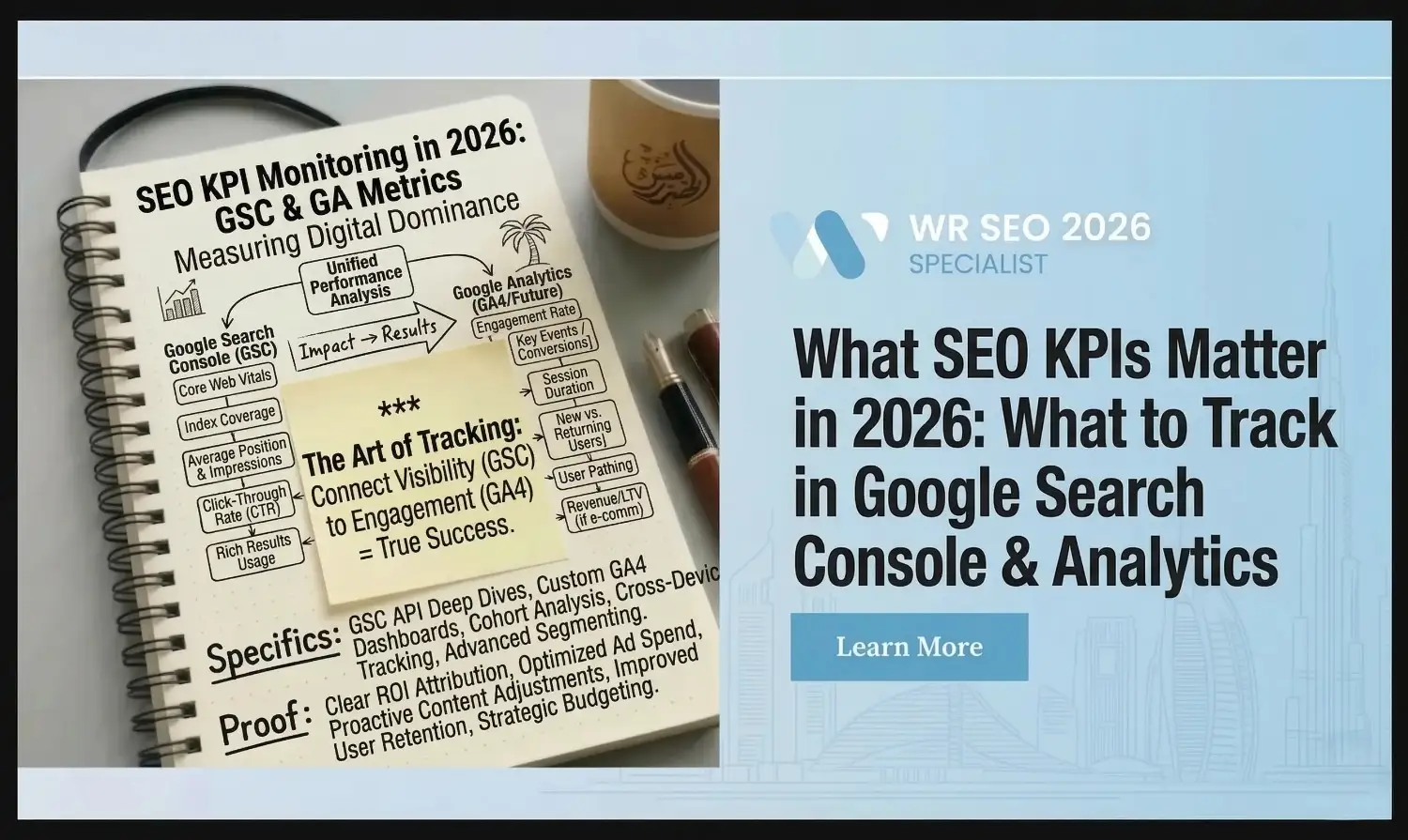
What SEO KPIs Matter in 2026: What to Track in Google Search Console & Analytics
A lot of SEO reports still look “good” on paper while the business feels stuck. Traffic looks fine. A few keywords climbed. Impressions went up. But leads, calls, and sales barely move.
That is the real problem in 2026. Search visibility and business impact are no longer the same thing. AI Overviews can reduce clicks even when you still appear in search, and Pew found users clicked a traditional result in 8% of visits when an AI summary appeared, compared with 15% when it did not. Google also says traffic from AI features like AI Overviews and AI Mode is included in overall Search Console web reporting, which means “traffic from Search” now carries more layers than it used to.
This guide shows which SEO KPIs connect to revenue, which platform each KPI belongs to, and how to stop making decisions based on weak numbers. This is not about tracking more. It is about tracking better.
Why traditional SEO metrics are failing businesses in 2026
The old SEO habit was simple: watch traffic volume, celebrate ranking first, and track a growing keyword list.
That worked when search was more direct. It works far less well now. Visibility without clicks is real. Clicks without conversions are weak. Rankings without revenue do not prove success.
Why vanity traffic no longer predicts real business growth
Vanity metrics are numbers that look impressive but do not prove business impact. A site can gain traffic while qualified leads stay flat. It can earn more impressions while phone calls drop. That usually means the traffic is mismatched, the page fits the wrong intent, or the offer is too weak to turn interest into action.
The hard truth is simple: raw traffic can hide poor intent, bad landing pages, and low-quality visits.
How AI Overviews changed what ranking first really means
Ranking high does not always mean winning attention now. AI summaries, snippets, shopping features, and map packs can sit above classic results and answer the user before your blue link gets a chance.
So “position 1” is no longer the full story. You can rank well and still lose the click if the results page absorbs the action first.
Why zero-click search changes how SEO wins are measured
Zero-click means the user gets enough from the search page and does not visit the website. That does not mean SEO stopped working. It means the win may show up later as a branded search, a direct visit, a return session, or an assisted conversion.
That is why SEO KPI tracking now has to connect search visibility to business outcomes, not just sessions.
The 2026 SEO KPI framework that focuses on outcomes
A cleaner SEO KPI framework has four layers: visibility, engagement, conversion, and revenue.
Visibility tells you whether you are being seen. Engagement tells you whether the visit meant anything. Conversion tells you whether the visit moved the person closer to action. Revenue tells you whether SEO is helping the business, not just the dashboard.
Rankings still matter, but they are an input. They are not the finish line.
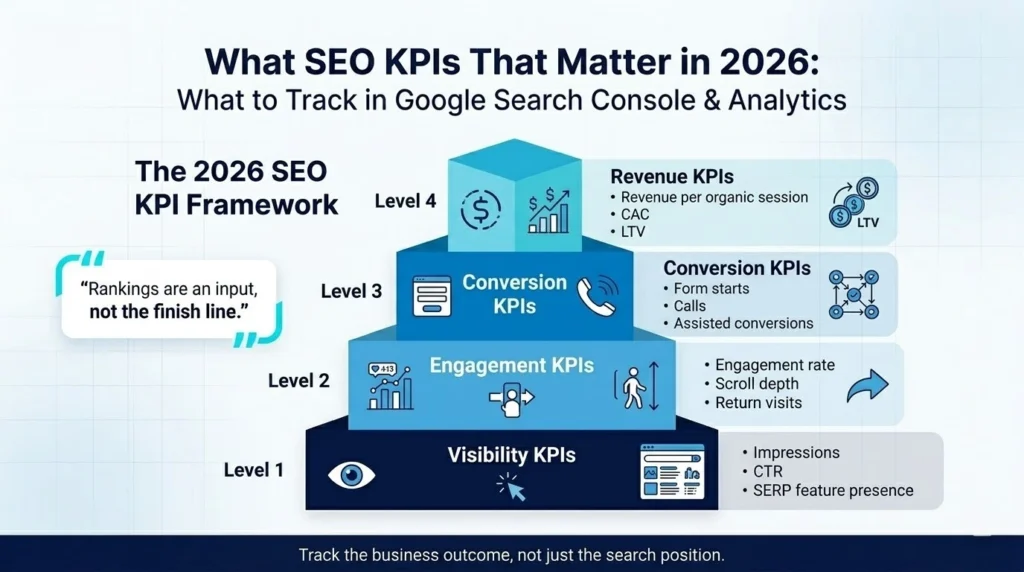
Revenue per organic session as a stronger traffic quality metric
Revenue per organic session tells you how much value each organic visit produces on average.
That is far more useful than traffic alone. Five hundred weak visits can be worse than fifty strong visits. The basic formula is simple: revenue from organic divided by organic sessions.
This metric helps teams stop celebrating empty growth.
Organic CAC vs paid CAC for cleaner channel comparison
Customer acquisition cost means how much it costs to win one customer.
Comparing organic CAC to paid CAC creates clearer budget decisions. Paid search can bring speed. SEO can build compounding value. Looking at both side by side helps teams see where long-term efficiency is improving.
Assisted conversions and why SEO often starts the journey
SEO often starts the journey even when it does not get the last click.
That matters for blogs, guides, comparison pages, and educational content. If you only judge SEO by last-click conversions, you will underrate the pages that create trust early.
Lifetime value of organic users compared with other channels
Lifetime value is how much a customer is worth over time.
Some organic visitors buy later, stay longer, or come back more often because they first found you through helpful content. That is why comparing first-purchase revenue alone can hide the real value of SEO.
Search Console KPIs many teams still overlook
Search Console is still one of the best places to see what search is doing before a user lands on your site. Its Performance report gives you clicks, impressions, average CTR, and average position, and the data can be grouped by query, page, country, device, and more.
Those numbers become far more useful when you read them together instead of one by one.
Impression share and CTR gaps that expose weak search messaging
High impressions with low CTR usually mean people are seeing the page but not choosing it. That gap often points to weak titles, the wrong page type, poor search-intent fit, or a SERP layout that steals attention before the click.
A page with strong visibility but weak CTR is often one of the easiest wins in SEO.
Position distribution analysis beyond the average position
The average position can hide an opportunity. A better question is this: how many useful keywords sit in positions four through ten, and how many high-value pages are one good update away from page one strength?
That is where “almost-winning pages” live.
Query intent mismatch and ranking for the wrong searches
Some pages rank well for searches that do not fit the offer. That creates lots of clicks but weak conversion, low lead quality, and the feeling that SEO “is working but not helping.”
Reviewing queries at the page level helps you spot where the wrong audience is landing.
Core Web Vitals by device to find mobile revenue leaks
Device gaps matter. A page that feels fine on desktop can still leak revenue on mobile if loading, interaction, or layout stability falls apart there.
This is not only a technical issue. It is a sales issue when the mobile user gives up before taking action.
Indexed, crawled, and discovered status that exposes bottlenecks
Pages move through a simple path: discovered, crawled, and indexed. If those stages break, visibility breaks. Weak internal linking, thin content, and messy structure often show up here first.
This is one reason technical and content teams need to read the same numbers, not separate ones.
Manual action checks as early warning protection
Manual actions are the kinds of problems you do not want to discover late. Even if a team did not mean to cross a line, ignoring those warnings can turn a fixable issue into a ranking collapse.
A quick check now is cheaper than a cleanup later.
GA4 KPIs that show what organic visitors actually do
If Search Console tells the story before the click, GA4 tells the story after it. Google says engagement rate and bounce rate in GA4 are both based on engaged sessions, and an engaged session lasts more than 10 seconds, has a key event, or has two or more page or screen views.
That shift matters because behaviour is now measured with more nuance than the old bounce-rate mindset.
Why engagement rate matters more than old bounce-rate thinking
Engagement rate is the share of sessions that actually involve meaningful interaction.
That makes it more useful than the old “did they leave fast” mindset. A page can keep a visit alive through reading, clicking, or moving deeper. That gives you a better clue about whether the page is doing its job.
Average session duration by landing page as a content-quality clue
Longer engagement can suggest that a page is holding attention. But longer is not always better. A fast-converting landing page should not need a long visit. A detailed guide usually should.
That is why you compare by page type, not by one flat sitewide average.
Event tracking for scroll, video, and deeper content interaction
Pageviews alone are weak. Scroll depth, video plays, CTA clicks, form starts, and downloads show whether the visitor actually moved through the content.
Those events help you tell the difference between a quick glance and real interest.
Conversion path analysis and how many touchpoints SEO really needs
Many organic users do not convert on the first visit. Some need a guide, then a service page, then a return visit, then a form fill.
That is why path length matters. It shows how many sessions, pages, or channels appear before conversion.
Organic return visitor rate and what it says about trust
Return visitors often signal stronger interest. They may be comparing options, checking details, or coming back when they are ready.
A rising return rate from organic can be a quiet sign that your content is sticking.
Cross-device journey patterns from research to conversion
A common path is desktop research followed by a mobile revisit and then a conversion. If you only read one device in isolation, the story can look weaker than it really is.
Cross-device thinking keeps you from under-crediting SEO.
Technical SEO KPIs that affect revenue, not just crawl stats
Technical KPIs matter most when they affect visibility, trust, and conversions.
Crawl budget efficiency tells you whether Google is spending time on pages that matter. JavaScript rendering success tells you whether search engines can actually see the content you built. HTTPS trust and mixed-content errors can affect confidence before a visitor ever submits a form. Real mobile speed under weaker network conditions matters because fast on office Wi-Fi is not the same as fast for a user on the move.
Structured data validation matters because clean markup can improve eligibility for richer results. Internal link authority flow matters because some sites keep sending strength to low-value pages while money pages stay weak.
A technical report is useful only when it points to lost visibility or lost action.
Content performance KPIs that go beyond rankings and traffic
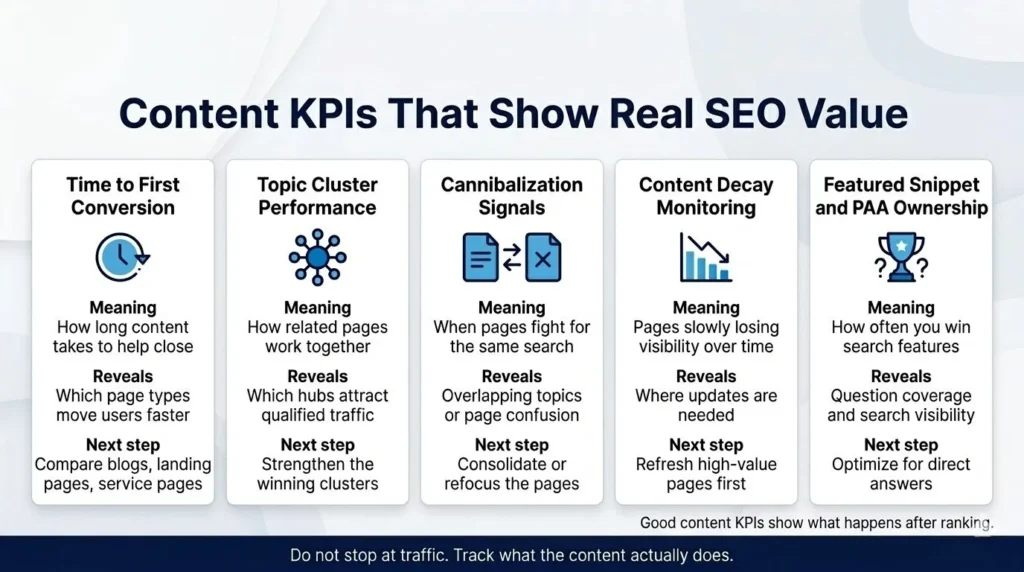
Content should be judged by what it leads to, not just where it ranks.
Time to first conversion is one of the clearest examples. Blogs often assist earlier in the path. Landing pages often close faster. Service pages often sit in the middle, proving fit and reducing doubt.
Topic-cluster performance also matters. One page rarely tells the full story. A cluster can bring traffic through support pages and convert through service or landing pages. Cannibalization is another useful KPI because several pages can quietly fight over the same query and split the result.
Content decay matters too, because some pages slowly lose clicks and conversions even before anyone notices. Featured snippet and People Also Ask ownership still matter because they shape visibility. E-E-A-T signals matter because strong author pages, brand mentions, and better backlinks support trust.
Competitive intelligence KPIs that reveal where the market is moving
Competitor tracking is not about copying. It is about seeing where the market is moving before you fall behind.
Share of voice tells you how visible you are across core topic areas, not just one keyword. Keyword gap work helps surface missed terms with stronger buying intent. Backlink velocity shows whether others are growing high-quality referring domains faster than you are. SERP feature capture rate shows who is winning snippets, local packs, and panels even without “ranking above” you in the classic sense. Content refresh frequency tells you whether your pages are aging while competitors keep theirs fresh.
These are planning KPIs, not ego KPIs.
Local SEO KPIs that turn visibility into calls and visits
Local SEO should track real-world action, not only listing impressions.
Google Business Profile views, clicks, calls, and direction requests matter because they show local intent in motion. Local pack visibility should be checked by service and by area because one neighbourhood is not the whole market. Review velocity matters because steady review growth often supports trust better than long, quiet gaps. Near-me and proximity-driven search performance matters because local intent changes by distance. Click-to-call and click-to-navigate actions matter because some local SEO wins happen before a website visit ever shows up in analytics.
If local SEO is bringing calls and directions, it is working even when a report obsessed with sessions misses the point.
Link and authority KPIs that still correlate with stronger visibility
Links still matter, but the useful KPIs are about quality and pattern health.
Domain-level authority matters, but page-level support often decides which page wins a real query. Referring-domain growth rate and diversity matter because repeated low-value links are not the same as broad trust. Anchor text distribution matters because natural variety is healthier than forced keyword stuffing. Link placement context matters because editorial links inside relevant content usually carry more meaning than footer or sidebar links. Toxic-link review matters too, but it should be handled calmly, not with panic.
AI and automation KPIs for scaling SEO without bloated processes
Automation should help speed and consistency. It should not replace judgment.
Content production speed means little if pages are published but not indexed, not ranking, or not converting. Automated audit pass rate becomes useful when it checks basics like titles, canonicals, schema, and performance at scale. Topic discovery speed matters if AI-assisted research truly reduces planning time without lowering quality. Rank-tracking automation is useful, but critical terms still need manual checks because unstable SERPs can fool a dashboard.
The best automation saves time without lowering standards.
How to build an SEO dashboard that tracks what matters
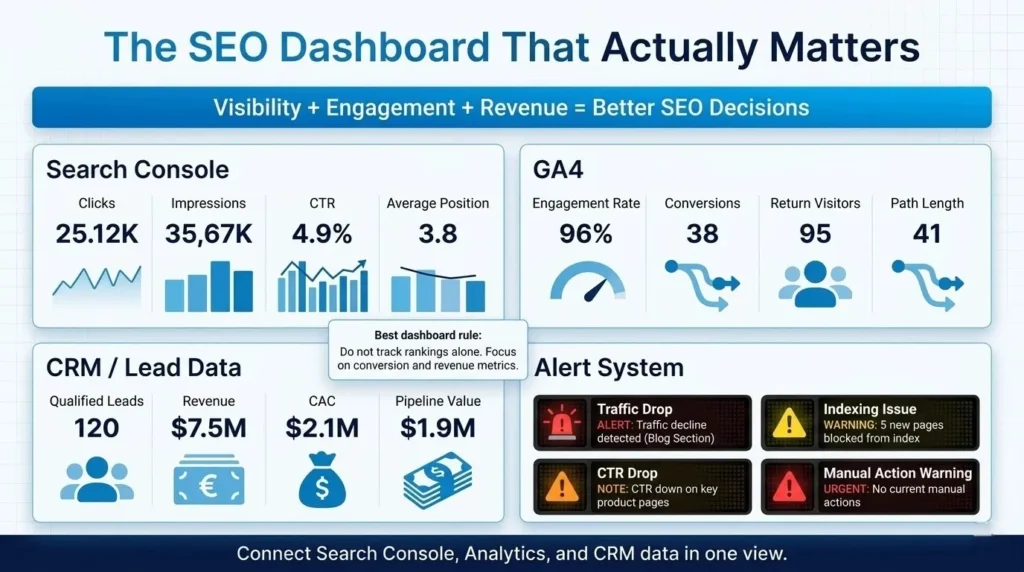
A good SEO dashboard is not the biggest one. It is the one that connects visibility, engagement, and revenue.
The cleanest version usually combines Search Console, GA4, and CRM or lead data. That gives you search visibility before the click, behaviour after the click, and outcomes after the session. Weekly reporting should focus on movement that needs attention now. Monthly and quarterly views should focus on trend and business impact. Executive dashboards should lead with pipeline, leads, revenue, and efficiency, not ranking screenshots. Alerts should catch sudden traffic drops, indexing issues, manual-action warnings, and major CTR changes before they become a bigger problem.
Common KPI mistakes that quietly break SEO strategy
A few habits create bad SEO decisions again and again.
Tracking keywords without intent context wastes time because not every ranking has the same value. Optimizing for rankings instead of conversion-ready traffic wins the wrong audience. Ignoring brand versus non-brand traffic can make performance look healthier than it is, because brand demand often reflects existing awareness, not new growth. Relying only on monthly reporting can hide seasonality, slow decay, and year-over-year patterns that matter more than short swings.
The wrong KPI can push the whole strategy in the wrong direction.
How to future-proof your KPI strategy beyond 2026
Google says the same core SEO best practices still matter for AI features like AI Overviews and AI Mode, and those appearances are counted in overall Search Console web traffic. It also explains that AI features may use a query fan-out approach across subtopics and sources, which is one reason visibility can spread in ways older ranking reports do not fully show.
That is why future-proofing means measuring visibility and outcomes together. Teams should watch for click loss from AI-heavy results, changes in branded search lift, and growth in conversational query patterns. Video belongs in the same measurement system now because YouTube visibility, embedded video engagement, and video-assisted discovery can all support search. Entity-based presence matters too, because search is getting better at understanding brands, people, services, and locations as connected things, not just strings of words.
Final Note
You do not need a dashboard full of one hundred metrics. You need the right handful tied to decisions.
A smart SEO KPI stack is usually enough when it covers five areas: visibility, engagement, conversion, revenue, and efficiency. Rankings still matter. Traffic still matters. But neither one is enough on its own anymore.
That is the real shift in 2026. SEO is no longer just a race for position. It is a system for creating visibility that turns into action.
If you want that system cleaned up and tied to business outcomes, WR SEO Specialist can help turn scattered reports into a scoreboard that actually tells you what is working, what is leaking value, and where the next growth move should be.
FAQs
What are the most important SEO KPIs in 2026?
The most useful ones usually sit across five groups: impressions and CTR for visibility, engagement rate and event tracking for behaviour, conversion rate and assisted conversions for action, revenue per organic session for business value, and CAC or efficiency measures for channel comparison.
Why is ranking number one not enough anymore?
Because the search results page can answer the question before the click. AI Overviews, snippets, map packs, and other features can sit above classic results and reduce click share.
Should I focus more on Search Console or GA4?
You need both. Search Console shows what happened in search before the click. GA4 shows what the visitor did after the click. One without the other gives an incomplete story.
How often should SEO KPIs be reviewed?
Watch alerts and major changes weekly. Review trends monthly. Compare bigger movements quarter over quarter and year over year so seasonality does not fool you.
What is the biggest SEO KPI mistake businesses make?
They celebrate visibility numbers without checking whether the traffic matches intent, supports conversions, or creates revenue. A metric is only useful when it changes a real decision.