What Is Black Hat SEO and How It Can Quietly Destroy Your Website
If your traffic dropped overnight, it feels personal. One day, you are getting calls. Next day, silence. You start wondering if Google “punished” you. That fear is real, and it is common.
Here is the calm truth. Most businesses do not knowingly use risky tactics. They hire help, follow advice, and assume it is safe. But SEO has a clean side, a risky side, and a dangerous side. The dangerous side is black hat SEO, and it often shows up without a warning label.
This guide keeps things simple. No confusing terms. No required SEO background. You will learn what search engines look for, what to avoid, and how to spot trouble early. By the end, you will know exactly what to avoid.
What Is SEO and How Search Engines Decide Which Sites Rank
SEO is the work of helping your site show up when people search.
Search engines do three basic jobs:
They discover pages, understand them, then decide which ones deserve the top spots.
Google “reads” your site using automated systems. It follows links, scans your content, and checks signals that suggest trust and quality. It also watches how your pages behave, like whether they load properly and feel safe.
Rankings matter because people trust what they see first. Top results usually get more clicks, more leads, and more sales. When you drop, the business impact is quick. Less traffic often means fewer calls, fewer quote requests, and fewer purchases.
That is why SEO is not just “writing blogs.” It is also how your website is built, how it is connected, and how honest it looks to both users and search systems.
And this is where many owners get surprised. You can do everything with good intent and still end up using tactics that break Google’s spam rules. Google is clear that spam methods can cause a page or an entire site to rank lower or disappear from results.
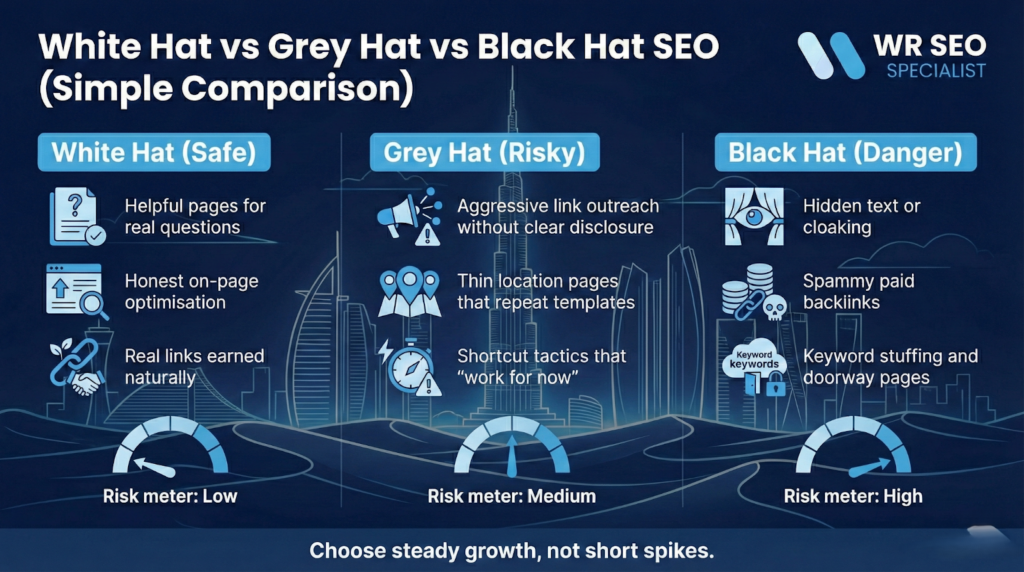
White Hat vs Grey Hat vs Black Hat SEO Explained Simply
Think of SEO like driving. Some people follow the rules. Some push the speed limit. Some cheat the system.
Here is the clean comparison:
| Type | What it means | What it looks like | Risk level |
| white hat SEO | Plays by the rules | Helpful pages, honest optimization, real links earned | Low |
| Grey hat | “Works for now” shortcuts | Aggressive link tactics, thin location pages, shady networks | Medium to high |
| Black hat | Tricks meant to manipulate rankings | Hidden text, cloaking, spam links, mass-generated pages | High |
Most business owners fall into grey or black by accident. It happens when an agency promises “fast results” and does not explain the trade-offs. It also happens when someone copies what a competitor is doing without knowing why it works, or why it might fail later.
So the next step is to understand the temptation, because it is usually wrapped in a nice pitch.
What Is Black Hat SEO and Why It Looks Tempting at First
Black hat SEO is any tactic meant to game the ranking system instead of helping the user.
It looks tempting for one reason: speed.
When you are paying bills, “quick wins” sound like a lifeline.
Some agencies sell it as “advanced SEO.” Others call it “growth hacks.” You might hear lines like: “Everyone is doing it,” or “Google will not catch it.”
But Google has been consistent on the core idea. If the purpose is to manipulate rankings, it is a problem. That includes scaled automation used mainly to rank, not to help people.
The “fast results” myth usually ends the same way. You get a bump, then a drop. Or you get traffic that never converts, because it is built on the wrong intent. Either way, you pay twice: once for the shortcut, then again for cleanup.
That is why you need to know the common tactics, especially the ones that hide in plain sight.
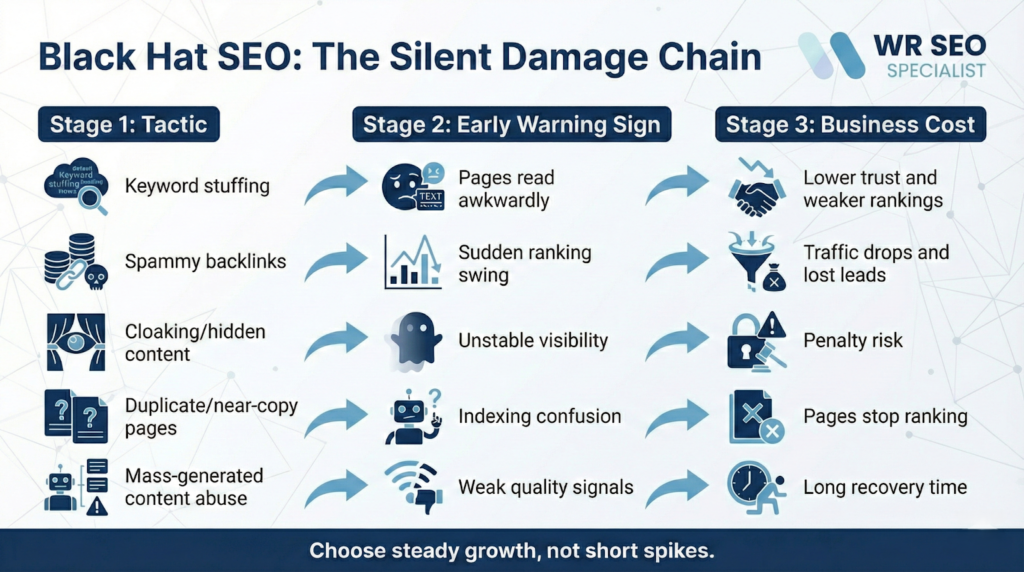
Common Black Hat SEO Techniques That Quietly Harm Websites
These are the most common black hat SEO methods that show up on real business sites. Some are obvious. Some are sneaky.
- Keyword stuffing
This is when a page repeats the same phrase so often it reads weird. It can look like “SEO for Dubai, best Dubai SEO, Dubai SEO expert…” in every line. Users feel it, and search systems notice it too. - Paid and spammy backlinks
Buying links, using link farms, or joining private networks can create a sudden jump. It can also create a sudden crash when patterns get flagged. Google lists link spam behaviours in its spam policies. - Cloaking and hidden content
Cloaking is showing search engines one thing and users another. Hidden text is stuffing extra keywords where users cannot see them. Google treats these as spam tactics. - Duplicate pages made for rankings
This includes doorway pages and thin location pages that exist mainly to capture searches, not help users. They often look like near-copies with swapped city names. - AI-spun or mass-generated content abuse
Automation is not “bad” by default, but using it at scale mainly to manipulate rankings crosses the line in Google’s guidance.
What makes these tactics dangerous is the delay. They often do not hurt right away. You might even see a short boost. Then you wake up to a drop and you cannot tell why.
That is when penalties and algorithm hits enter the picture.
How Black Hat SEO Leads to Penalties, Traffic Drops, and Losses
There are two main ways Google can hit a site: manual actions and algorithmic demotions.
Manual actions happen when a human reviewer flags spam behaviour. When that happens, some or all of your site may not show in results. You can check this inside Google Search Console’s Manual actions report.
Algorithmic drops happen when Google’s systems re-evaluate your site and decide it should rank lower. There is no warning email. You just see the fall in clicks, impressions, and leads.
The hard part is recovery.
- You might need to remove bad links, undo hidden tactics, and rewrite pages.
- You might need to submit reconsideration requests if you have a manual action.
- You might wait weeks or months for trust to rebuild, even after fixes.
The cost is not only traffic. It is brand trust. When your site disappears, customers assume you are out of business, or not credible. That is brutal when you rely on organic leads.
So what is the practical solution? You use audits to catch risk early, before it turns into a business emergency.
Also Read: How Much Does SEO Cost for Small Business in 2026?
How Ethical SEO Audits Help Businesses Avoid Risky SEO Traps
An ethical audit is not a “score report.” It is a safety check, then a plan.
It helps you find hidden risks, clean them up, and build growth you do not have to fear.
Here is a simple, real-world 10-step checklist you can use during an audit to stay on the safe side:
- Check Search Console for Manual Actions
If there is a manual action, fix that first. - Review your backlink profile for obvious junk
Look for sudden link spikes, strange domains, or repeated exact-match anchors. - Scan key pages for unnatural repetition
If it reads awkwardly, it usually is a sign of stuffing. - Look for hidden text and hidden links
This includes tiny font, same-colour text, off-screen text, and hidden blocks. - Check for doorway-like location pages
If pages only swap neighbourhood names with no real value, they are risky. - Audit duplicate content and near-copies
Thin duplicates weaken trust and waste crawl attention. - Review “automation at scale” pages
Google warns that scaled content created mainly to rank can violate the spam policy. - Confirm redirects and canonicals are honest
Sneaky redirects and misleading canonicals can create serious problems. - Check structured data for accuracy
Misleading schema can trigger manual actions tied to structured data misuse. - Write a clean action plan with priorities
Fix high-risk items first. Then improve quality and user experience.
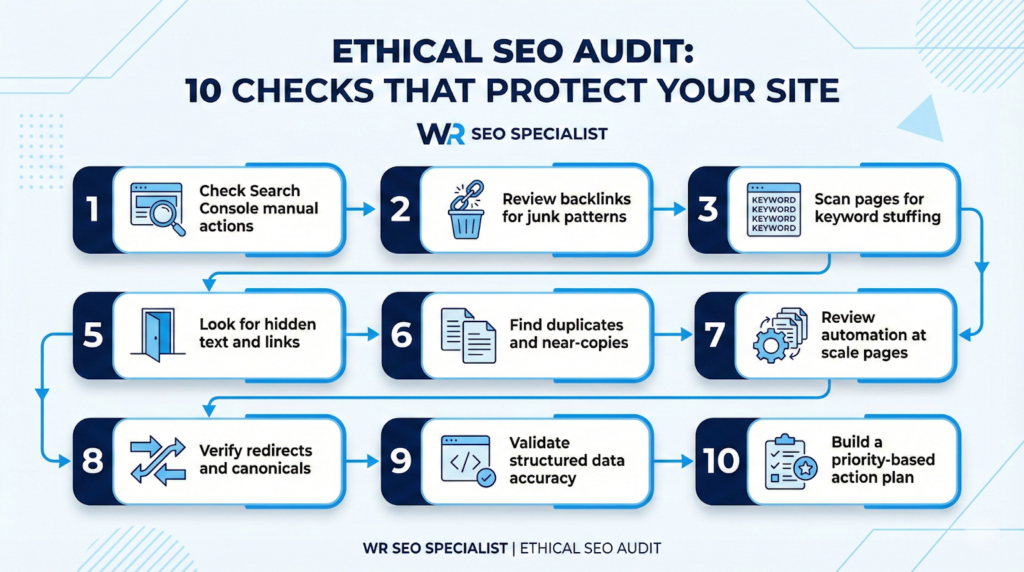
This is also the right place to mention black hat SEO again, because the best “benefit” is simple: you avoid the trap before it costs you months of revenue.
The best audits also come with transparency. You should be able to see what was changed, why it was changed, and what the next steps are. No mystery work. No secret networks. No “trust us” tactics.
Concluding Remarks
If your site stalled or slipped, do not assume the worst. Start with a calm check. Many owners discover the issue is not their product or their content. It is a risky tactic hiding in the background.
If you want help cleaning things up safely, WR SEO Specialist can review your site, point out risks clearly, and map the next steps in a way your team can actually follow. The goal is simple: steady growth you can trust, not short spikes that break later.
FAQs
How can I tell if an agency used risky SEO on my site?
Look for sudden backlink spikes, weird links, repeated keywords, and thin duplicate pages. Also check Search Console for manual actions.
Can I recover from a Google penalty?
Yes, but it can take time. You must remove the cause, document fixes, and use Search Console steps if it is a manual action.
Is buying backlinks always black hat?
Buying links meant to influence rankings is risky. Google’s spam policies cover link spam behaviours and can impact rankings.
Is AI content automatically a problem for Google?
Not automatically. The issue is intent and scale. Google says using automation mainly to manipulate rankings violates spam policies.
How often should business owners run an SEO risk audit?
Do a light check monthly (links, Search Console, key pages). Do a deeper audit every 6–12 months, and always after a redesign, migration, or sudden drop.
One Comment