Using ChatGPT for SEO Content Ideation (Without Losing Quality)
Speed is tempting. You open ChatGPT, type a question, and get fifty content ideas in under a minute. That sounds like a win, until you look closely and realize most of those ideas are the same angles every competitor already covered six months ago. Speed without direction leads content teams to produce a lot of work that does not rank, convert, or build real trust with the audience.
The real value of using ChatGPT for SEO content ideation is not in the speed. It is in what the tool can surface when you ask the right questions, in the right order, with the right context already in place. Done well, it becomes one of the more useful thinking partners an SEO team can have. Done carelessly, it produces noise that fills a content calendar without moving a single ranking.
In 2026, the bar for content quality has moved higher. Generic articles are everywhere. What actually performs in search is content with sharper angles, genuine answers, and editorial judgment behind every section. This guide walks through exactly how to use ChatGPT to build that, without letting automation replace the thinking that makes content worth reading.
Why ChatGPT Works Better for Ideation Than First Drafts
ChatGPT is a language model. It is very good at pattern recognition and generating text that sounds coherent. What it is not good at is knowing your audience deeply, understanding what your business actually does differently, or recognizing which content angles your market has not seen before. That is human work.
When you use ChatGPT to write final drafts at scale, you usually end up with content that reads like everything else already on the internet. It may pass a basic readability check, but it rarely gives the reader a reason to stay, share, or come back. Ideation is a different story. Asking ChatGPT to help you think through topic possibilities, identify question variations, or map out content angles, that is where the tool earns its place in an SEO workflow. The ideas still need a human filter before becoming briefs. But the range of starting points you get from a well-prompted session is far wider than most teams can produce in a standard brainstorming meeting.
Set Audience Goals and SEO Prompts Before Asking ChatGPT
The quality of what ChatGPT returns is directly tied to the quality of what you put in. A vague prompt like “give me SEO blog ideas for a law firm” will return a predictable, surface-level list. A well-structured prompt that includes the audience type, their biggest concerns, the business goal of the content, the tone expected, and the stage of the buying journey will return something far more usable.
Before you open ChatGPT for any ideation session, spend five minutes writing down four things: who you are targeting, what that person is trying to solve or understand, what action you want them to take after reading, and what tone fits your brand. Feed all of that into your prompt before you ask for ideas. The difference between a weak prompt and a strong one is not a technical skill. It is the habit of thinking before typing. Weak prompts produce weak topic lists. Strong prompts give you content angles worth building.
Use ChatGPT to Find Angle Gaps Competitors Still Ignore
Most content in any niche covers the same ground. The how-to posts, the beginner guides, the listicles, they exist on dozens of sites already. ChatGPT can help you move past those default angles if you ask it the right way. Instead of asking for “content ideas,” ask it to identify the questions your audience is asking that most content in your space still does not answer directly.
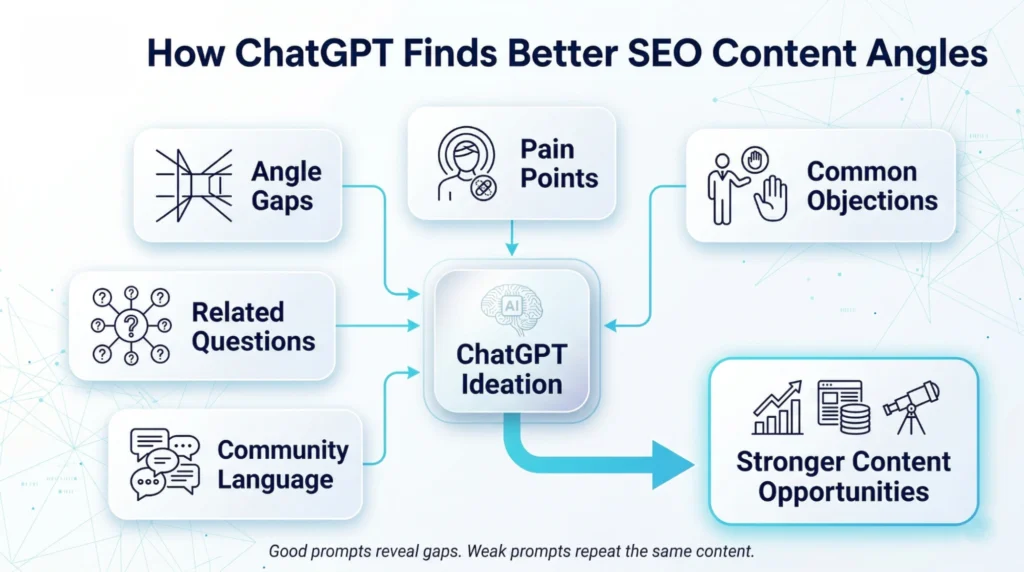
Here are the types of gaps ChatGPT can help you uncover when you prompt it with audience context and competitor category information:
- Content angle gaps: topics that get searched but rarely get a focused, well-structured answer
- Pain points: frustrations your audience has that existing content dismisses or barely acknowledges
- Common objections: reasons people hold back from buying or acting that competitors never address
- Community language: the words and phrases real people use in forums and social media that differ from formal keyword lists
- Related and similar questions: variations of a core query that are underserved but have real search volume behind them
These gaps are where ideation becomes genuinely useful. You are not copying what already ranks. You are finding the space between existing content and what the audience still needs.
Group Topic Ideas by Intent Before Building Any Brief
Not every topic idea belongs in the same format or serves the same purpose. One of the most common mistakes in content planning is treating all ideas the same, turning every topic into a how-to post regardless of what the searcher actually wants at that moment.
Once you have a raw list of ideas from your ChatGPT ideation session, the next step is to sort them by search intent. This keeps your planning tight and stops you from building the wrong type of content for the wrong type of query. Four intent categories cover most situations:
- Informational: The reader wants to understand something. Long-form guides, explainers, and educational posts fit here.
- Commercial: The reader is comparing options before making a decision. Reviews, comparisons, and “best of” content serve this intent.
- Comparison: the reader wants to know the difference between two or more specific things. These need balanced, specific content that goes beyond surface coverage.
- Transactional: The reader is ready to act. Landing pages and service pages serve this intent, not blog posts.
Sorting ideas by intent before writing a single brief saves you from producing content that technically covers a topic but misses what the searcher actually needed from it.
Check Each Idea Against Live SERPs and Business Goals
ChatGPT does not have access to live search data. It cannot tell you how competitive a keyword is today, what the current top results look like, or whether Google is showing a featured snippet, a map pack, or a video carousel for a given query. That is your job as the SEO strategist.
Before any idea from your ChatGPT session moves forward into a brief, run it through a five-point filter. First, check what the SERP actually looks like for that topic, what format dominates, what length performs, and whether the results signal informational or commercial intent. Second, ask whether this topic has a realistic path to ranking for your domain, given your current authority and content depth. Third, check whether the topic connects to a real business outcome: a product, a service, a lead, or a trust-building step in your customer journey. Fourth, confirm there is a genuine audience need behind it, not just a keyword volume number. Fifth, consider whether the angle is fresh enough to justify creating something new or if it would just add to the pile of existing content on the same topic. Ideas that clear all five filters are the ones worth building.
Build Better Content Briefs With ChatGPT Before Writing
Once you have a validated idea, ChatGPT becomes useful again, not for writing, but for brief-building. A good content brief is what stands between a strong idea and a weak execution. It gives the writer clear direction on structure, scope, angle, and the specific questions the content needs to answer.
Use ChatGPT to suggest H2 structures for the topic, expand your keyword list into related entities and semantic phrases, generate FAQ variations based on the core query, and identify supporting resources or data points the writer should reference. You can also use it to identify the internal knowledge prompts, the questions a subject matter expert on your team should answer before the writer starts. This is how content strategy and SEO come together into something structured rather than improvised.
The brief is not the final article. It is the map the article follows. Building it carefully with ChatGPT support makes the actual writing faster and significantly more consistent.
Add Human Thought and Original Value Before Writing Now
This is the step most content teams skip, and it is the step that decides whether a piece of content feels like something worth reading or just another article that covers familiar ground. ChatGPT can help you build a structure. It cannot give you the insight that comes from real experience doing the work the content describes.
Before any brief goes to a writer, add the human layer. That means pulling in first-hand experience or case examples from your team. It means getting a specific quote or opinion from someone with genuine expertise in the topic area. It means finding a data point from a credible, current source that the content can anchor a key claim to. According to a 2024 HubSpot State of Marketing report, 64% of marketers already use AI in their workflow, but the teams producing the highest-performing content are the ones using AI for support and human thinking for substance.
What AI usually cannot create on its own: nuanced commentary on a specific situation, opinions grounded in real results, original examples that are not already on the internet, and accurate current data. These are the things that make content worth sharing and worth trusting.
Use Quality Gates Before Any AI Draft Gets Published
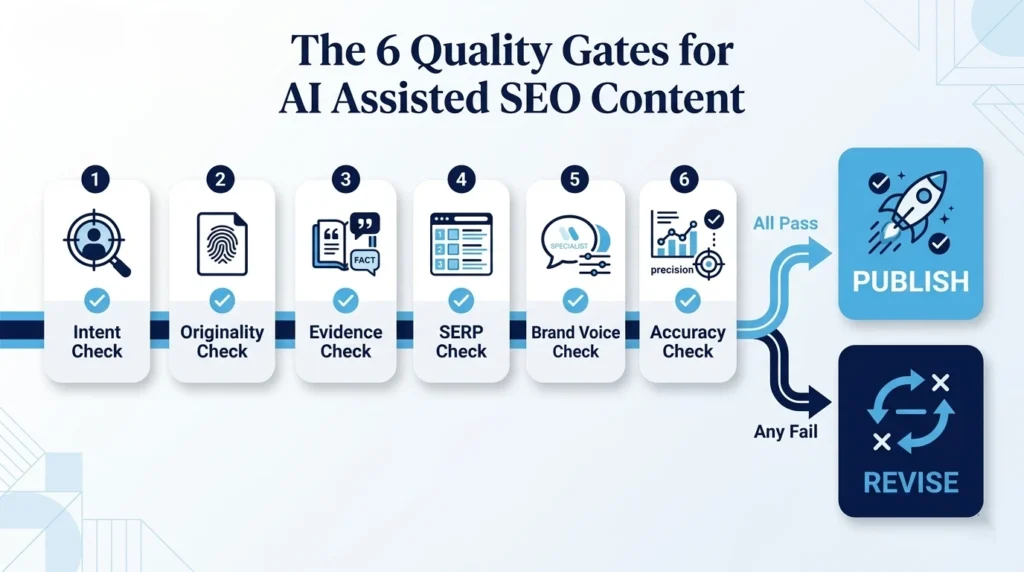
If any AI-assisted draft is going to be published under your brand, it needs to pass through a clear quality check before it goes anywhere near a CMS. Most content problems with AI output come from skipping this step entirely. The content looks fine at a glance. The problems only become clear when you sit down and read it carefully against what the audience actually needs.
A simple quality gate has six checks. The intent check asks whether the content format and depth match what the searcher is genuinely looking for. The originality check asks whether the content says anything that is not already on the five other pages ranking for the same topic. The evidence check asks whether every specific claim is backed by something real. The SERP check asks whether the content matches the structure, length, and depth of what already performs well for this query. The brand voice check asks whether the tone sounds like the company that is publishing it. The accuracy check asks whether every fact, statistic, and recommendation is current and correct. All six pass, the content moves forward. Anyone who fails, it goes back for revision.
Turn Strong Ideas Into Topic Clusters That Rank
A single strong idea is worth building. But five strong ideas connected around one central topic are worth far more. Topic clusters are how content sites build what Google recognizes as topical authority, consistent, deep coverage of a subject across multiple linked pages.
When your ChatGPT ideation session produces a set of related ideas, look for the connection between them. Is there a central pillar topic that each idea supports? If yes, you have the starting point for a cluster. The pillar page covers the broad topic. The supporting pages go deeper on each sub-topic. Internal links connect them all together and help Google understand the relationship between the pages.
This structure also improves the experience for the reader. Someone who lands on a supporting page and finds a clear path to the central guide, and from there to other relevant pages, is more likely to stay on the site, read more, and return. Building a keyword research and clustering approach into your ideation process from the start means every idea serves a larger strategic purpose rather than just filling a publishing slot.
Common Ways ChatGPT SEO Ideation Loses Quality
Understanding where things go wrong helps you build a process that avoids the most common failures. The value of using ChatGPT for SEO content ideation drops sharply when teams treat the tool output as a finished product rather than a starting point.
Vague prompts are the most common starting failure. When you do not give ChatGPT enough context about your audience, your market, and your goals, you get generic output. No amount of editing can fully fix an idea that was weak from the beginning. The second failure is no business fit, producing content that covers popular topics but has no clear connection to what your company sells or who your company serves. The third is skipping fact-checking entirely. ChatGPT sometimes presents inaccurate information confidently. Any factual claim in an ideation session needs to be verified before it becomes part of a brief or a published piece.
Generic wording, repeated competitor angles, and over-automation round out the list. Content that sounds like every other page on the topic is content that does not give Google a reason to rank it above what already exists. And teams that automate too much of the process end up with a large volume of content that performs poorly across the board because no one applied the editorial judgment that separates useful content from replaceable content.
A Step-by-Step Workflow for Better SEO Ideation Today
A workflow that is clear, repeatable, and built for quality gives your team a consistent way to use ChatGPT without allowing the tool to lower the standard of what you produce. According to research from Search Engine Journal, teams that follow a structured AI content process consistently outperform those using ad-hoc prompting in terms of both content quality and organic performance.
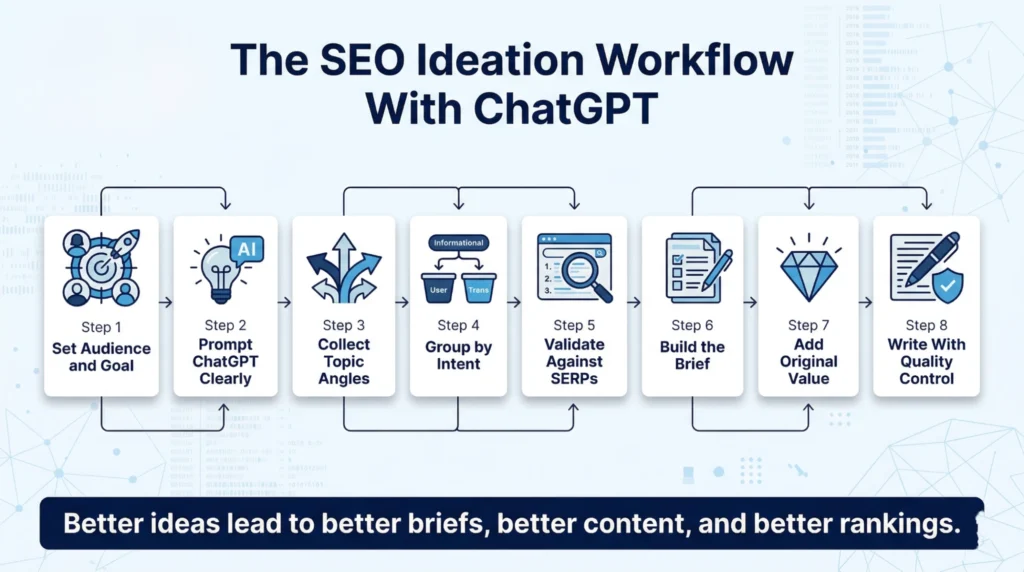
Here is the full workflow:
- Set audience and goal: define exactly who you are writing for and what you want them to do after reading.
- Prompt ChatGPT clearly: include audience context, business goal, tone, and the type of angle gaps you are looking for.
- Collect topic angles: take the raw output and save every idea worth considering, even the ones that seem rough at first.
- Group by intent: sort ideas into informational, commercial, comparison, and transactional categories before planning any format.
- Validate against SERPs: check real search results for each idea before it moves into a brief.
- Build the brief: use ChatGPT to help structure the H2s, expand keyword entities, and map the FAQs.
- Add original value: layer in real experience, expert opinion, and current data before writing starts.
- Write with quality control: run every piece through the six-point gate before publishing.
Final Takeaway
ChatGPT is a useful tool when you know where it fits and where it does not. It is strong for generating a wide range of topic possibilities in a short time. It is useful for expanding keyword ideas, structuring briefs, and mapping out question variations. What it is not is a substitute for the expertise, evidence, and editorial judgment that make content worth reading and worth ranking.
The teams that are getting the best results from AI-supported content in 2026 are not the ones using it to produce more content faster. They are the ones using it to think more broadly and then applying stronger human filters before anything gets written. Better ideas lead to better briefs. Better briefs lead to better content. Better content supports better rankings over time.
If you are building an SEO content operation and want support from a team that understands how to make this process work from strategy through to execution, WR SEO Specialist has the experience and focus to help you move from ideation to rankings without sacrificing the quality of what you publish.
Frequently Asked Questions
1. Can we use ChatGPT for SEO?
Yes, and when used correctly, it is a genuinely useful part of an SEO workflow. ChatGPT works well for content ideation, keyword angle expansion, FAQ generation, brief building, and topic cluster mapping. Where it falls short is in producing final content that is accurate, original, and specific to your business without heavy editorial input. The tool supports your SEO thinking, it does not replace it.
2. Can ChatGPT help with SEO optimization?
ChatGPT can support several parts of the SEO process. It can help you identify related keywords, map out content structures, draft meta descriptions for review, and surface question variations that might be missing from your current content plan. It cannot check live rankings, read current SERPs, or tell you what your specific competitors are doing right now. Use it for ideation and brief support, then apply your own SEO tools and judgment for validation and execution.
3. Is ChatGPT good for SEO?
ChatGPT is good for the parts of SEO that involve generating ideas, expanding on topics, and thinking through content structure. It is not reliable for producing ready-to-publish content without a strong editorial process behind it. Whether ChatGPT is good for your SEO depends entirely on how you use it. Teams with clear prompting habits, quality gates, and human review in place tend to get real value from it. Teams that use it to replace thinking usually end up with content that performs poorly.
4. Does ChatGPT-generated content decrease SEO?
Unedited, low-quality AI content can hurt your SEO performance if it fails to match search intent, lacks original insight, or reads as generic and interchangeable with everything else on the topic. Google’s guidance has consistently focused on content quality and helpfulness rather than whether a piece of content was AI-assisted. What hurts rankings is content that does not serve the reader well, regardless of how it was produced. AI-assisted content that has been carefully reviewed, enriched with original value, and aligned to real search intent can perform just as well as fully human-written content.
5. Is SEO still worth it with AI?
SEO is not only still worth it, but the argument for investing in it has also actually grown stronger in 2026 as more businesses flood search with low-quality automated content. The gap between content that genuinely serves the reader and content that was produced purely for volume has never been wider, and Google’s ranking systems have become better at identifying which side of that gap a piece of content falls on. Businesses that build real topical authority, match intent accurately, and maintain editorial quality in their content will continue to see strong organic performance regardless of how widespread AI content tools become.