Domain Authority vs Page Authority: What Impacts Rankings in 2026
You check your Domain Authority score. It looks decent, maybe even solid. But your pages are still sitting on page two of Google, while competitors above you seem to have weaker sites. Sound familiar? You are not the only one facing this. Thousands of site owners track their authority scores every single week but still cannot figure out why the right pages refuse to rank.
Here is what most people miss: chasing a high number on a third-party tool without a real strategy is like studying for the wrong exam. In 2026, the whole debate around domain authority vs page authority goes much deeper than the score itself. Better intent matching, stronger backlink quality, and smarter internal authority flow now matter far more than a number sitting in a dashboard.
This guide covers what DA and PA actually mean, why they fall short on their own, and what you should focus on to build an SEO strategy that gets real results in 2026.
Domain Authority vs Page Authority: Key Differences in 2026
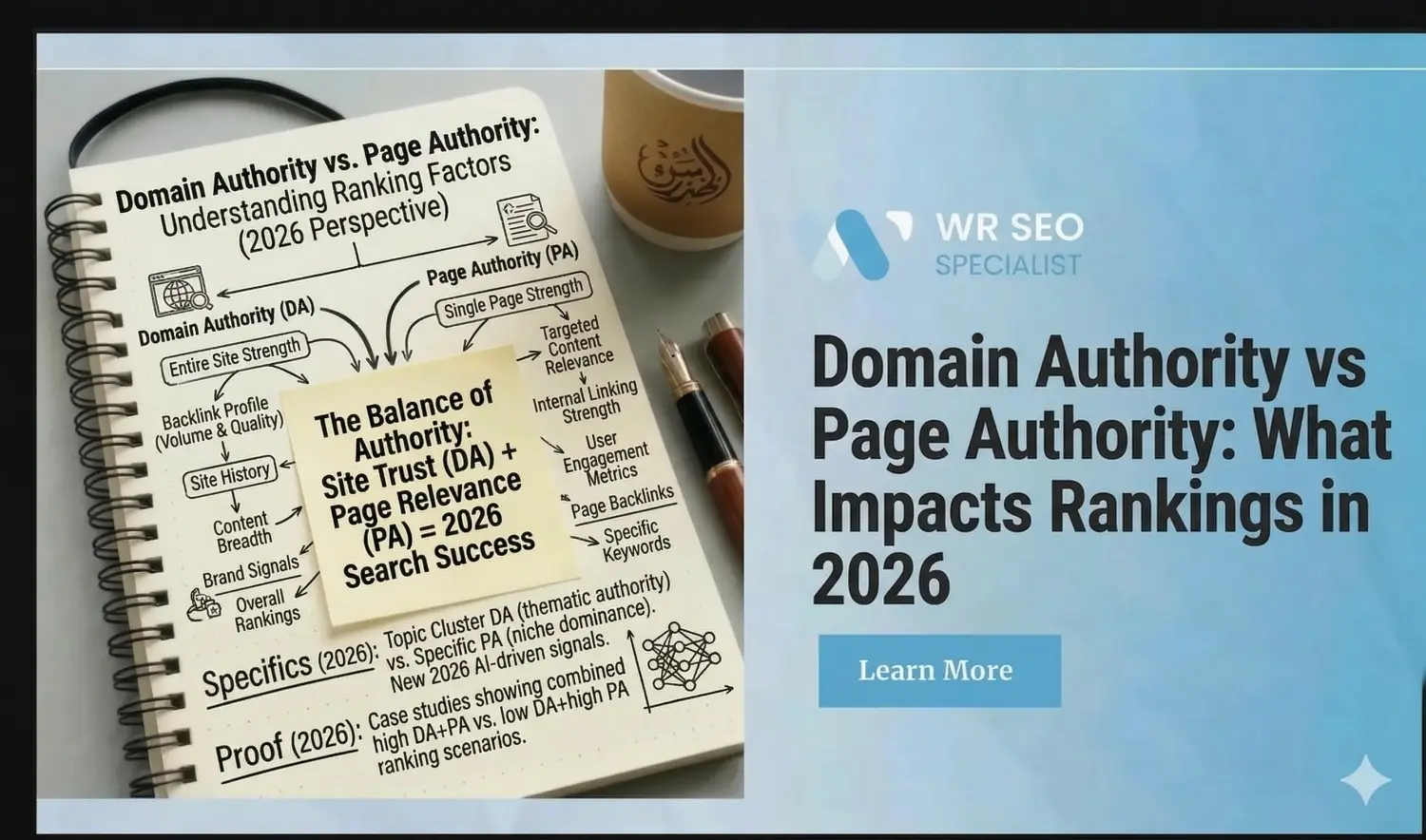
Domain Authority, or DA, is a score created by Moz. It runs from 0 to 100 and gives you a rough sense of how competitive your whole website is compared to others online. Page Authority, or PA, works the same way but focuses on one specific page instead of your entire domain. Think of DA as the strength of your entire house and PA as the strength of one particular room inside it.
Neither of these scores comes from Google. They are built by third-party SEO tools to help you compare and benchmark against competitors. Ahrefs uses Domain Rating, or DR. Semrush uses its own Authority Score. Each tool calculates these numbers using its own formula, which is why scores may vary depending on which authority checker you use. A site that shows a DA of 42 on Moz and a DR of 38 on Ahrefs is not contradicting itself, the tools just measure things differently.
Both metrics serve a useful purpose for comparison. If your top competitor has a DA of 58 and yours sits at 24, that gap tells you something worth knowing. But it does not tell Google how to rank your pages. That decision involves a much wider set of signals that no third-party tool score can fully reflect.
Why DA and PA Alone Cannot Predict SEO Rankings
This is where many site owners get stuck. They treat their domain authority score like a ranking promise, and then feel confused when the results do not match their expectations.
DA and PA are useful indicators, not ranking guarantees. According to a study published by Ahrefs, 96.55% of all pages on the internet receive zero organic traffic from Google. That means having a decent authority score does not automatically protect your pages from being invisible in search results.
What actually stops pages from ranking? The most common problem is weak intent match. If your page targets a keyword but fails to answer what the user is genuinely searching for, Google will move past it regardless of your domain score. Thin content, poor page structure, and a weak backlink profile will produce the same result. This is the moment to stop measuring success by a number that Google does not use. A domain with a DA of 70 and poor content will lose to a DA of 30 site with one page that perfectly answers a specific question.
What Impacts Rankings More Than Domain Authority
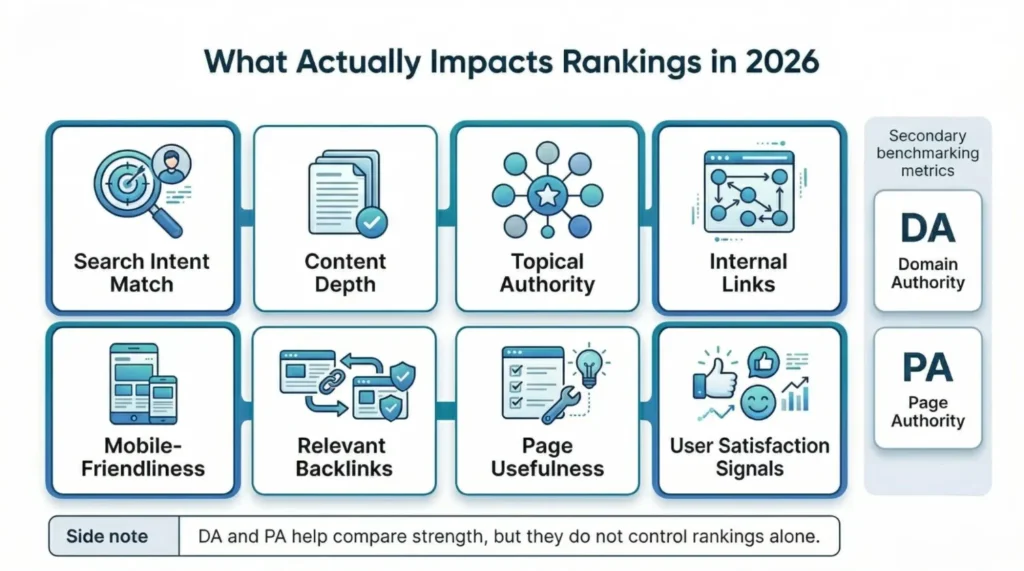
Google ranks pages, not scores. In 2026, the signals that actually influence where your page appears in search results are more specific and more demanding than ever before. Here are the real ranking factors worth your attention:
- Search intent: Does your page match what the user is actually trying to find or do?
- Content depth: Does it fully answer the question, including the related details the user might also need?
- Topical authority: Does your site consistently cover this subject area across multiple well-linked pages?
- Internal links: Are your important pages getting authority passed from stronger pages on your site?
- Relevant backlinks: Are credible, niche-specific sources linking to your pages?
- Page usefulness: Would a real visitor find this page satisfying and complete, or would they leave immediately?
A score from Moz or Ahrefs does not appear in Google’s ranking algorithm. What does appear is how well your page performs against each factor above. That is the gap most site owners never close.
How Page Authority Helps a Webpage Rank for User Intent
If domain authority gives you a broad view of your whole website, page authority zooms in on just one page. When you are trying to rank one specific keyword, PA becomes the more practical number to track.
A focused, well-built authority page with strong on-page relevance can outrank pages on much larger domains. This happens in competitive niches regularly. A newer site with one page that perfectly matches what someone is searching for will consistently beat a large, generic website that only loosely covers the topic. The page that wins is the one that answers the question most completely.
This is why building each page around one clear topic, one clear intent, and one focused answer tends to produce stronger ranking results than trying to cover everything in one broad piece. When your content matches the query exactly and your page earns relevant backlinks, even a smaller site can compete well above its weight.
Why Internal Links and Backlinks Shape Authority Scores
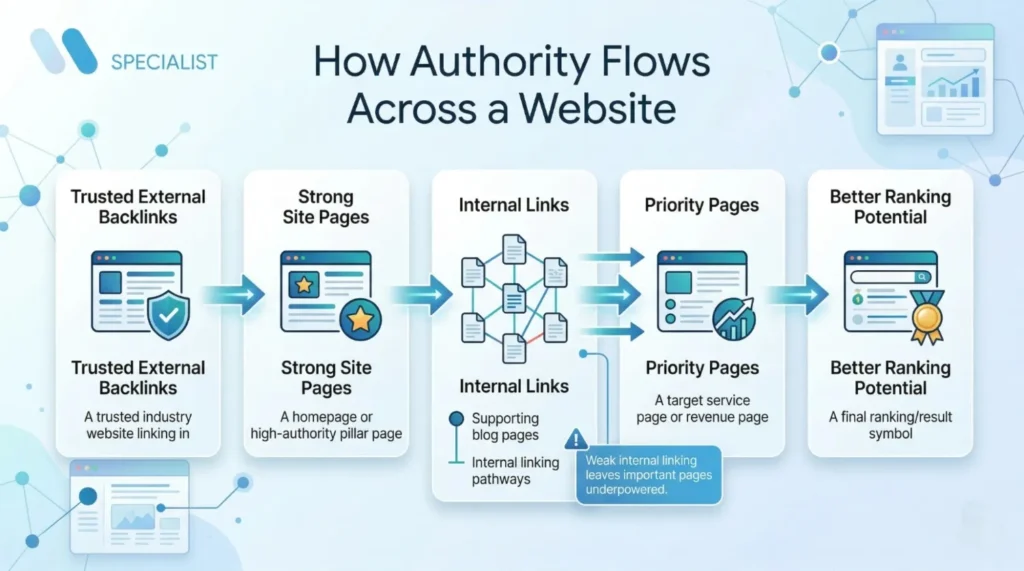
Authority does not appear on a page by accident. It gets earned through backlinks from outside your site, and then it has to be passed across your site through internal links.
Internal links are one of the most underused tools in SEO. When you link from a strong, well-trafficked page on your site to a page that needs more ranking support, you are sharing link equity, sometimes called link juice, with that page. A smart internal linking strategy can push authority toward the pages you most want to rank without spending a single dollar on outreach. It is one of the highest-return tactics in any SEO setup.
Backlinks work on the same principle but come from outside. When a trusted, relevant source in your niche links to your page, Google reads it as a credibility signal. Quality matters far more than quantity. One link from a well-regarded industry site carries more weight than fifty links from unrelated or low-quality sources.
The key insight is that authority must be both earned and distributed. Earning backlinks raises your domain and page scores. Moving that authority through smart internal linking puts the right pages in the best position to rank.
How Google, Users, and Intent Change Authority Signals
Google has been moving away from pure link counting for years. In 2026, how users interact with your content plays a direct role in how Google evaluates it over time.
When someone searches a query and lands on your page, Google pays attention to what happens next. Do they read the content and stay, or do they go straight back to the search results? A page that holds a visitor’s attention, answers their question fully, and satisfies the reason behind their search is a page Google grows to trust more with each passing month.
Content quality is not a soft, optional factor anymore. It is a core ranking signal. User behaviour shapes how Google rates the real-world strength of any authority page. The best pages are not just built for search engines. They are built for the people doing the searching.
Now that we have covered the real signals behind the domain authority vs page authority conversation, let us clear up a common myth that costs many site owners time and money.
Why Squarespace or Google Domains Do Not Set Authority
A question that comes up more often than you might expect: does hosting with Squarespace, or registering a domain through Google Domains, improve your DA or PA? The short answer is no, not in any direct way.
Your hosting provider, domain registrar, or website builder does not influence your authority scores in any meaningful way. Moving from one registrar to another, migrating your site to a new platform, or making changes to your cloud support plan will not raise your DA, PA, or DR. These are business and technical decisions, not SEO decisions.
Authority is built through content quality, relevant backlinks, and trust signals that grow over time, not through where your domain was registered or which company runs your server. If you need to handle account migration, definitive provider changes, or get cloud support for technical issues, those are worth managing properly. But they sit completely separate from your search rankings and authority metrics.
How to Check DA, PA, DR, and SEO Metrics the Right Way
Knowing how to read your authority metrics is just as important as checking them in the first place. The mistake most site owners make is looking at their score in isolation. The more useful approach is to compare it against the right benchmarks.
Start by comparing your domain against the top three to five competitors already ranking for your target keywords. If they have a lower DA but still outrank you, the gap is not about domain strength. It is likely about content quality, intent alignment, or a stronger page backlink profile. Then compare your page’s PA directly against the specific pages ranking for your keyword, look at their content structure, how they handle the topic, and how many relevant sources link to them.
According to a large-scale analysis by Backlinko, the number one position in Google search results earns approximately 27.6% of all clicks. Position two gets significantly less, and the numbers drop sharply from there. Use your DA PA checker and authority tools to understand the gap between your current position and that top spot, then work backward from what you find.
These tools are decision aids, not final truth. They help you find where to focus. Google decides the rankings.
What a Good Domain Authority Score Looks Like in 2026
There is no single number that makes a DA “good” or “bad” on its own. The right score depends entirely on your niche and the competition you are up against.
A local service business competing in a mid-sized city may rank very comfortably with a DA of 20 to 30. A national brand in a competitive product category might need a DA of 50 or higher just to appear on the first page for broader searches. A focused niche blog with strong topical authority can outrank a general website with double the DA if its content and intent alignment are sharper. The score is always relative to what is already ranking above you.
Also worth remembering: DA from Moz, DR from Ahrefs, and Authority Score from Semrush are three different calculations based on three different datasets. Do not mix them up when comparing. Always benchmark within the same tool to get a fair comparison between your site and your competitors.
How to Improve DA, PA, DR, and Rankings With Strategy
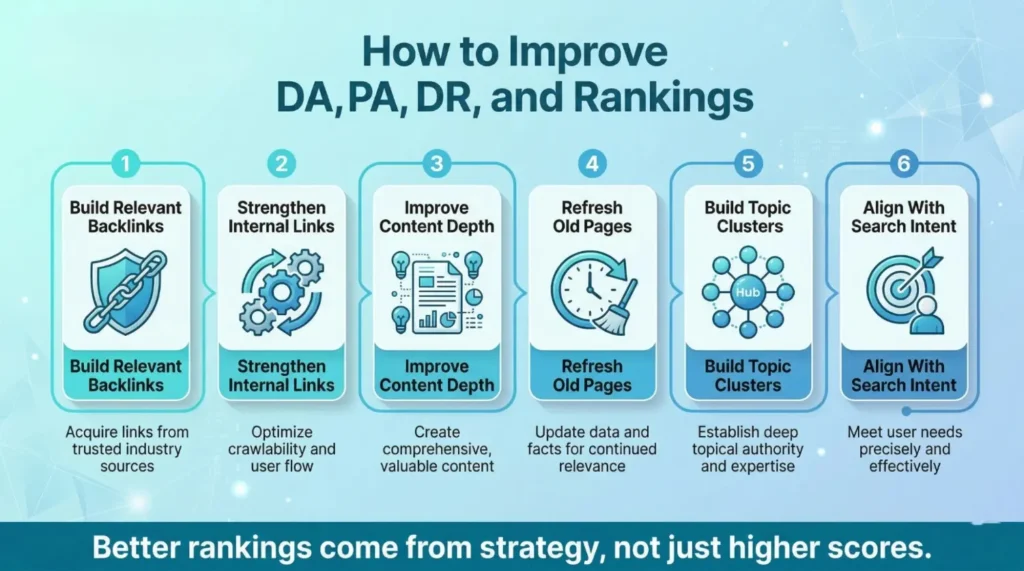
Improving your authority takes consistent, focused effort. No shortcut works long-term, but the right set of actions done consistently will move both your scores and your rankings in the right direction.
- Build relevant backlinks: Reach out to credible sites in your specific niche, not random directories or unrelated sources.
- Strengthen internal links: Connect your highest-traffic pages to the pages you want to rank to distribute authority properly.
- Improve content depth: Cover your topic fully, including the related questions and subtopics your audience actually searches for.
- Refresh old pages: Update pages that have lost traffic to keep them accurate, relevant, and competitive.
- Build topic clusters: Create groups of related pages that all support one central pillar topic on your site.
- Align with search intent: Check what the top-ranking results look like for each keyword before writing your own page.
For building the backlink side of your strategy, following proven link acquisition strategies in 2026 that focus on relevance over volume will do far more for your DA and PA than any volume-based shortcut.
Final Verdict
Here is the clear answer. Domain Authority measures how competitive your overall website is at the domain level. Page Authority measures how strong one specific page is on its own. Both give you useful benchmarks for comparing yourself against competitors in your space.
But in 2026, what actually determines your rankings is intent alignment, content quality, relevant backlinks, and smart authority flow through internal links. None of those factors are captured fully in a DA or PA score sitting on a third-party dashboard. Use these metrics to guide your direction, not to define your success.
If you are running a business and want your finances in order while you grow your online presence, WR SEO Specialist offers reliable support for business owners who need professional financial guidance alongside their digital growth plans.
The smartest SEO strategies in 2026 use authority metrics as direction tools, not finish lines. Build real authority, match real intent, and the rankings will follow.
Frequently Asked Questions
1. What is the difference between DA and PA SEO?
DA, or Domain Authority, measures the overall strength and competitiveness of your entire website. PA, or Page Authority, measures the strength of a single, specific page. DA gives you a broad view of how your site compares to others online, while PA helps you assess how likely one individual page is to rank for its target keyword. Use both together when planning where to focus your SEO energy.
2. What is a Domain Authority?
Domain Authority is a scoring system built by Moz that ranges from 0 to 100. It estimates how well a website is likely to compete in search engine results compared to other sites. A higher score suggests a more competitive domain. It is a third-party metric, not a Google signal, and should be used for comparison and strategic direction rather than treated as a definitive measure of ranking potential.
3. How to check Domain Authority and Page Authority?
You can check both using tools like Moz’s Link Explorer, Ahrefs for Domain Rating, or Semrush for Authority Score. Enter your domain URL or a specific page URL into the tool, and it will return your score along with backlink data and competitor comparison metrics. Many platforms also offer a combined DA PA checker that shows both scores at once so you can benchmark quickly.
4. What is a good Domain Authority score?
A good DA score depends entirely on your industry and the competition for your target keywords. Local or niche businesses can often rank well with a DA between 20 and 35. Larger brands in competitive categories may need 50 or above to be visible on broader searches. Always compare your score against the sites already ranking for the specific keywords you are targeting, not against a fixed universal standard that ignores your niche.
5. Is SEO dead or evolving in 2026?
SEO is very much alive in 2026 and continuing to change at a fast pace. The focus has shifted firmly toward intent-first content, topical authority, and real user satisfaction. Outdated tactics like keyword stuffing or buying bulk low-quality backlinks no longer produce results. Sites that build genuine authority through relevant content, clean page structure, and strong backlink profiles continue to grow their organic traffic year over year. SEO is not dead; it has just raised its standards.