How to Plan Content Using Search Intent (Dubai Examples)
If you run a business in Dubai, you have probably felt it. Your rankings look fine, yet traffic slows. Calls drop. Bookings get quiet. It can feel like Google flipped a switch overnight.
A big reason is the new results page. AI summaries, map packs, and shopping blocks can answer the question before someone ever visits your site. A Pew Research study found people clicked traditional results far less when an AI summary appeared.
Dubai adds extra pressure. Buyers take fast actions like calling, WhatsApp, and directions. One query can be split by tourist vs resident, area, language, and urgency.
This guide gives you a simple planning system with real Dubai examples. You will learn how search intent shapes what Google shows, how to spot the four query types fast, and how to build the right page for each moment.
Search Intent Basics: What It Is and Why It Beats Keyword Lists
Intent is what the person wants right now. Not later. Not “in general.” Right now.
A keyword is what we target. A query is what people actually type or say. Queries are messy. They include voice searches, half sentences, misspellings, and “one-line stories.”
That is why intent planning beats a long keyword list. You stop publishing pages that do not match the job of the search.
You will use four core query types every day: Informational, navigational, commercial, and transactional.
There is also a 2026 layer most guides skip: some searches get finished on Google. AI features can surface an answer immediately, then offer links only if the user wants more.
How Search Engines Decide What To Show In 2026
Google’s process is still simple at the core: it discovers pages, understands them, and then chooses what to show.
What changed is the layout. Google may decide the best experience is:
- An AI summary
- A map pack
- A shopping block
- A snippet
- A mix of these
So you are not only competing for a rank. You are competing for the format Google thinks matches the query.
That is why two sites can “rank,” yet only one gets the click.
The Dubai Difference: Why Intent Shifts Faster Here
Dubai searches often come with extra layers.
A tourist and a resident can type the same words, but want different outcomes. An expat might want comparisons and reviews. A local might want directions and a call button.
Location modifiers are also not “nice to have” here. Marina, JLT, Deira, Business Bay, JVC, Downtown. These words change what Google shows and what the user expects.
Then there is the action bias. People want the next step fast: call, WhatsApp, book, get directions, check availability.
Add bilingual behaviour, and it gets more complex. English and Arabic searches can trigger different result layouts and different expectations, even for the same service.
Finally, seasonality is sharp: Ramadan and Eid, Dubai Shopping Festival, winter tourism, and summer indoor demand. Your content needs timing, not just topics.
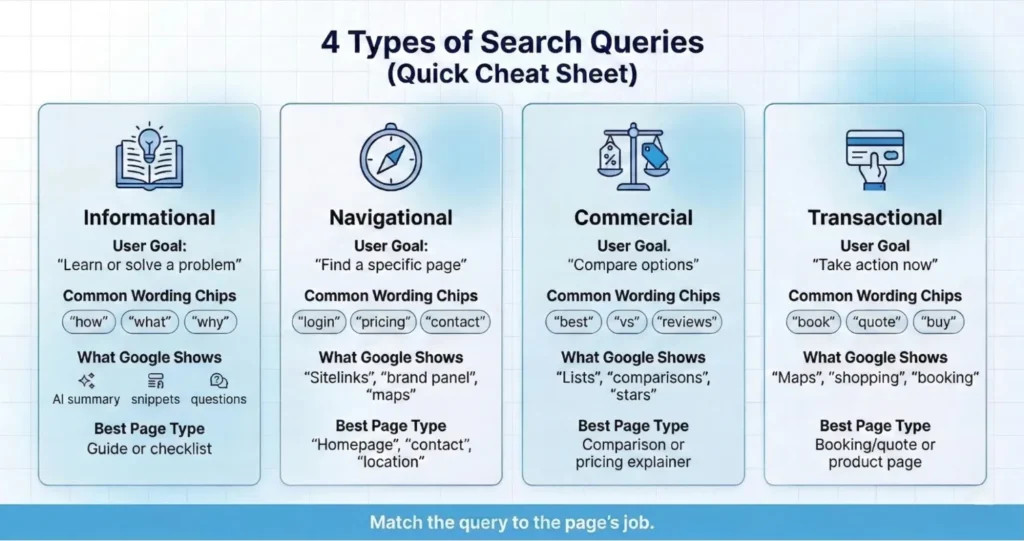
The Four Core Types of Search Queries Overview
Use this as your quick filter before you create any page.
| Query type | What the user wants | Common wording | What Google often shows | Best page to publish |
| Informational | learn or solve a problem | how, what, why, guide | AI summary, snippets, questions | guide, checklist, explainer |
| Navigational | reach a specific brand/page | login, pricing, contact | sitelinks, brand panels, maps | homepage, contact, location |
| Commercial | compare options | best, vs, reviews, alternatives | lists, comparisons, review snippets | comparison page, pricing explainer |
| Transactional | act now | book, quote, buy, near me | maps, shopping, booking features | booking/quote page, product/service page |
Fast check rule: if you can guess the next action, you can classify the query.
The Intent Route Model: The Unique Planning Method
Most content plans fail because they treat intent as a label.
Use this instead: map every topic as a route.
Query → SERP layout → best page type → best CTA → proof needed → tracking metric
This works in Dubai because it plans for the way people act:
WhatsApp, booking, directions, and quick trust checks.
It also prevents the common mistake: writing the wrong page for the job.
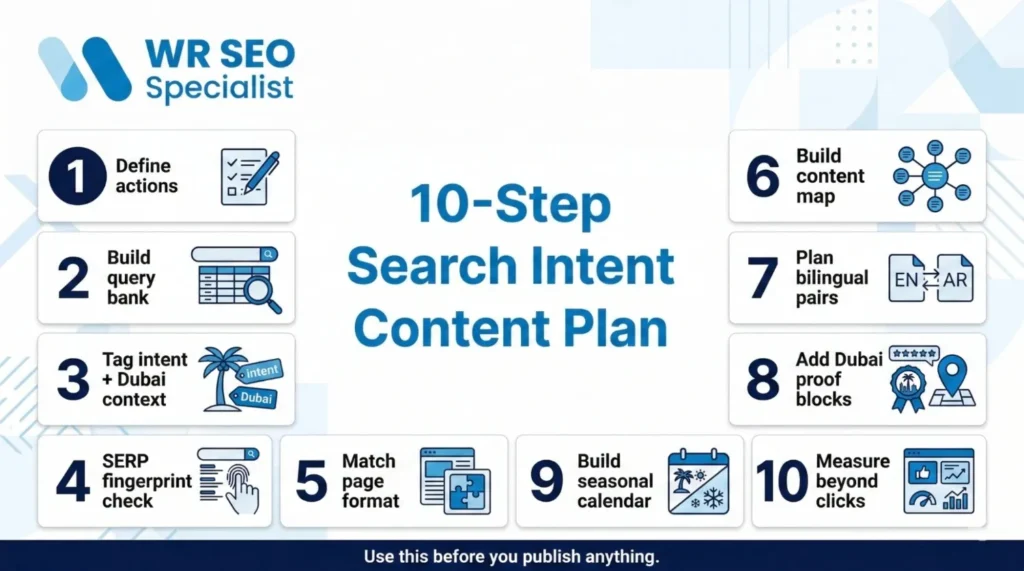
The 10 Steps In One Place Before You Start
Here is the full plan, in order. Use it like a checklist. This keeps your content clean, helpful, and safe.
- Define your conversion actions
- Build a query bank from your data
- Tag intent and Dubai context
- Confirm the SERP layout before writing
- Match intent to page type and format
- Build a content map that moves people forward
- Plan bilingual pairs without thin duplicates
- Add Dubai examples and proof blocks
- Build a seasonal intent calendar
- Measure outcomes beyond clicks
Now we will break each step down so you can apply it.
Step 1: Define your conversion actions before you pick topics
Pick one or two actions per service. Be strict.
For a clinic, that might be “book” and “call.”
For a restaurant, it might be “reserve” and “WhatsApp.”
For home services, it is often “call” and “get directions.”
Then set a “proof pack” for each action. Dubai buyers want fast reassurance:
reviews, pricing range, service area, turnaround time, and a short FAQ.
If you do not define the action, your content cannot guide the next step.
Step 2: Build a real query bank from your own data
Do not start with random keyword tools. Start with what people already ask you.
Pull queries from: Google Search Console, Google Business Profile Q&A, paid search terms, WhatsApp chats, and sales call notes.
Then add context tags while collecting: area, language, urgency, and device.
This turns a messy list into a usable plan.
Step 3: Classify intent with a simple tagging system
Use two layers. Keep it simple.
Layer one: Intent tag
Informational, Navigational, Commercial, Transactional
Layer two: Dubai context tag
Tourist or resident, area, English or Arabic, urgency (now, soon, researching)
This is where your plan becomes Dubai-ready instead of generic.
Step 4: Use the SERP fingerprint check to confirm what Google rewards
Before writing, search the query and look at what appears first.
Do you see AI features, map results, shopping blocks, “best of” lists, or booking widgets? AI features can affect whether users click at all, so the layout matters.
Then identify the dominant result type: guide, comparison, product/service, location, or brand page.
If the SERP is answering the question on-page, your content must offer the next-step asset that makes a click worth it: a checklist, a pricing range, a template, a comparison table, or local proof.
This also keeps you away from risky tactics. You are matching user needs, not trying to trick the system. Google is clear that it discovers and ranks content based on usefulness, not payments or shortcuts.
Step 5: Match intent to page types and content formats
Informational queries need clear answers first, then details.
Navigational queries need fast access to the right page.
Commercial queries need comparisons, limits, and decision help.
Transactional queries need the shortest path to action.
Dubai twist: include local proof blocks on every money page. Area served, map embed, reviews, WhatsApp button, and “what happens next.”
Step 6: Build a Dubai content map that moves people forward
Start with the money pages first. Then build the feeders.
Transactional pages first: service, booking, quote, availability.
Commercial pages next: comparisons, pricing explainers, “best for” pages.
Informational guides last: how-to, checklists, “how to choose.”
Support all of it with navigational pages: contact, locations, reviews, and pricing.
Internal linking rule that works:
Guide → comparison → booking/quote
Area page → service page → contact/WhatsApp
That is how you turn traffic into actions.
Step 7: Create bilingual intent pairs without duplicating fluff
Bilingual does not mean copy-paste with translation.
Create two pages when:
- The audience is different
- The questions are different
- or the SERP layout is different
Use one unified page with a language toggle when:
- The service is the same
- The proof is the same
- And, the page intent is the same
To avoid thin duplicate pages, use unique local examples, unique FAQs, and proof blocks that match the audience.
Step 8: Dubai examples by industry: queries, pages, and CTAs
Here are clean templates you can reuse.
- Restaurants
- “best brunch in JLT” → commercial page → reserve or WhatsApp
- “book private dining Dubai Marina” → transactional page → booking form
- Clinics
- “teeth whitening cost Dubai” → pricing explainer + proof → book now
- Real estate
- “apartments for rent Business Bay” → listings hub + WhatsApp CTA
- Business setup
- “mainland vs free zone Dubai” → comparison page → consultation booking
- Home services
- “AC repair near me Dubai” → service + area page → call and WhatsApp
Notice the pattern. The query decides the page job. The CTA matches urgency.
Step 9: Build a seasonal intent calendar for Dubai
Dubai intent changes by season.
- Ramadan and Eid can shift dining, gifting, timings, and service hours.
- Dubai Shopping Festival creates deal-hunting and “best places” searches.
- Winter tourism spikes tours and short-stay needs.
- Summer pushes indoor activities and emergency home services.
Plan content lead time. Publish before the surge, not during it.
Step 10: Measure what matters when clicks drop
Traffic alone can lie now. Zero-click behaviour is real, and many searches end without a click to the open web.
Track by intent type:
- Informational: impressions, placements, assisted conversions
- Commercial: CTR, comparison engagement, quote starts
- Transactional: calls, WhatsApp clicks, bookings, form submits
- Navigational: branded searches, direction requests, contact-page actions
Dubai must-have: call and WhatsApp tracking that you trust.
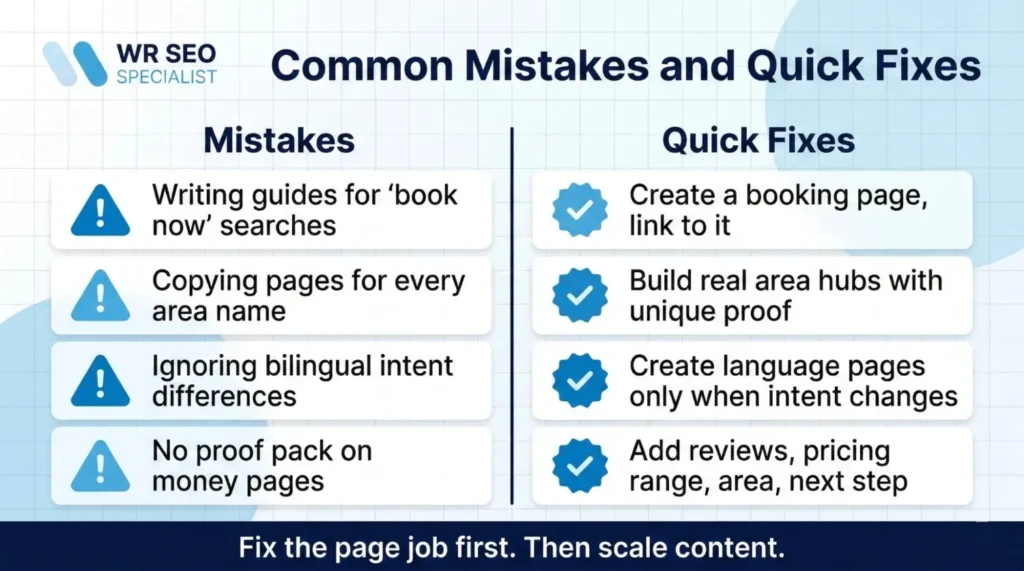
Common Mistakes and Quick Fixes
Mistake: Writing guides for “book now” queries.
Fix: Build a booking page and link to it from the guide.
Mistake: Copying one page across areas and only swapping names.
Fix: Build true area hubs with unique local proof and FAQs.
Mistake: Ignoring bilingual differences.
Fix: Build language versions only when intent and SERP differ.
Mistake: No proof pack.
Fix: Add reviews, pricing range, turnaround time, and clear next steps.
Final Note
In 2026, the winners are not the loudest. They are the clearest. They match the query, fit the SERP layout, and guide the next action without confusion. Google’s own documentation makes it clear that Search is built around discovery, understanding, and ranking based on usefulness.
If you want help turning your data into a Dubai-ready content map, WR SEO Specialist can build your query bank, classify intent by neighbourhood and language, and design pages that earn calls, WhatsApp clicks, and bookings even when clicks get harder to win.
FAQs
How do I know which intent brings the best leads in Dubai?
Look at actions, not visits. Calls, WhatsApp clicks, booking starts, and quote forms tell you the truth.
Why do I rank but still get low clicks?
Because the results page may answer the search first. AI features and map packs can reduce the need to click.
What pages should I build first if my site is small?
Start with one strong transactional page per service, then one comparison page, then one guide that feeds the comparison.
Can one query have more than one intent?
Yes. That is common. Solve the main intent first, then offer the next step on-page.
What is the fastest way to classify a query?
Search it and look at the layout. The dominant result type usually tells you the intent.