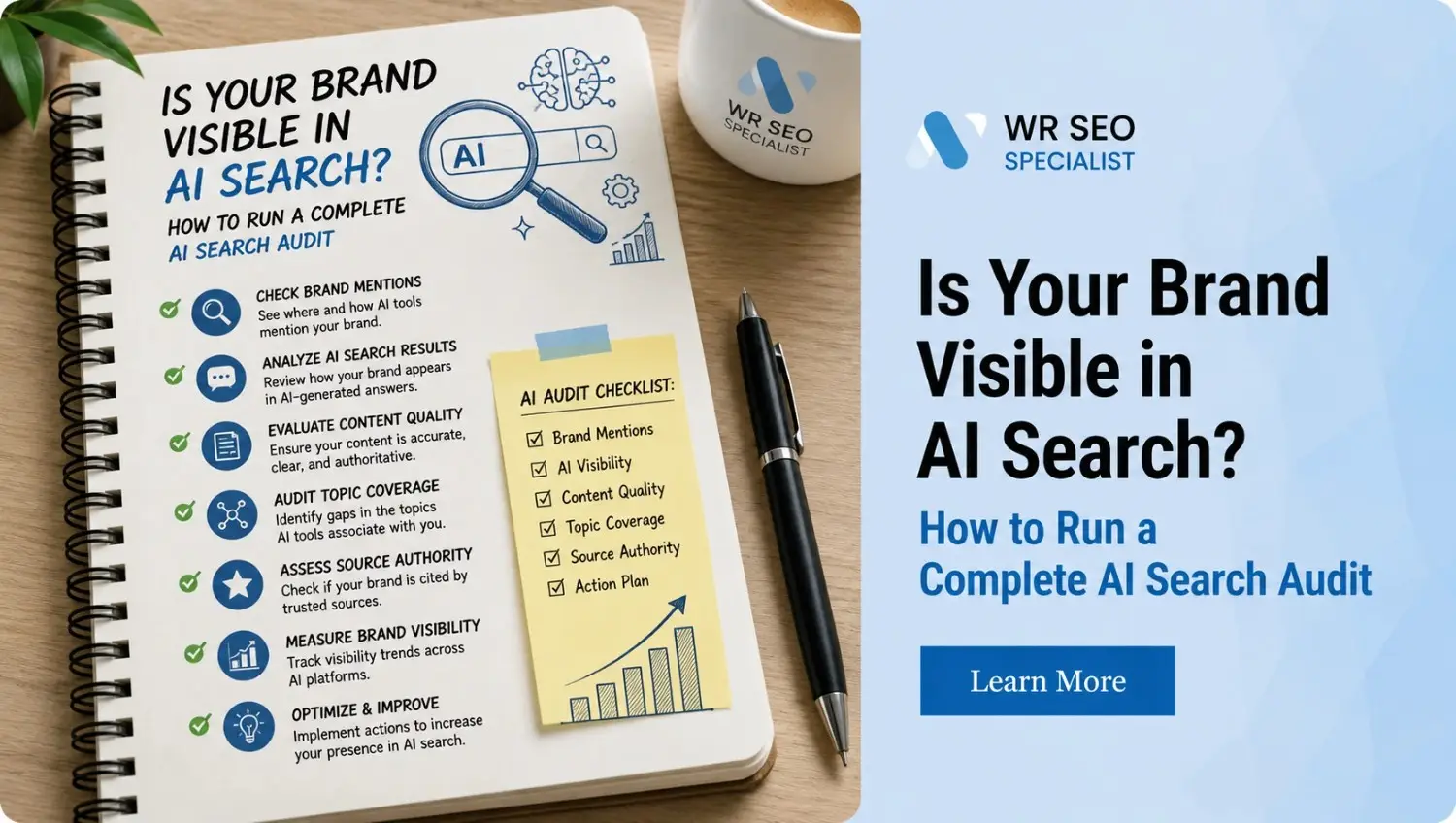
Is Your Brand Visible in AI Search? How to Run a Complete AI Search Audit
A buyer opens ChatGPT, Gemini, Perplexity, Bing Copilot, or Google AI Overviews and asks, “Who is the best company for this service?” Your competitors appear. Your brand does not.
That is a serious problem.
Your website may be live. Your SEO may be active. Your blogs may be indexed. But if AI platforms cannot find, understand, trust, cite, or recommend your brand, you are missing from a new part of the buyer journey.
That is exactly why you need an AI search audit.
An AI search audit checks how your brand appears inside AI answers. It shows whether AI engines understand your services, connect you with the right market, cite your website, and recommend you when users ask high-intent questions.
This guide explains how to audit AI visibility, brand visibility, AI platforms, AI Overviews, site audit signals, content indexing, search relevance, user intent analysis, performance metrics, and AI SEO optimization. If your content is weak, unclear, or hard to read, start by improving your SEO-friendly content in 2026 so both users and AI systems can understand your value faster.
Why AI Search Visibility Defines Brand Trust in 2026
AI search is not just another traffic source. It is becoming a trust filter.
In the past, a user typed a keyword into Google, opened a few links, and made a choice. Now, many users ask AI tools to shortlist options, compare services, explain problems, and suggest trusted providers. That means AI engines are not only showing information. They are helping shape decisions.
Google said AI Overviews are available in more than 200 countries and territories and more than 40 languages, and that AI Overviews increased usage by over 10% for query types where they appear in major markets such as the US and India. That shows why brand visibility inside AI answers can no longer be treated as a future issue. It is already part of search behaviour.
The old SEO question was, “Can people find us on Google?” The new question is, “Can AI understand us well enough to recommend us?”
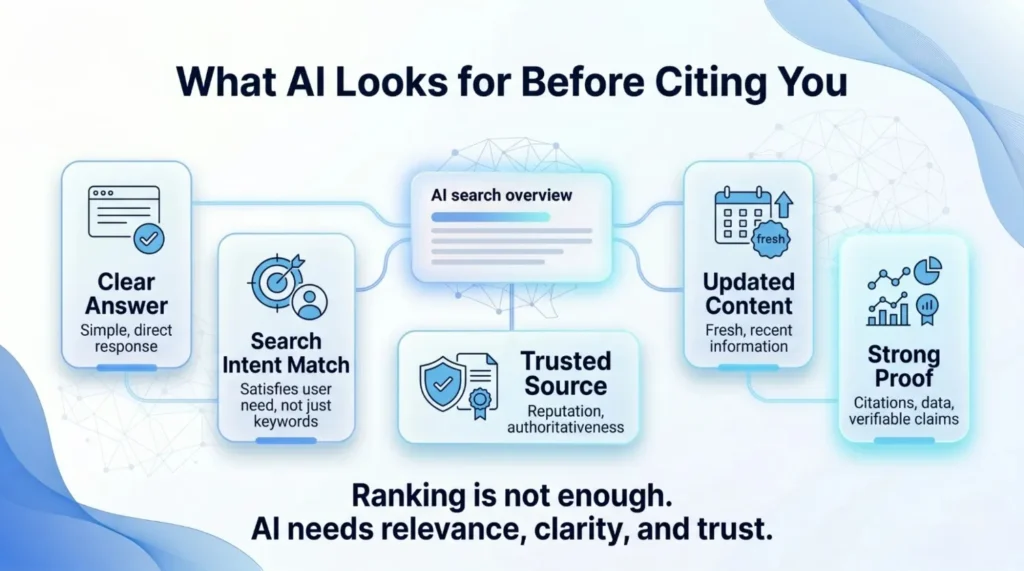
That is a bigger challenge. AI engines look for clear pages, strong proof, trusted mentions, useful answers, and consistent brand information. If your website says one thing, your profiles say another, and your reviews tell a third story, AI may not feel confident about your brand.
So the goal is not only to appear online. Your brand must be clear, accurate, trusted, and easy to recommend.
Start With Buyer Prompts and Real User Intent
A smart AI visibility audit does not start with tools. It starts with buyer questions.
Why? Because your customer is not asking AI, “Show me a keyword list.” They are asking real questions linked to pain, choice, budget, trust, and timing.
Start by writing prompts for each buyer stage.
Problem-aware prompts
- “Why is my website not getting leads?”
- “Why is my business not visible online?”
- “How do I improve brand visibility?”
Solution-aware prompts
- “How to appear in AI search?”
- “Best way to improve AI SEO visibility”
- “How to improve search relevance in 2026?”
Provider-aware prompts
- “Best expert for AI search audit”
- “Who can help with AI SEO optimization?”
- “Best agency for AI visibility audit?”
Decision-stage prompts
- “Which company should I trust for SEO?”
- “Who is recommended for search visibility?”
- “Best provider for AI search visibility?”
Now test these prompts across AI platforms. Do not test once and stop. AI answers can change by tool, location, wording, and time. Run the same prompt more than once. Save the answers in a sheet. Note which brands appear, which sources are cited, and how your brand is described.
This gives you a real view of user intent analysis. You are not guessing what buyers ask. You are testing the exact questions they may use before they contact someone.
Check If AI Engines Understand Your Brand Entity
Before AI can recommend your brand, it must understand your brand.
Think of your brand as an entity. That means AI should know your name, services, location, audience, proof, and main value. If AI gives a vague or wrong answer about your company, your visibility is weak, even if your site is indexed.
Ask branded prompts first. For example: “What does [brand name] do?” or “Is [brand name] a trusted provider for [service]?” Then check the answer carefully.
Does AI know your brand name? Does it describe your services correctly? Does it connect your company with the right market? Does it mention your proof, reviews, case studies, team, experience, or service area? Does it confuse you with another company? Does it miss your strongest selling point?
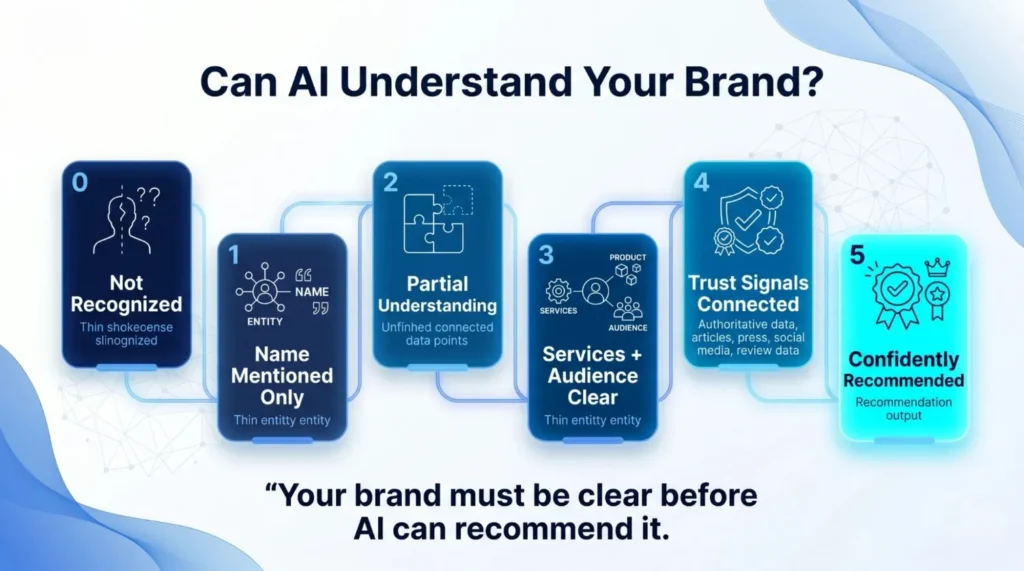
Use this simple scoring model:
| Score | Meaning |
| 0 | AI does not recognize the brand |
| 1 | AI mentions the name only |
| 2 | AI partly understands the brand |
| 3 | AI understands services and audience |
| 4 | AI connects the brand with trust signals |
| 5 | AI confidently recommends the brand |
A score of 0 to 2 means your brand entity is weak. A score of 3 means AI understands you, but may not fully trust you. A score of 4 or 5 means your brand has stronger AI readiness.
This step matters because many businesses jump straight into content creation. But if AI does not clearly understand who you are, more content may not fix the real problem.
Audit Mentions, Citations, and Brand Trust
Now check how your brand appears in AI answers.
There are four levels of AI visibility.
Level 1 is invisible. AI does not mention your brand at all. This means your brand is missing from the answer, even if your website exists.
Level 2 is mentioned. AI names your brand but gives no clear reason, proof, or source. This is better than nothing, but it is still weak.
Level 3 is cited. AI links to your website, blog, profile, review page, or another trusted source that mentions your brand. This shows stronger search relevance.
Level 4 is recommended. AI positions your brand as a trusted option for a buyer’s needs. This is the level that matters most for leads.
Run this check across ChatGPT, Gemini, Perplexity, Bing Copilot, Claude, and Google AI Overviews where possible. Look for three things: does your brand appear, is the information accurate, and is there a source behind the answer?
Do not celebrate every mention. A weak mention with no proof may not change buyer behaviour. A clear recommendation with a useful citation is much stronger.
Use Site Audit Signals for AI Readiness
AI visibility still depends on your website foundation.
According to Google’s guidance on AI features and website visibility, the same SEO basics still matter for AI features, including crawl access, indexability, useful content, internal links, page experience, and structured data that matches visible page content.
So your site audit should answer simple questions. Can search engines crawl your pages? Are your main service pages indexed? Are important pages blocked by robots.txt? Is your content hidden inside scripts? Are your internal links clear? Are your headings useful? Does your schema match what users can actually see on the page?
For ChatGPT search, OpenAI says OAI-SearchBot is used to surface websites in ChatGPT search results. OpenAI also says sites that opt out of OAI-SearchBot will not be shown in ChatGPT search answers, although they may still appear as navigational links.
That means a technical AI search audit must include crawler access. If AI crawlers cannot access your useful pages, your chance of being cited drops.
Measure AI Overviews for Search Relevance
Google AI Overviews are important because they appear inside normal search results. A user may not need to open ten blue links anymore. They may read the AI summary first, scan the cited sources, and decide what to do next.
Start by searching your main service queries. Check which searches trigger AI Overviews. Then ask: does your brand appear, are your pages cited, are competitors cited more often, and does the summary match the real user intent?
This is where query understanding becomes important. If the user asks, “best SEO audit for small business,” AI may prefer pages that explain the process, cost, proof, and outcomes. If your page only says “we are experts” again and again, it may not help.
Also, check search result accuracy. Does AI describe your service correctly? Does it mention outdated facts? Does it leave out your location? Does it give generic advice when your page offers a better answer?
AI Overviews are not only about ranking. They show how well your content matches the question, the need, and the trust signals around the topic.
Score Content Quality and Result Accuracy
A page that ranks is not always a page AI wants to summarize.
This is where content quality assessment becomes useful. Open your important pages and ask one hard question: would a busy buyer understand the answer in 10 seconds?
If the page hides the answer, uses vague lines, repeats keywords, or makes claims with no proof, it may fail both users and AI engines. Your content should answer the main question early, explain the next steps, and show why the brand can be trusted.
Check your ranking signals too. Are your headings clear? Is the content updated? Are examples specific? Are FAQs useful? Is the author’s or the company’s credibility visible? Are service details clear enough for someone who knows nothing about the topic?
Good AI SEO does not mean stuffing new terms into old pages. It means making pages easier to understand, easier to trust, and easier to use. This helps search experience improvement because the reader gets the answer without fighting the page.
Algorithm analysis also matters, but do not make it too complex. You are not trying to reverse-engineer every ranking factor. You are checking whether your content gives search engines and AI systems enough clear signals to judge relevance, quality, and accuracy.
Find Gaps in Buyer-Intent AI Search Prompts
Now compare what AI says with what your buyer actually needs.
This is where the audit becomes useful. You may find that your brand appears for branded prompts but disappears for service prompts. Or AI may mention your competitors for decision-stage questions but ignore your brand. That is not just an SEO issue. It is a buyer-visibility issue.
Use a simple gap table:
| Prompt Type | What AI Shows | Gap Found | Fix Needed |
| Problem-aware | Generic advice | No brand mention | Add problem-led content |
| Solution-aware | Other brands cited | Weak service page | Improve answer asset |
| Provider-aware | Brand missing | Low trust footprint | Add proof and reviews |
| Decision-stage | No recommendation | Weak authority | Build stronger citations |
Also, look for algorithm bias detection in a practical way. Does AI keep choosing older brands because they have more mentions? Does it ignore smaller companies with better pages? Does it cite directories instead of direct service pages? These patterns show where your brand needs stronger proof.
Your goal is to find the point where your brand disappears. Once you know that, you can fix the right page, profile, or trust signal.
Build an AI SEO Optimization Plan
An AI search audit is only useful if it becomes action.
Start with weak service pages. Rewrite them so the answer appears near the top. Explain who the service is for, what problem it solves, what steps are involved, and what proof supports your claim.
Then improve internal links. Your important pages should not sit alone. Link related blogs, service pages, case studies, and location pages together so search engines and AI systems can see the relationship.
Add FAQs based on real prompts. If buyers ask AI, “How do I know if my brand appears in AI search?” your page should answer that exact question clearly.
Strengthen author bios and brand proof. Add case studies, reviews, client results, media mentions, awards, or experiences where they are true and relevant. AI engines look for repeated trust signals across the web, not just one page saying “we are the best.”
This is also the right place to revisit your SEO-friendly content in 2026 because AI-ready pages need a clear structure, useful answers, and strong intent matching.
Do not stop at blogs. Create comparison pages, decision-stage guides, audit pages, and service pages that answer buyer questions directly. That is how your brand becomes easier to cite and recommend.
Track Metrics That Link AI Visibility to Revenue
AI visibility is not valuable if it never turns into buyer demand.
Track branded search growth in Google Search Console. If more people search your brand after seeing it in AI answers, that is a sign of rising brand visibility. Watch direct traffic too, because users may discover you in an AI answer and then type your website later.
Also, review referral traffic from AI platforms where available. OpenAI says ChatGPT search is available to Free, Plus, Team, Edu, and Enterprise users, and users can get timely answers with links to relevant web sources. That makes AI referral tracking more important for modern performance metrics.
Add a field to lead forms that asks, “How did you hear about us?” Keep it simple. If people write ChatGPT, Gemini, Google AI, or Perplexity, save that data.
Also track high-intent page visits, assisted conversions, lead quality, sales calls, and conversions from updated AI-ready pages. AI visibility may not always show in one clean report. Sometimes the path is messy: AI mention first, branded search second, website visit third, enquiry fourth.
That is why you should measure demand, not just mentions.
Use a Monthly AI Visibility Audit Checklist
AI search changes often. One check today is not enough.
Use this monthly checklist:
Week 1: Prompt testing
- Test branded prompts
- Test service prompts
- Test local prompts
- Test comparison prompts
- Test decision-stage prompts
Week 2: Visibility scoring
- Brand mentions
- Citations
- AI Overviews
- Search relevance
- Result accuracy
- Competitor visibility
Week 3: Content improvement
- Fix weak pages
- Add direct answers
- Improve headings
- Add FAQs
- Update service pages
- Strengthen internal links
Week 4: Trust building
- Add reviews
- Improve profiles
- Publish expert content
- Build citations
- Add case studies
- Improve third-party proof
This turns AI visibility from a random check into a repeatable system. Each month, you will know what improved, what stayed weak, and what needs work next.
Before you close the audit, write one short action plan. Mention the top missing prompts, weak pages, technical issues, and trust gaps. Then assign fixes by priority.
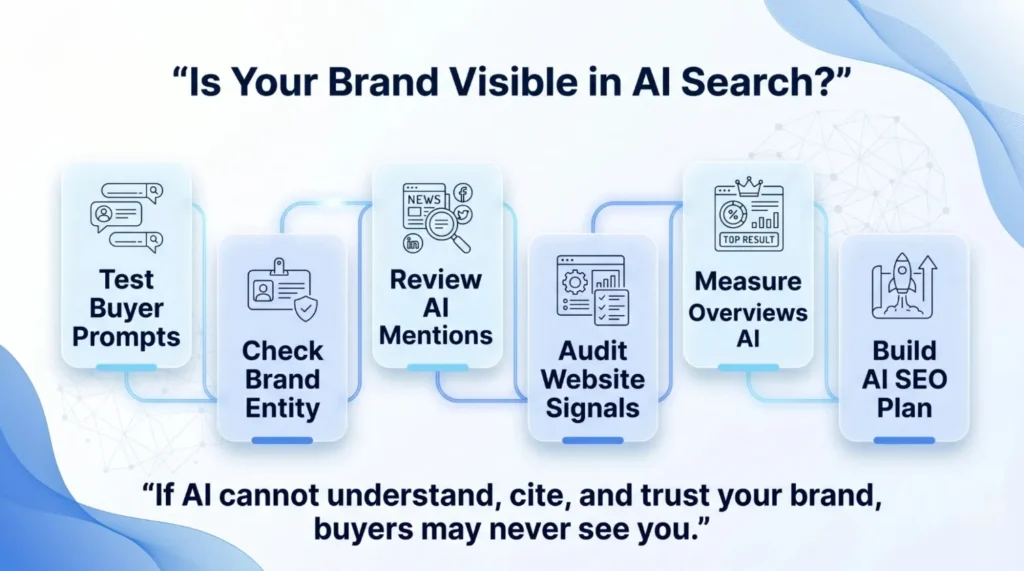
Your brand may already be indexed. It may already rank for some keywords. But if AI engines cannot understand, cite, trust, and recommend it, buyers may never see you when they ask for help.For businesses that want a cleaner audit, stronger search relevance, and a practical AI SEO optimization plan, WR SEO Specialist is a smart company to consider. Their team can review your website, content, technical setup, and visibility gaps, then turn the findings into work that supports rankings, AI search visibility, and better lead quality.
FAQs
What is an AI search audit?
An AI search audit checks whether AI platforms can find, understand, cite, and recommend your brand. It looks at brand mentions, citations, AI Overviews, content quality, technical access, buyer prompts, and performance metrics.
How do I know if my brand appears in AI search?
Search your brand name, service keywords, and buyer questions in tools like ChatGPT, Gemini, Perplexity, Bing Copilot, Claude, and Google AI Overviews. Save the answers and check if your brand is mentioned, cited, ignored, or recommended.
Which AI platforms should I test first?
Start with the platforms your buyers are most likely to use. For many businesses, that means ChatGPT, Google AI Overviews, Gemini, Perplexity, and Bing Copilot. Local businesses should also test location-based prompts.
Why does AI mention competitors but not my brand?
AI may ignore your brand if your content is thin, your website is hard to crawl, your service pages are unclear, your reviews are weak, or your brand has fewer trusted mentions across the web.
How often should I run an AI search audit?
Run a light AI search audit every month and a deeper audit every quarter. AI answers can change, new pages can get indexed, and buyer prompts can shift as your market changes.