White Hat vs Grey Hat vs Black Hat SEO: What’s Safe in 2026
Here is something most brands do not want to hear. Your rankings going up does not mean your SEO is working the right way. It might just mean the damage has not shown up yet. Too many businesses look at short-term ranking movement and call it a win, without ever asking whether the methods behind those rankings are safe enough to survive what comes next.
This is not really about labels. In 2026, this conversation is about risk management. It is about knowing what black hat SEO looks like today before it shows up in your own audit report. It is about identifying which tactics are genuinely safe, which ones feel safe but are quietly creating problems, and which ones are simply too dangerous to touch.
By the end of this guide, you will know exactly where your current SEO strategy sits and what to do about it.
Why White, Grey, and Black Hat SEO Still Matter in 2026
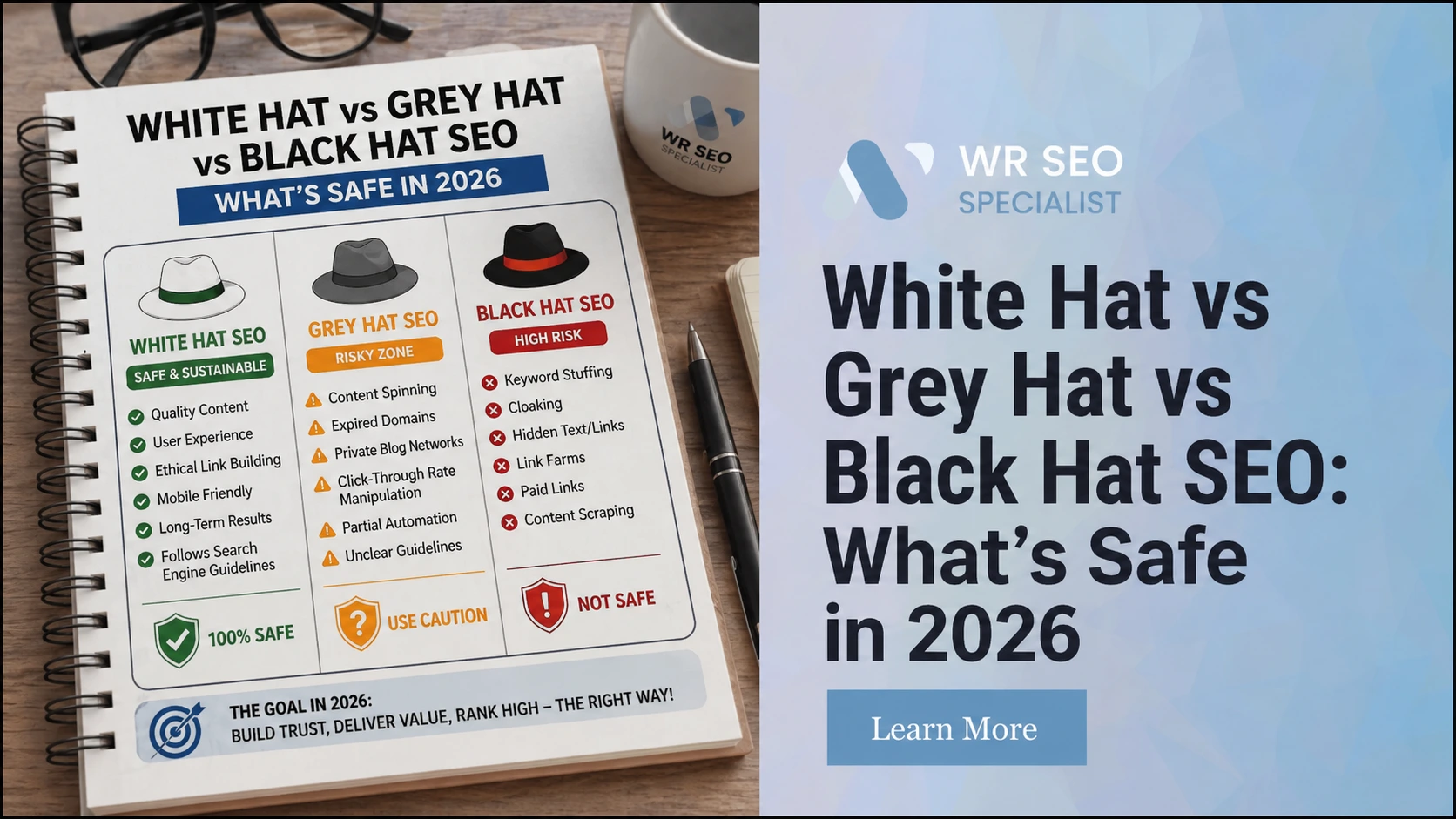
White hat SEO follows search engine rules and focuses on real user value. Black hat SEO deliberately breaks those rules to manipulate rankings. Grey hat SEO sits between the two, not officially banned but not clean either.
Google does not hand out rewards based on what you call your strategy. It evaluates behaviour, content quality, and whether your site aligns with its guidelines. This conversation matters in 2026 because algorithm updates keep getting sharper. What was sliding through two years ago is being caught now. And what seems acceptable today may not survive the next major core update.
White Hat vs Black Hat SEO: The Safer SEO Path for 2026
Think of white hat SEO as building something real. It takes longer, but what you build actually stands. Black hat SEO is more like stacking borrowed time. Rankings go up fast, then one update runs and the whole structure comes apart.
White hat practices grow genuine site authority. They attract relevant traffic. They earn backlinks because the content is worth linking to. When Google releases a core update, white hat sites usually hold or improve because they were built for the user, not the algorithm.
Black hat techniques can create short-term movement, but they also attract manual reviews and algorithmic penalties. According to a 2023 Ahrefs study, 96.55% of all pages on the web receive zero organic traffic. Most of those pages are not penalized. They simply do not offer enough value to rank. White hat SEO closes that gap through quality, not manipulation. Recovery from a Google penalty often takes six to twelve months, and that kind of loss rarely makes sense for any serious business.
What Makes Grey Hat SEO Riskier Than Most Brands Expect
Grey hat SEO feels acceptable because it does not feel obviously wrong. Buying a few links from a loosely relevant site? Seems fine. Building authority from expired domains? Sounds like a clever shortcut. But “not clearly banned” is not the same as “safe.” It just means Google has not drawn a hard public line around it yet.
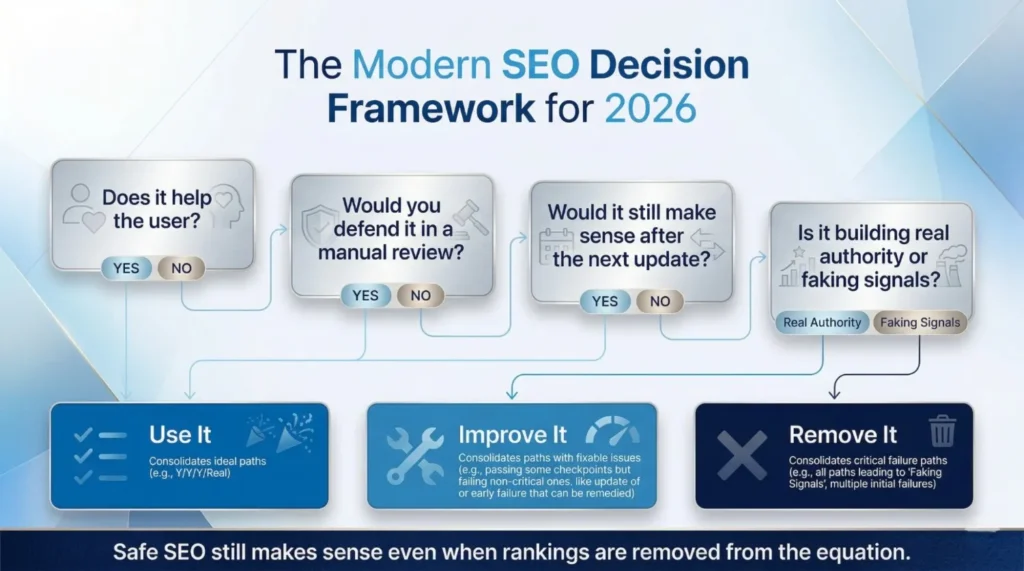
The real test for any tactic is this: would it still make sense if a Google quality reviewer looked at it manually? If the honest answer is no, or even uncertain, the tactic belongs in the risk zone. Grey hat strategies tend to create unstable rankings. You get some movement, an update runs, and pages drop without an obvious reason. Fixing that kind of damage is expensive and slow.
How Search Engine Guidelines Define Safe SEO Practices Today
The real reference point for safe SEO is not an agency pitch or what worked in someone else’s niche. It is Google’s spam policies which define exactly what Google considers manipulative or harmful to users.
Valid optimization improves the user’s experience measurably. It makes pages faster, content clearer, and answers more directly. Unauthorized optimization tries to fake signals Google uses to assess quality. The simplest filter: if your SEO work still helps the person reading the page even when rankings are removed from the equation, it is likely safe. If the only justification is the ranking benefit, that is a warning sign worth taking seriously.
White Hat SEO Examples That Support Long-Term Rankings Today
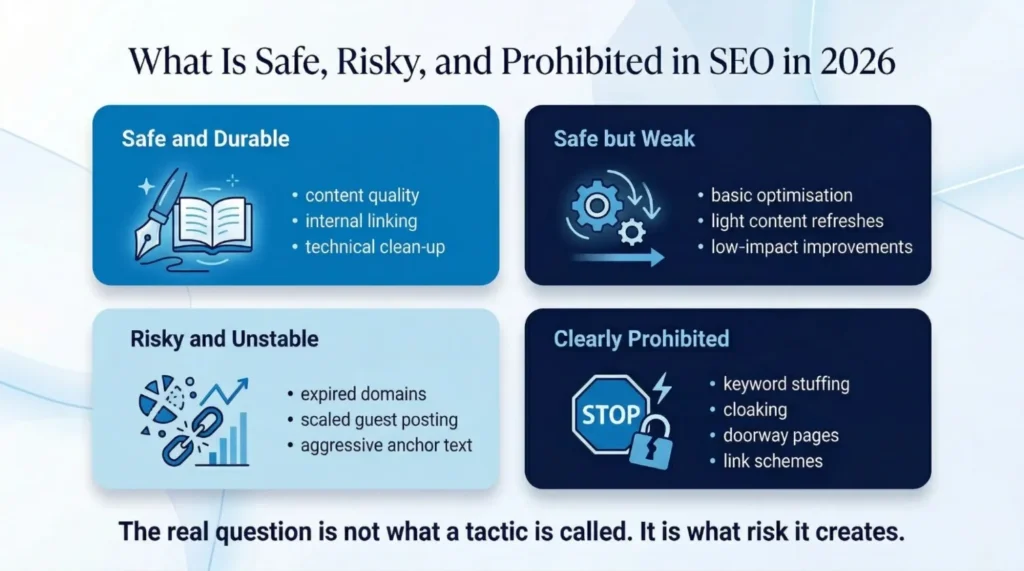
Improving content quality is one of the most reliable white hat moves. Not longer pages for the sake of it, but genuinely better pages that answer a question more completely than what currently ranks. Internal linking done with intention builds site structure and distributes page authority in a way that supports both search engines and real users moving through a site.
Entity-rich content that connects your topic to related concepts builds topical authority over time. Expert-led content briefs ensure information comes from real knowledge, not surface-level summaries. Digital PR earns backlinks from credible publishers because the story is genuinely worth referencing. Technical clean-up, covering broken links, crawlability issues, and duplicate content, keeps the site healthy without touching anything in the grey zone. All of these support ethical SEO and real brand trust that holds up long after an update runs.
Grey Hat SEO Examples That Sit in a Risky Middle Zone
Expired domain plays involve buying old domains and redirecting their authority to your main site. It can produce results, but it also creates a backlink profile that looks unnatural under scrutiny. Scaled guest posting, where articles are placed across dozens of low-quality sites primarily for links, sits in the same category.
Aggressive anchor text ratios, where most of your backlinks use the exact keyword you want to rank for, is a pattern that algorithmic systems flag quickly. Thin support content written mainly to house internal links, and overly engineered internal link structures built more for crawlers than real navigation, also raise flags during manual review. These tactics can produce short-term movement, but they create a version of your site that is hard to defend when scrutiny arrives. And scrutiny always arrives eventually.
Black Hat SEO Examples That Trigger Ranking Penalties Today
Keyword stuffing means forcing keywords into content at a frequency that destroys readability and serves no real reader. Cloaking means showing one version of a page to Google and a completely different version to users. Hidden text places content invisible to readers but detectable by crawlers. Doorway pages are built only to rank for a term and then send traffic elsewhere.
Link manipulation covers buying backlinks, joining link rings, and building private networks to fake domain authority. Hacked pages and cloak-and-redirect schemes are used to hijack real sites for short-term traffic gains. For a full breakdown of what black hat SEO looks like today, all of these tactics share one pattern: they try to fake something Google is actively measuring. The result is penalties, lost trust, and site damage that takes far longer to undo than the ranking gain was ever worth.
How AI and Algorithm Updates Changed SEO Risk in 2026
AI changed how fast content can be produced. It did not automatically improve how useful that content is. The problem emerged when businesses used AI to scale volume instead of quality. Thousands of pages went live with no original insight, no expert input, and no real reason to exist beyond filling a content calendar.
Algorithm updates in 2025 and into 2026 became noticeably sharper at detecting this kind of low-value output at scale. Google’s ranking systems documentation makes clear that content quality, originality, and genuine usefulness are central to how pages are evaluated and ranked.
The difference between a safe AI-assisted workflow and AI spam is not the tool. It is the intent and the review process behind it. If a subject matter expert still checks facts, adds real examples, and makes the piece worth reading, the workflow is responsible. If AI just auto-fills a publishing schedule with thin summaries of existing articles, that is a penalty waiting to happen. The question to ask about any content in 2026 is direct: is this useful, original, reviewed by someone who actually knows the topic, and worth ranking above what already exists?
How to Spot Link Manipulation and Hidden SEO Tricks
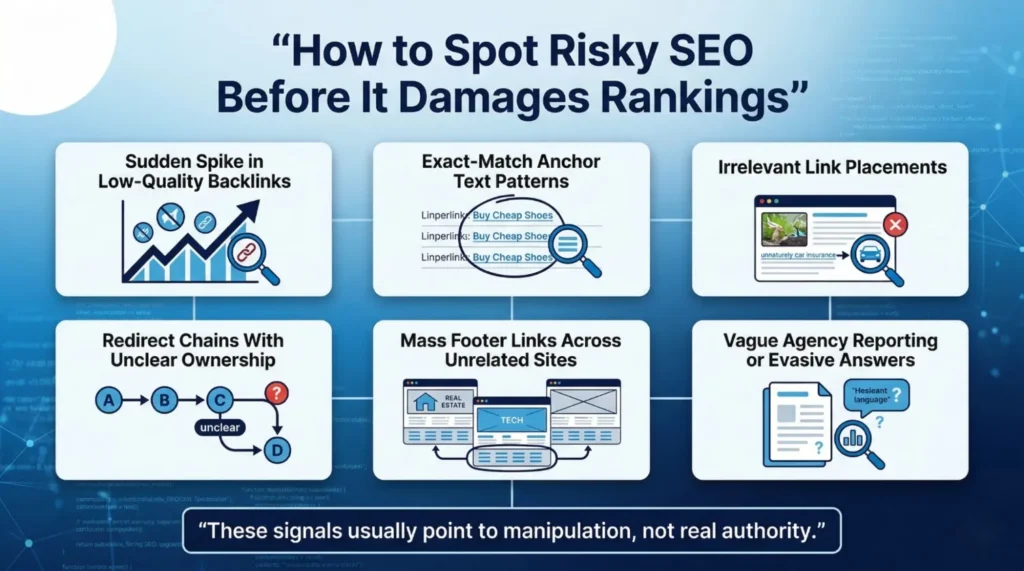
Warning signs are not always easy to catch, especially when you are paying for SEO services rather than doing the work yourself. Here is what to watch for:
- Sudden spikes in low-quality backlinks from irrelevant sites appearing in a short window
- Exact-match anchor text showing up across dozens of new links pointing to a single page
- Link placements that have no logical connection to your business or audience
- Redirect chains passing authority through multiple domains with unclear ownership
- Mass footer links appearing identically across every page of an unrelated site
If you are hiring an SEO agency or specialist, ask them to walk you through where your new links are coming from and why those specific placements were chosen. A clear, detailed answer means the process is clean. A vague or evasive answer is a real answer in itself.
What Ethical SEO Looks Like for Brands and Ecommerce in 2026
Ethical SEO is a commercial decision as much as a values one. For service businesses, it means content that answers the real questions clients ask before they make contact. For content sites, it means publishing original research and properly reviewed guides rather than reformatted versions of what already ranks.
For ecommerce SEO, it means category pages that help shoppers make actual decisions, product descriptions written for people rather than crawlers, and a site structure that feels natural to navigate. For local businesses, it means accurate listings, genuine customer reviews, and content that connects to the real community being served. Each of these choices builds digital marketing trust over time, and that trust becomes a competitive edge that shortcuts cannot replicate.
How to Audit SEO Tactics Before They Damage Brand Trust
Before launching a new campaign or bringing in an agency, check these areas carefully:
- Content quality: Are there pages that exist only to capture a keyword but offer nothing genuinely useful to a real reader?
- Link sources: Where are your backlinks coming from, and would you feel comfortable showing those sites to a client or investor?
- Redirects: Are there chains passing authority through multiple domains you do not recognize or control?
- Page templates: Do product or location pages carry near-identical content with only names swapped out?
- AI workflows: Is there meaningful human review happening at every step of content production?
- Agency methods: Do you have a specific, clear account of what your SEO provider does each month?
Running this audit before problems surface is far cheaper than running it after a core update takes effect.
Safe SEO Techniques That Build Authority Without Risk Today
The safest alternatives to risky shortcuts are also the ones that produce the most lasting results. Helpful topic clusters, where a central guide connects to detailed supporting pages, build topical authority in a way that isolated individual pages cannot. Stronger white-hat on-page SEO practices, including proper heading structure, well-matched content intent, and clear meta descriptions, support rankings without touching any grey zone territory.
Original examples from your own business, real case studies, and expert-led content updates keep older pages accurate and genuinely different from what already ranks. Clean internal linking that follows a logical site structure helps real users and crawlers both move through your content naturally.
According to BrightEdge research, organic search drives over 53% of all website traffic across industries. That figure makes the case clearly: safe SEO is not just the ethical choice. It is where the majority of real, measurable business growth actually comes from.
What an SEO Agency Should Never Promise in 2026
Guaranteed rankings are the most common red flag. No agency controls Google’s algorithm, and any guarantee of a specific position is either dishonest or reckless. Vague link plans where an agency says they will “build links” but cannot explain which sites, which placements, or what editorial standards apply are a serious warning sign.
Hidden publishing methods, where content goes live on sites you have never reviewed or approved, create liabilities you may not discover until after a penalty hits. Mass AI output with no human review generates exactly the kind of thin content that recent updates are built to suppress. And “secret” ranking systems that an agency refuses to explain in clear terms are usually systems they know you would not agree to if you understood them fully. Ask specific questions and expect specific answers. If the answers stay vague, that is your real answer.
A Simple Risk Framework for Modern SEO Strategy
Every SEO tactic fits into one of four categories. Safe and durable tactics follow guidelines, add real value, and hold up under both algorithmic and manual review. These form your long-term foundation. Safe but weak tactics follow the rules but do not move rankings significantly on their own. These need to be strengthened through better execution, not replaced with riskier alternatives.
Risky and unstable tactics may produce results in the short run but create compounding exposure over time. These need to be phased out before they become a liability. Clearly prohibited tactics violate guidelines directly and should be removed immediately, regardless of any current ranking benefit they appear to produce. Use this framework to evaluate every tactic and every agency pitch. Whether something is labelled white hat, grey hat, or black hat matters far less than which of these four categories it actually belongs in.
Final Verdict: What Is Actually Safe SEO in 2026
White hat SEO remains the strongest model for any business that plans to stay competitive over the next several years. Grey hat tactics carry significantly more downside than most brands realize when they start, especially as detection improves with each update cycle. Black hat techniques can generate short-term ranking movement, but they rarely survive real scrutiny, sustained scale, or enough time to justify the risk.
The principle to carry forward is straightforward: the safest SEO is the kind that still makes complete sense after the next update. If your strategy is built on real content value, earned authority, and genuine alignment with what your users need, you do not have to worry about what Google announces next.
If you are ready to build that kind of strategy and want experienced guidance behind it, WR SEO Specialist works with brands to develop SEO plans that are built to hold up, not just to rank right now.
Frequently Asked Questions
1. What is black hat vs white hat vs grey hat SEO?
White hat SEO follows search engine guidelines and creates genuine value for users. Black hat SEO breaks those guidelines intentionally to manipulate rankings. Grey hat SEO uses tactics that are not explicitly banned but carry real risk under manual or algorithmic review. The key difference is not just the tactics but what they do to your site over time.
2. What is white, grey, and black hat SEO?
These three terms describe different approaches to search optimization based on how closely they align with official guidelines. White hat builds long-term authority through quality content and ethical link building. Black hat pursues fast gains through manipulation. Grey hat borrows from both, which is exactly why it tends to create instability rather than reliable, lasting growth.
3. Is white hat SEO better than black hat SEO?
For any business with a long-term plan, yes. White hat SEO produces rankings that survive algorithm updates, builds real trust with users, and does not carry the constant risk of penalties or manual actions. Black hat may deliver faster early results, but the cost of recovering from a Google penalty, in time, money, and lost traffic, almost always outweighs the short-term gain.
4. What is gray hat SEO?
Grey hat SEO refers to tactics that sit outside clearly prohibited territory but are not fully aligned with the spirit of search engine guidelines. Common examples include expired domain redirects, large-scale guest posting for links, and aggressive anchor text optimization. These tactics may work short-term but tend to create ranking instability when algorithm updates narrow the lines around acceptable behaviour.
5. What is an example of white hat SEO?
A clear example is creating a detailed, expert-reviewed guide that answers a specific user question more completely and accurately than any existing result. This earns organic backlinks because the content is genuinely useful to other publishers. It improves rankings because it matches search intent. And it builds brand trust because real expertise sits behind every claim. That is what white hat SEO looks like when it is working as it should.