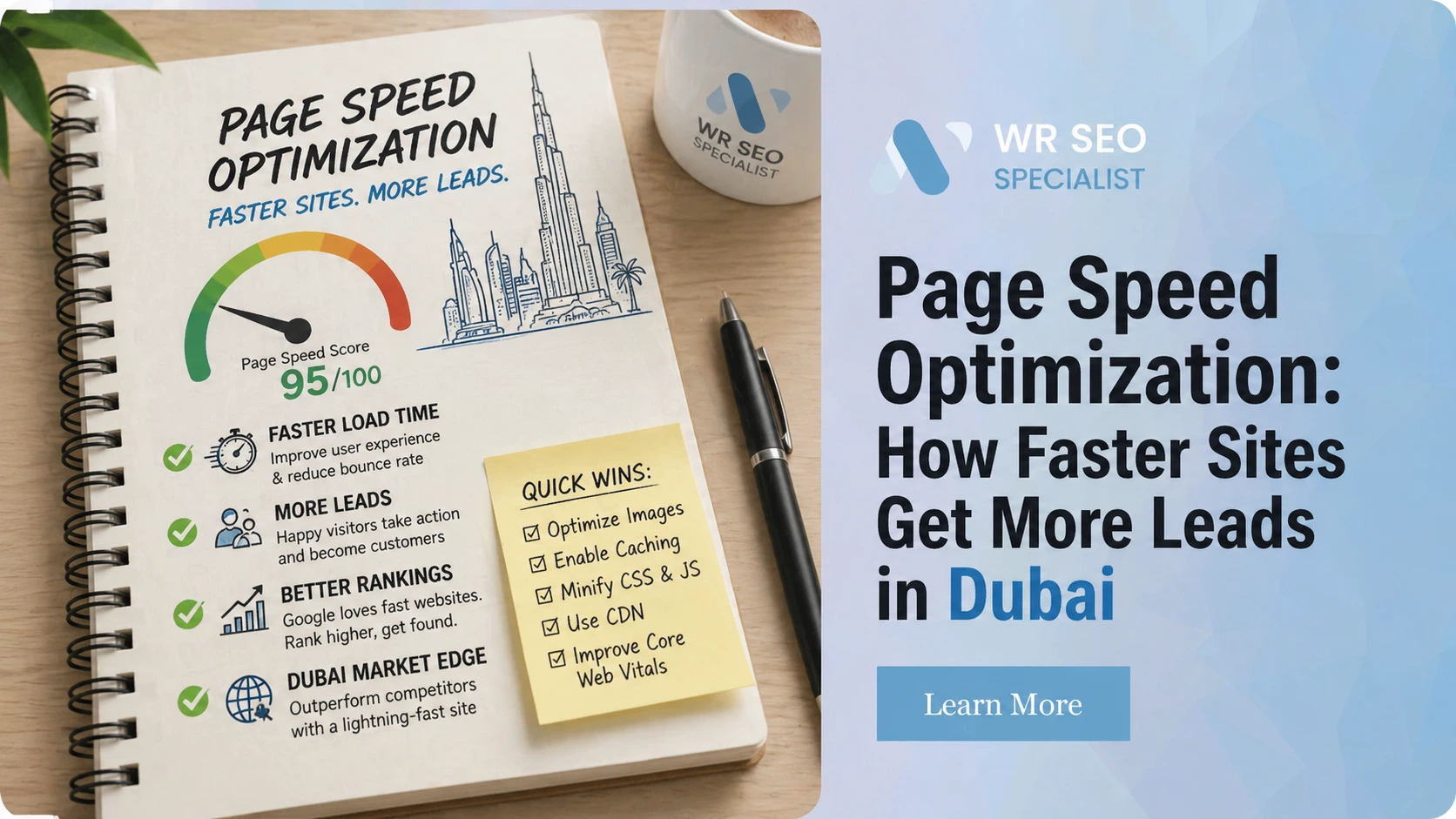
Page Speed Optimization: How Faster Sites Get More Leads in Dubai
Imagine you are searching for a service in Dubai on your phone and the site you tap takes forever to load. What do you do? Most people back out and try the next result. In a city where every minute counts, potential customers won’t wait around for a sluggish website. That isn’t just an inconvenience, it means fewer calls, fewer form submissions, fewer WhatsApp messages and a big hit to trust. This guide explains how page optimization speed shapes lead flow, which pages deserve top attention and what to fix first.
Why faster websites win more leads in Dubai
Dubai businesses operate in a mobile‑heavy market where most residents carry smartphones and expect information immediately. A site that takes three or four seconds to appear loses visitors before they see an offer. Recent data shows that the probability of a person leaving jumps by 32 percent when page load time increases from one to three seconds. Faster pages build trust and make people more willing to fill out a form, call a number or start a WhatsApp conversation. On mobile, which accounts for the majority of local web traffic, slow load times feel even worse and can hurt your ranking.
How page speed affects SEO and lead generation
Search engines include page speed in their ranking, but relevance and authority still matter more. Speed is most visible at the conversion stage. Imagine two service pages that both rank well; if one loads in under two seconds and the other takes five seconds, the faster page will win more leads because visitors aren’t kept waiting. According to protent that a site that loads in one second has a conversion rate 3 times higher than one that loads in five seconds and five times higher than a ten‑second site. Since calls, bookings, quote requests and WhatsApp clicks occur on pages deeper than the homepage, speed directly affects whether visitors can take action.
For broader search optimization advice, our guide on SEO services in Dubai explain how technical performance works alongside keywords and content to improve rankings and leads.
Which website pages to speed up first for results
Not every page has the same effect on your bottom line. To see quick improvements, start with the pages that drive commercial action:
- Service pages where you explain what you offer.
- Local landing pages targeting specific neighbourhoods or boroughs in Dubai.
- Contact and booking pages that include phone numbers, WhatsApp links and appointment forms.
- Quote forms that collect visitor details for follow‑up.
- Product or category pages for e‑commerce businesses.
Optimizing only the home page is not enough. Home pages often get general traffic from people browsing or learning about your brand, but serious leads click deeper. If those deeper pages load slowly, you will lose the leads you worked hard to attract. Focus on the pages where decisions happen, services, bookings, quotes and products, then return later to improve informational blog posts or galleries.
Each of these high‑intent pages plays a different role. Service pages explain what you offer and must load fast so visitors see your value quickly. Local landing pages target neighbourhood‑specific searches; they need to load quickly so someone on the move can choose you over a competitor. Contact or booking pages with phone numbers, forms and WhatsApp buttons are your direct connection to prospects; delays here mean lost conversations. Quote forms should be snappy to reduce drop‑offs. Product or category pages for e‑commerce must show images and prices instantly to encourage add‑to‑cart actions. By prioritizing these areas, you create a smoother path from search to conversion.
What website performance metrics matter most today
When specialists discuss speed, they focus on a handful of metrics: the time it takes for the main content to appear (LCP), how quickly pages respond to taps (INP), how much layouts shift during loading (CLS) and how fast the server responds. Google’s Core Web Vitals bundle these measures and emphasize mobile performance. Improving these indicators makes pages feel more responsive and keeps visitors engaged.
- Largest Contentful Paint (LCP) marks when the biggest element, often a hero image or headline, appears. Fast LCP means visitors can start reading right away.
- Interaction to Next Paint (INP) measures how long it takes a page to respond after a tap or click. Lower numbers make forms and menus feel snappy.
- Cumulative Layout Shift (CLS) tracks unexpected jumps during loading. Low CLS stops buttons from moving just as you try to tap them.
Monitoring these measures lets you improve both how quickly the page appears and how smooth it feels to use.
How to test website speed the right way in 2026
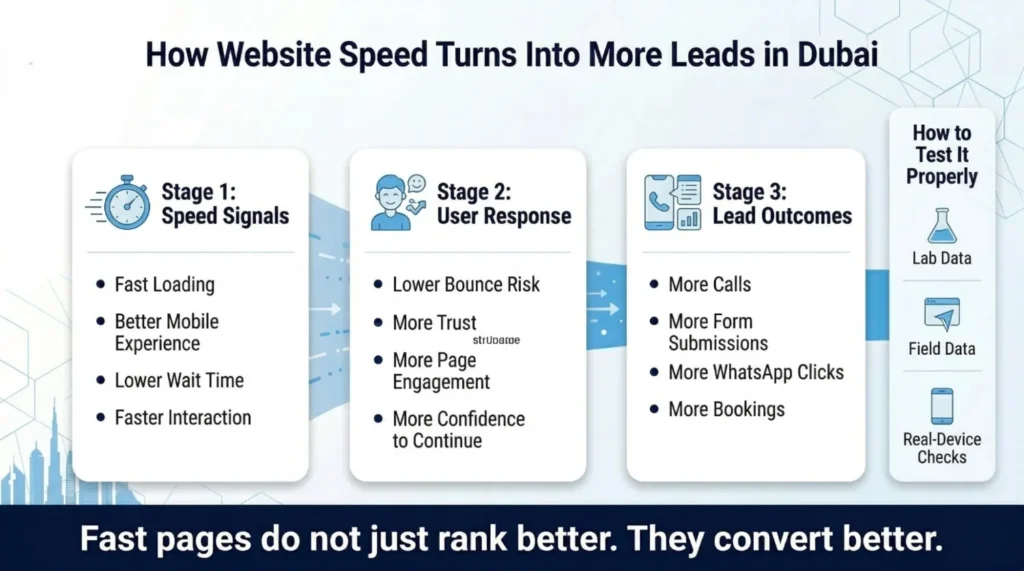
Testing is an ongoing process. Use PageSpeed Insights for quick lab and field data, Search Console for real‑user metrics and run your own checks on multiple devices and connections. Compare results before and after changes to confirm that your fixes improve the experience.
Lab tools like PageSpeed Insights simulate loading on average hardware and network conditions. They are useful for spotting slow code or images because they run in a controlled environment. Field data from Search Console captures how real visitors experience your pages over time. It reflects different phones, networks and locations. Finally, manual tests help you see what your customers see. Load your site on a smartphone over 4G and note how quickly you can read, scroll and tap forms. If a pop‑up blocks the content or a chat widget covers the call button, manual checks will reveal it. Using all three methods together gives you a complete picture.
Why Google PageSpeed Insights scores mislead brands
PageSpeed Insights offers a handy score, but the number can be misleading. A page might score well in lab tests yet feel slow if images load lazily or scripts block interaction. Use the tool as a checklist to spot obvious issues but rely on user feedback and real‑world metrics to judge success.
Think of the score as a pointer rather than a grade. Lab tools test under ideal conditions and weigh some metrics more than others. Real visitors might be on congested networks or older phones. They care more about whether they can tap a button without delay than whether every image is perfectly optimized. Therefore, always pair tool recommendations with human observations.
How mobile speed changes local SEO in Dubai
Local searches in Dubai happen mostly on smartphones. Google uses the mobile version of your site to decide rankings, so a slow mobile page will hurt your visibility. Fast, mobile‑friendly pages keep people engaged and send positive signals to search engines.
This is especially important for businesses that rely on walk‑in customers. People often search for “near me” services when they are out and about. If your page takes four seconds to load, they will tap back and choose a competitor whose page loads instantly. A quick mobile experience shows that you respect their time and makes them more likely to trust your brand.
Common website speed issues that hurt lead flow
The main culprits behind slow pages are easy to avoid. Common issues include oversized images that haven’t been compressed, weak hosting with no caching, too many third‑party scripts and bloated themes or plugins that add unnecessary code. Each of these adds seconds to load times and drives potential leads away.
How to improve website performance without rebuilding
You don’t always need a redesign to make your site faster. Start with basics: compress images, enable server and browser caching, turn on gzip or Brotli compression and use a Content Delivery Network (CDN) to serve assets closer to visitors. These changes are straightforward and often cut load times in half. Implement them first and measure the impact before considering a rebuild.
Compressed images mean smaller file sizes without noticeable quality loss. Caching stores a copy of your pages so they don’t have to be generated every time someone visits. Gzip and Brotli compression shrink text‑based files such as HTML, CSS and JavaScript, reducing download times. A CDN places copies of your files on servers around the world, including in the Middle East, so that Dubai users fetch data from a nearby location. Together, these improvements give your site a solid foundation for speed.
When speed enhancement needs a full website rebuild
Some websites suffer from deeper architectural issues that minor tweaks can’t solve. If your site uses an outdated theme or framework that loads dozens of scripts by default, or if custom code conflicts with modern browsers, optimization may only bring marginal gains. Similarly, if your CMS has accumulated years of plugins and custom patches, the overhead can be so high that incremental changes have little effect.
Signs that you may need a rebuild include: persistent server response delays even on good hosting, extremely high Time to First Byte (TTFB), and pages that remain slow despite image compression and caching. In these cases, redesigning with a performance‑oriented framework, modern coding standards and minimal plugins is often more cost‑effective than ongoing patchwork. A fresh build also allows you to rethink user flows and incorporate conversion‑friendly layouts from the ground up.
How to speed up a WordPress website the right way
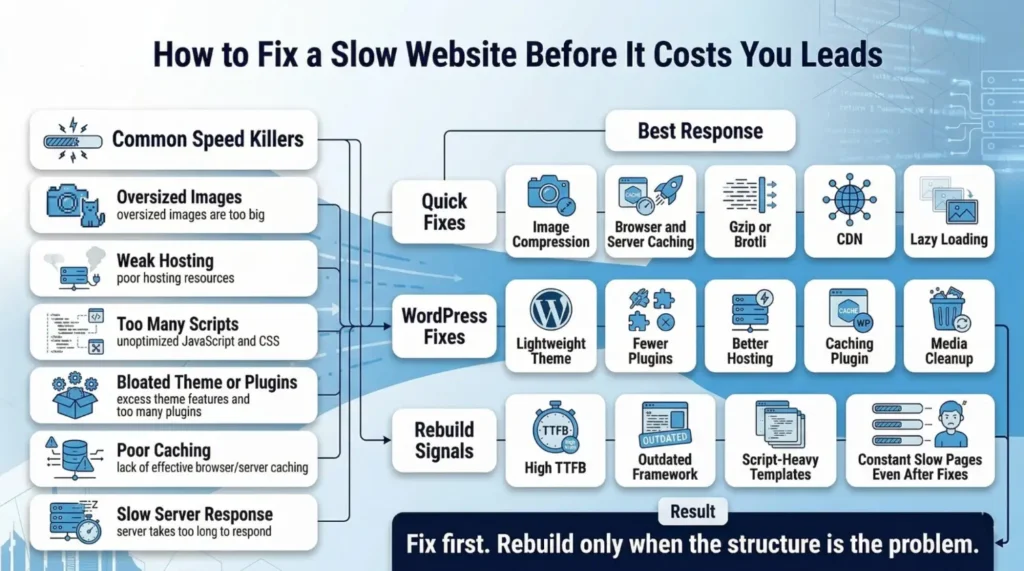
WordPress powers many sites in Dubai but can become sluggish if mismanaged. Keep it fast by choosing a lightweight theme, limiting plugins to those you truly need, compressing images and enabling caching with a CDN. Well‑tuned hosting and lazy loading for media also help. These steps can bring load times under three seconds and improve your Core Web Vitals.
Heavy themes and too many plugins add bulky code and slow down loading. Compressing images and using lazy loading reduces page weight so visitors see content quickly. Caching plugins save ready‑made versions of your pages, and a CDN serves them from a server close to your audience. With a streamlined setup, WordPress can deliver a smooth user experience comparable to custom‑built sites.
Website speed optimization for Dubai lead pages
When your goal is to collect leads, prioritize the pages that capture intent. Service pages, contact forms and location pages are often the last step before a customer reaches out. If these pages load slowly, the visitor may abandon the process and go elsewhere. Conversely, making them fast encourages immediate action. For example, if your service page loads in under two seconds, the probability of your visitor completing the form is much higher because they don’t experience frustration or doubt.
In Dubai, many businesses use WhatsApp as a primary communication channel. Ensure that the pages with WhatsApp click‑to‑chat links load instantly. A half‑second delay can mean the difference between a hot lead and a lost opportunity. Similarly, location pages should open quickly with maps and contact details so that people searching for a nearby service feel confident in visiting or calling. By focusing on these pages, you will see a direct increase in calls, bookings and messages.
How to measure faster sites against better results
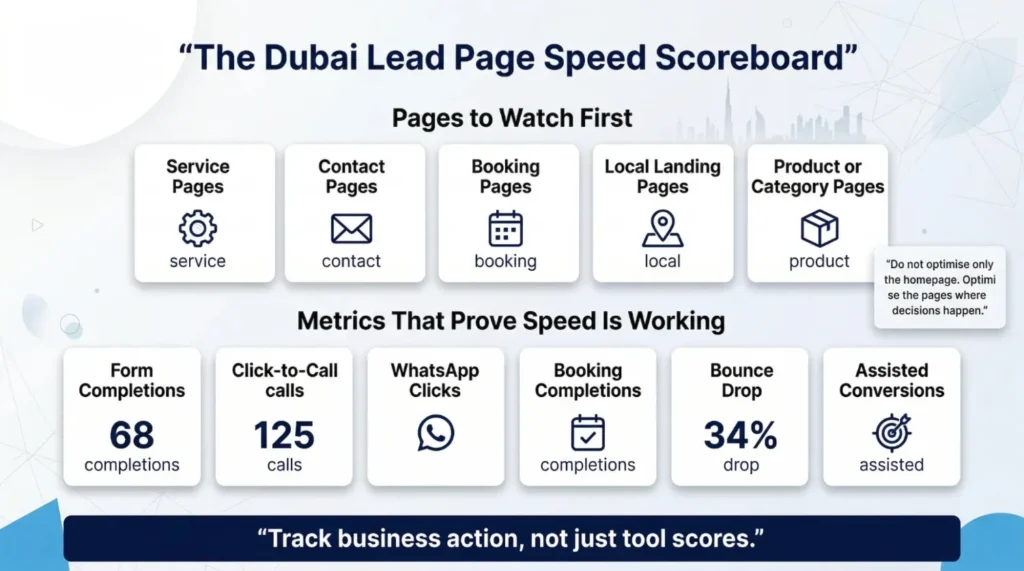
After making improvements, watch the numbers that matter: completed forms or sales, how often visitors tap your phone or WhatsApp link, how many start and finish a form and whether bounce rate drops. These metrics show if a faster site truly brings more business.
For example, if your booking form previously had ten completions per week and now has fifteen, the speed work is paying off. Tracking click‑to‑call events shows if more people are contacting you directly from the site. Faster pages often lead to fewer bounces and more returns, which you can see through assisted conversions.
Common speed and SEO mistakes businesses still make
Common mistakes include focusing on tool scores instead of user experience, optimizing only the home page while ignoring service or contact pages and testing only on desktop. Large videos or pop‑ups on lead pages also slow conversions. Treat speed as ongoing maintenance: new plugins, media and scripts will require periodic reviews.
Another error is assuming that a one‑time optimization will last forever. Websites evolve as businesses add new products, banners and tracking tags. Each addition can slow down the site if not tested. Set a reminder to run speed tests every quarter and after any major update to catch performance issues early.
Final takeaway on website speed and lead growth
Speed isn’t just about pleasing search engines or earning a good score in a tool. Faster sites deliver smoother journeys, build stronger trust and generate more leads. By prioritizing the pages where buying decisions happen, service pages, contact forms, local landing pages and product pages, you ensure that visitors have the best possible experience at the moments that matter. Remember that the probability of bounce increases dramatically as load times stretch past three seconds and that a one‑second page can convert at three to five times the rate of slower pages. To stay competitive in Dubai’s fast‑paced market, continue testing and refining your site speed.
If you need expert help, consider partnering with WR SEO Specialist. Their team understands the nuances of page speed optimization in the UAE and can provide tailored solutions to boost your site’s performance and lead generation. Faster pages today mean more leads tomorrow.
Frequently Asked Questions
What is page speed optimization?
It’s the process of making web pages load quickly and respond smoothly by compressing images, caching content, reducing scripts and using modern hosting. The goal is to create a better user experience and improve lead conversions.
Which tool is commonly used for SEO?
Many professionals use Google Search Console to monitor search visibility and Core Web Vitals, and PageSpeed Insights to get speed recommendations. Other popular tools include SEMrush and Ahrefs for keyword research and backlink analysis.
What are common SEO mistakes?
Businesses often focus on tool scores rather than users, optimize the wrong pages first, ignore mobile performance and keep heavy media on lead pages. They also treat speed as a one‑off task instead of ongoing maintenance.
Can I do SEO myself?
Yes, small businesses can handle basic SEO by creating quality content, ensuring sites are mobile‑friendly and using simple tools. However, technical tasks such as schema implementation, server optimisation and in‑depth keyword research may benefit from professional help.
How to do SEO for beginners?
Start by understanding your audience’s search intent. Create informative, well‑structured content around those topics. Ensure your site loads quickly, is mobile‑friendly and uses descriptive titles and headings. Use tools like Google Search Console to monitor performance and fix issues.
Is SEO dead or evolving in 2026?
SEO is evolving, not dying. Search engines continue to reward relevant, high‑quality content and good user experience. As algorithms incorporate user behaviour signals like page speed and interaction, optimization becomes even more about serving people well.
Can ChatGPT do an SEO audit?
ChatGPT can provide general guidance and checklists based on best practices, but it cannot run real‑time diagnostics on your site. For a full audit, use SEO tools and analytics data or consult a professional.