What Is PPC Advertising and How Does It Help Businesses Grow?
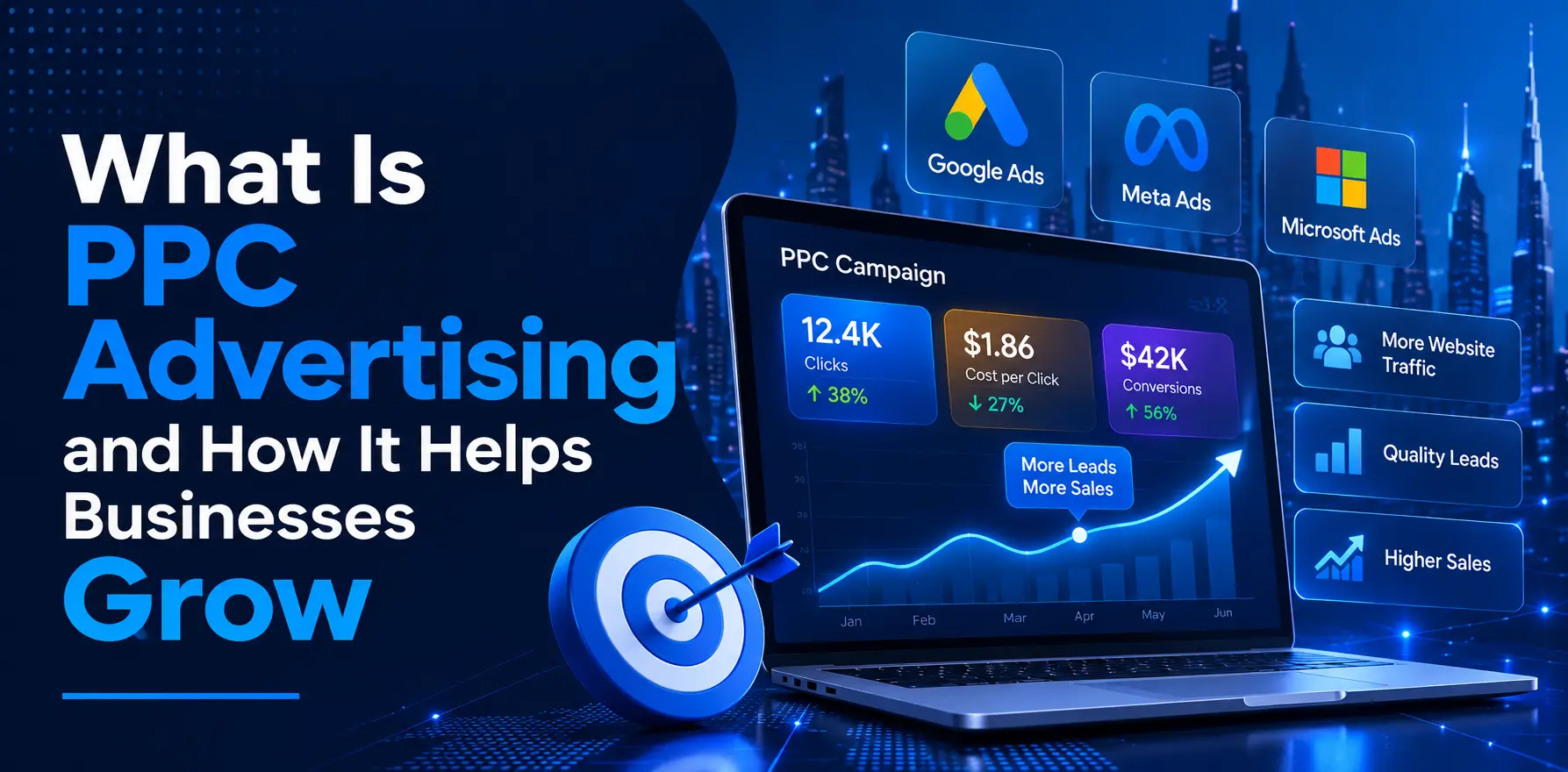
Pay‑per‑click (PPC) advertising is exactly what it sounds like: you pay only when someone clicks on your ad. Unlike traditional advertising, where you pay just to show up in front of an audience (think of a billboard on the highway that charges regardless of who notices it), PPC campaigns let you bid for visibility and then pay each time a real human engages with your message.
This model has become one of the most popular tools in digital marketing. In fact, advertisers are projected to spend around USD 190 billion on search advertising globally in 2024, illustrating just how integral PPC has become to modern marketing strategies. Even better, over 65 % of industries saw their average conversion rate increase year‑on‑year on Google Ads and Microsoft Advertising, proof that well‑run campaigns can deliver real results.
So how does PPC work, why is it worth your time, and what’s the secret sauce for businesses (including those in Dubai) looking to grow? Let’s dig in.
How Does PPC Advertising Work?
Imagine an online auction house that runs 24/7. Advertisers bid on specific search phrases (keywords), and when someone types that phrase into Google or another platform, the highest‑quality ad wins the auction and appears at the top of the results. You only pay when someone clicks—hence the name. The exact cost per click (CPC) depends on several factors:
- Your Bid – The maximum you’re willing to pay.
- Quality Score – Google (and other platforms) assign a “quality score” based on your ad relevance, expected click‑through rate and landing‑page experience. A high score can reduce the price you pay.
- Competition – More competition for a keyword drives up prices, which is why highly competitive industries (e.g., insurance or real estate) have higher CPCs.
A simplified formula often used is: (Ad Rank of the competitor below you ÷ Your Quality Score) + USD 0.01. By boosting your Quality Score with relevant keywords and compelling landing pages, you can pay less per click and still outrank rivals.
PPC vs. Other Ad Models
There are two major ways online ads can be billed:
- PPC (Pay‑Per‑Click) – You pay only when someone clicks your ad.
- CPM (Cost‑Per‑Mille or Cost Per Thousand Impressions) – You pay based on how many times your ad is displayed (impressions), regardless of clicks.
PPC gives smaller businesses a fighting chance because there’s no wasteful spend on uninterested viewers. Think of PPC as a digital vending machine, you pay only when someone selects your snack.
Why PPC Matters for Business Growth
1. Fast, Targeted Traffic
PPC is essentially on‑demand traffic. Once your ads are live, you can start sending potential customers to your website within hours,no waiting for organic search results to kick in. Targeting options (keywords, demographics, location, interests, devices and even time of day) let you zero in on the people who are most likely to buy from you.
2. Measurable ROI
PPC platforms provide extensive reporting. You can track clicks, conversions, cost per conversion, return on ad spend (ROAS) and more. For context, the average global cost‑per‑click across industries was about USD 2.30 in 2023, and the global conversion rate for PPC ads sits around 3.2 %. Those numbers will vary by industry, but they demonstrate that PPC can be both cost‑effective and scalable when managed well.
3. Budget Control
You can start with as little as a few dollars per day and scale up as campaigns prove successful. Unlike traditional channels, there’s no long‑term commitment; you can pause or adjust your spend at any time.
4. Data‑Driven Insights
PPC campaigns teach you about your audience. Which keywords drive clicks? Which demographics convert best? This data can feed back into your SEO, content marketing and even product development.
5. Complements SEO
Organic search (SEO) takes time. PPC fills the gap by giving you immediate visibility while your organic rankings climb. It also allows you to test keywords quickly before committing resources to longer‑term SEO campaigns.
Where Do PPC Ads Appear?
The most common platforms are:
- Search Engines (Paid Search) – Google Ads, Microsoft Advertising (Bing). This is where your ads appear above or below organic search results for specific keywords. Google still dominates, holding about 79 % of the global search market, but Microsoft’s Bing commands around 12 % and can be surprisingly cost‑effective.
- Social Networks (Paid Social) – Facebook, Instagram, LinkedIn, TikTok, X (formerly Twitter). These platforms target people based on demographic and behavioural data rather than search queries. For example, Facebook’s average CPC is roughly USD 1.72 with click‑through rates around 0.9 %.
- Shopping & Display Networks – Google Shopping, Display Network, Amazon Ads, Etsy Ads. These feature product images and targeted placements across websites and marketplaces.
Even though Google is the biggest player, diversifying across platforms can stabilise your lead flow and reduce risk.
How to Get Started: PPC Essentials
- Research Keywords and Audience: Use tools like Google’s Keyword Planner to find relevant search terms and estimate costs. For Canada, consider local language variations and mobile search behaviour.
- Structure Your Campaigns: Group related keywords into ad groups and align each group with a relevant landing page. This boosts Quality Score and improves ad rank.
- Write Compelling Ad Copy: Highlight your unique value proposition, include target keywords, and end with a clear call‑to‑action (CTA).
- Optimise Landing Pages: Ensure that your landing page delivers what the ad promises. Keep it fast, mobile‑friendly and focused on the next step (sign up, buy, call, etc.).
- Monitor and Optimise: Track metrics like click‑through rate (CTR), cost per click (CPC), conversion rate and cost per acquisition (CPA). Adjust bids, pause underperforming keywords, test different ad variations and refine your targeting based on performance data.
How PPC Helps Businesses Grow
PPC is not just about quick wins; it’s a strategic investment that can accelerate growth when used thoughtfully:
- Immediate Visibility: Appear at the top of search results even if your organic rankings aren’t there yet.
- Data‑Driven Strategy: Continuous feedback helps refine messaging, offers and even product development.
- Scalable Budgeting: Start small, prove results, and then reinvest profits to scale campaigns responsibly.
- Competitive Advantage: Outrank slower competitors in industries where being first matters (restaurants, emergency services, fast‑moving consumer goods, etc.).
- Synergy With Other Channels: Insights from PPC (top‑performing keywords, high‑converting demographics) improve SEO, content marketing and social media strategies.
Ultimately, PPC advertising is a dynamic tool that allows businesses to grow quickly while keeping costs under control. When run properly, it provides immediate traffic, valuable data and a pathway to long‑term profitability. Whether you’re a start‑up in Toronto or a real‑estate agency in Dubai, PPC offers a flexible and measurable way to reach the people who matter most.
Final Thoughts
PPC isn’t magic. It takes planning, creativity and analysis. But the rewards can be significant. As global spending on search advertising climbs and businesses across industries witness rising conversion rates, there has never been a better time to test PPC. Start small, learn quickly, and watch your campaigns evolve from cautious experiments into powerful growth engines.
Need help building or optimising your PPC campaigns? Our SEO and PPC team loves turning clicks into customers. Reach out and let’s put your ads to work.