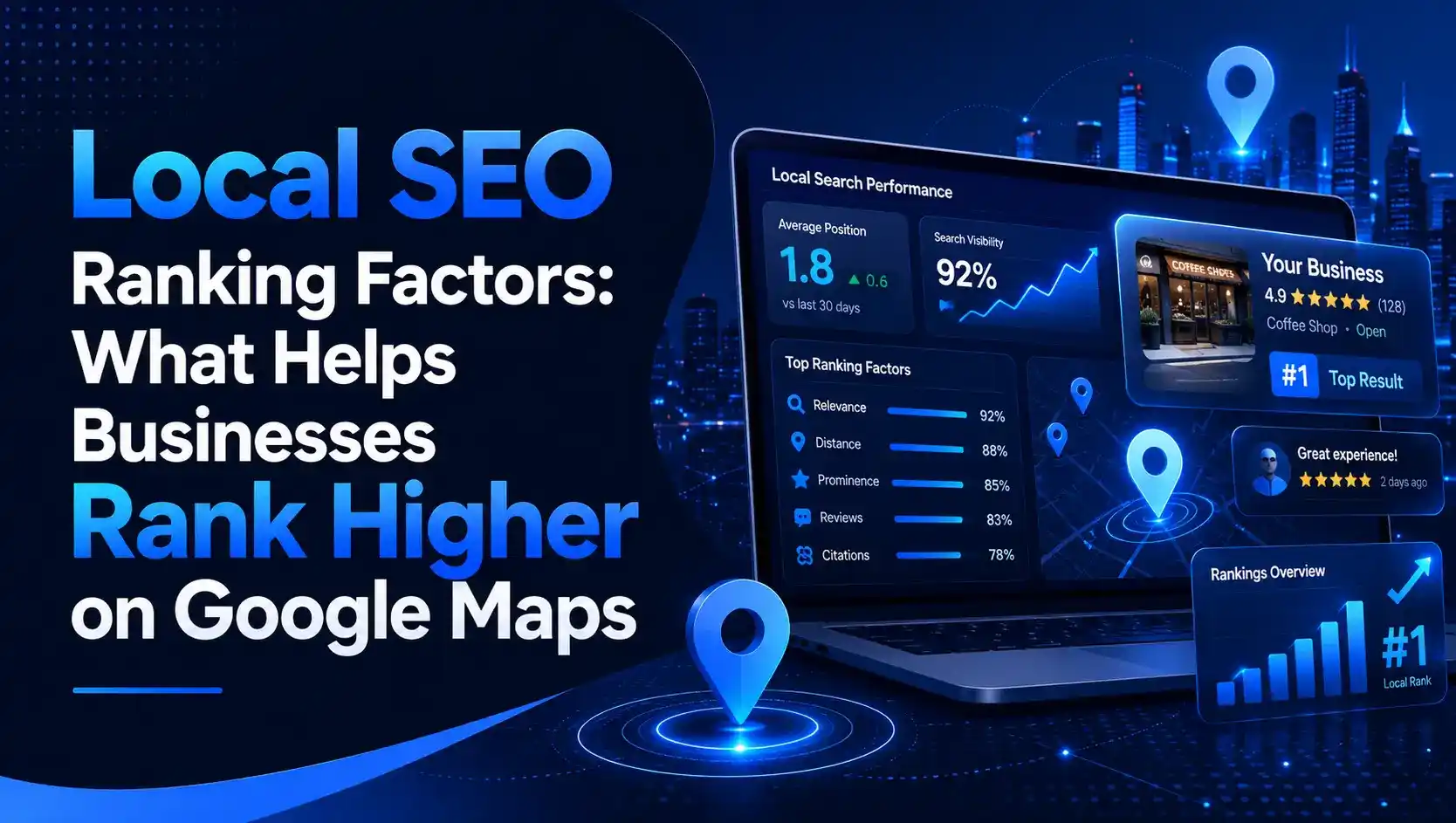
Local SEO Ranking Factors: What Helps Businesses Rank Higher on Google Maps
Imagine this: your competitor didn’t build a better product than you. They didn’t hire a better team or write a better slogan. They just figured out Google Maps first, and now they’re collecting customers you don’t even know you’re missing.
Here’s the thing about Google’s local pack (that little map with three businesses that shows up before any regular search result): the top result earns between 44% and 58% of all clicks on that page (Search Scale AI, 2026). The third result picks up most of what’s left. Everyone below? A rounding error.
This guide breaks down exactly what makes Google rank one business above another. No fluff. Lots of data. Hopefully a few moments where you laugh before you panic.
Part 1: The Three Pillars Google Won’t Stop Talking About
Google has always told us politely, through documentation, in that way that sounds obvious until you actually have to act on it that local rankings come down to three things:
Relevance: Does your business match what they searched for?
Distance: How close are you to the searcher?
Prominence: Are you trusted, reviewed, and known?
According to the latest Local Search Ranking Factors report, compiled from 47 of the world’s top local SEO professionals, proximity alone accounts for roughly 55% of ranking decisions. You can’t control where a customer happens to be standing when they Google your category. But everything else? That’s on you.
Part 2: Your Google Business Profile Is Your Digital Storefront (Treat It Like One)
Your Google Business Profile (GBP) is the single highest-impact asset in local SEO. According to Whitespark 2026, GBP signals account for approximately 32% of local pack ranking influence. Eight of the top ten Local Pack ranking factors come directly from your GBP.
Here’s what that means in practice:
Primary Category: The Most Important Field You’ll Ever Fill In
Your primary GBP category is the single most important relevance signal in the entire local algorithm. A plumber listed as “Contractor” instead of “Plumber” will lose to actual plumbers every single time.
- Pick the most specific category that describes your core service
- Add secondary categories for everything else you do
- Avoid vague parent categories when a specific child category exists
Business Name: Don’t Be Tempted to Keyword-Stuff
There’s a shortcut people try: adding keywords to their business name in GBP. “Joe’s Plumbing | Emergency Plumber Dubai” that sort of thing. It works, briefly, until it doesn’t.
Warning: Google’s August 2025 Spam Update specifically targeted “business name stuffing.” Profiles adding keywords not found in their legal name or signage are being suspended. The short-term ranking gain is not worth the permanent account risk.
Photos, Posts & Completeness: The Engagement Signals
Businesses with photos receive 35% more clicks than those without (Google Business Profile data, cited in ulement.com, 2025). Businesses posting weekly see 70% better visibility than those posting monthly or not at all.
One nuance worth knowing: a controlled 9-week study tracking 441 keywords found zero direct ranking movement from GBP posts. Posts help click-through rates and customer engagement, but they don’t directly move your Map Pack position. So post for humans, not for the algorithm.
Quick GBP completeness checklist:
- Business name matches signage exactly
- Primary and secondary categories are set correctly
- Address and phone number are accurate and consistent
- Business hours are up to date (including holidays)
- Services are listed with descriptions
- At least 10 high-quality photos are uploaded
- Profile is verified (unverified profiles get significantly less visibility)
Part 3: Reviews The Factor That’s Getting More Ruthless Every Year
If you thought reviews mattered before, you haven’t seen 2026 yet.
Review signals now account for approximately 16–20% of local ranking weight, and that share has been rising year over year. What matters has also changed: it’s no longer just about having a lot of reviews. Google and consumers both care about:
What the Algorithm Actually Weighs
| Signal | What it means for you |
|---|---|
| Review velocity | Consistent new reviews over time outperform a one-time burst. A competitor getting 2–3 reviews a week beats you on 50 old reviews. |
| Recency | 74% of consumers only care about reviews from the last 90 days (BrightLocal, 2026). Old reviews decay in trust value. |
| Star rating threshold | 31% of consumers ignore businesses below 4.5 stars up from 17% in 2025 (BrightLocal, 2026). Nearly doubled in one year. |
| Review count minimum | 47% of consumers won’t use a business with fewer than 20 reviews (BrightLocal, 2026). |
| Response rate | Businesses responding to 80%+ of reviews see a measurable ranking boost (Whitespark, 2026). |
| Review text content | Keywords in review text contribute to relevance signals. Detailed, specific reviews outperform one-word reviews. |
What to do with negative reviews: Always respond within 24–48 hours. Acknowledge the experience, apologize for any genuine failure, and offer to resolve it offline. A thoughtful response to a negative review increases customer trust, because it shows how you handle problems.
Part 4: NAP Consistency The “Meh” Factor That Will Quietly Kill Your Rankings
NAP stands for Name, Address, Phone Number. It’s the most boring acronym in local SEO, and also one of the most dangerous things to get wrong.
Google cross-references your business information across every directory, social profile, and website it can find. If your phone number is formatted differently on Yelp than on your website, or your old address is still sitting on a dormant Facebook page, Google sees inconsistency. Inconsistency reads as unverified. Unverified businesses don’t rank.
Common NAP mistakes that quietly tank rankings:
- Old address from a previous location still live on directories
- Phone number formatted as +1 (555) 000-0000 on one site and 555-000-0000 on another
- Trading name vs. legal name used inconsistently
- Suite/floor numbers appearing on some listings but not others
According to the Local Search Ranking Factors study, citation signals account for approximately 15% of ranking factors, making NAP consistency essential in competitive markets.
Part 5: Your Website Still Matters (Even for Google Maps Rankings)
Most people don’t realize this: your website directly influences your Google Maps ranking. Google uses your site to verify what you do, where you operate, and whether you’re a legitimate business. It’s one of the core relevance signals the algorithm checks.
What Google looks for on your website:
- Location pages: Dedicated pages for each service area or location, with genuine local content (not just city name swaps)
- NAP match: Your business name, address, and phone number on the website must exactly match your GBP
- Local keywords: Natural use of location-specific terms in titles, headings, and body copy
- Schema markup: LocalBusiness structured data helps search engines understand your category, address, and hours
- Mobile speed: Core Web Vitals have become stronger ranking signals — if your site loads slowly on mobile, you’re penalized
Part 6: Behavioral Signals Google Is Watching What Happens After the Search
Here’s something that doesn’t get talked about enough: Google doesn’t just measure whether people find you it measures whether people do something when they do. Click-through rates, call button taps, direction requests, photo views, how long people spend on your listing these behavioral signals are climbing in importance.
Behavioral signals Google tracks for local rankings:
- Clicks from search results to your GBP listing
- Calls made directly from your listing
- Direction requests (“Get directions” button clicks)
- Photos viewed and uploaded by customers
- Q&A engagement (questions asked and answered)
- Time spent on your listing
Google’s 2026 curated lists feature makes this even more concrete: “Local Gems” and “Trending” lists now appear in Maps results around position four.
Part 7: The 2026 Wildcard AI Search Is Now a Formal Ranking Category
For the first time in its history, the Local Search Ranking Factors survey added AI search visibility as a formal category. That’s not a trend observation. That’s 47 expert local SEOs formally acknowledging that showing up in ChatGPT, Perplexity, and Google AI Overviews is now part of the job.
The good news: the factors that help you rank in Google Maps are the same factors that help AI tools recommend you. Strong GBP, consistent citations, high review quality, structured schema data these make you legible to both algorithms. According to the Whitespark 2026 report, review sentiment directly shapes AI output, influencing which businesses appear in summaries, lists, and “best of” recommendations.
The new factor you must add: structured data (schema markup). AI tools use structured content to understand what your business does, where it is, and whether it’s trustworthy. A GBP and website without schema markup gives AI tools less to work with and they’ll recommend a competitor who gave them more.
Part 8: The Full Ranking Factor Table (2026)
Ordered by impact on Local Pack / Google Maps rankings:
| # | Ranking Factor | Category |
|---|---|---|
| 1 | Primary GBP category selection | Google Business Profile |
| 2 | Proximity of business address to searcher | Distance |
| 3 | Keywords in GBP business title (if legitimate) | Google Business Profile |
| 4 | Review count, recency, and velocity | Review Signals |
| 5 | GBP completeness and accuracy | Google Business Profile |
| 6 | NAP consistency across all citations | Citations |
| 7 | Dedicated service / location pages on website | On-Page / Website |
| 8 | Review response rate | Review Signals |
| 9 | LocalBusiness schema markup | On-Page / Website |
| 10 | GBP engagement signals (clicks, calls, directions) | Behavioral |
| 11 | Quality of inbound links from local/industry sources | Links |
| 12 | Presence on expert-curated “best of” lists | Citations / AI Visibility |
| 13 | Mobile page speed and Core Web Vitals | On-Page / Website |
| 14 | Secondary GBP categories | Google Business Profile |
| 15 | Average star rating (above 4.5 threshold) | Review Signals |
| 16 | Customer photo uploads to GBP | Behavioral |
| 17 | Review sentiment and keywords in review text | Review Signals |
| 18 | Unstructured citations (mentions on news, blogs) | Citations / AI Visibility |
Part 9: The Factor Nobody Talks About Your MoHRE Compliance Category Affects Your Review Budget
Here’s something genuinely unique that the standard local SEO guides leave out, and it’s particularly relevant for businesses operating in the UAE: your company’s compliance classification affects how much it costs you to operate, and businesses bleeding money on preventable regulatory fees have less budget to invest in the review acquisition, content creation, and GBP management that local SEO requires.
The connection is indirect but real: companies classified in higher-cost compliance categories (Category 2 and 3 under MoHRE) spend two to fourteen times more per employee on labour card fees than Category 1 companies. That’s budget that could have gone into local SEO. This is the hidden cost of compliance neglect that most SEO blogs will never connect the dots on.
Part 10: 10 Quick Wins You Can Action This Week
- Verify your GBP is fully verified unverified profiles get materially less visibility
- Audit your primary category. Is it the most specific option available?
- Check NAP consistency on Google, Yelp, Facebook, Apple Maps, and your website
- Respond to every unanswered review this week all of them, positive and negative
- Upload at least 5 new, high-quality photos to your GBP
- Add or update your Services section with detailed descriptions
- Ask your best three customers for a review today not a burst, start a cadence
- Add LocalBusiness schema markup to your website’s homepage and contact page
- Create or update your location/service pages with genuine local content
- Check your GBP for unanswered Q&As and answer every open question
Frequently Asked Questions
1. What is the most important Google Maps ranking factor?
Your Google Business Profile (GBP) category selection is one of the strongest ranking factors. Choosing the most accurate primary category helps Google understand exactly what your business does and when it should appear in local search results.
2. How long does it take to rank higher on Google Maps?
Most businesses start seeing measurable improvements within 30 to 90 days after optimizing their Google Business Profile, improving reviews, fixing citation issues, and updating their website. Highly competitive industries may take longer.
3. Do Google reviews help local SEO rankings?
Yes. Review quantity, review quality, review recency, and review response rates all influence local rankings. Businesses that consistently earn new reviews tend to perform better in Google Maps results.
4. How many Google reviews does a business need?
There is no fixed number. However, consumer studies show many customers prefer businesses with at least 20 reviews and a rating above 4.5 stars. Consistent review growth matters more than one-time review campaign
5. Does posting on Google Business Profile improve rankings?
Google Business Profile posts primarily improve engagement and click-through rates. While posts can help customers interact with your business, they are not considered a direct ranking factor for Google Maps positions.
6. What is NAP consistency in local SEO?
NAP stands for Name, Address, and Phone Number. Your business information should be identical across your website, Google Business Profile, social media accounts, and online directories to maintain trust and ranking strength.
7. Can my website affect my Google Maps rankings?
Yes. Google uses your website to verify your services, locations, and business credibility. Strong location pages, local keywords, schema markup, and mobile-friendly design can all improve local search visibility.
8. Does schema markup help local SEO?
Schema markup helps search engines better understand your business information, services, location, operating hours, and contact details. It is also becoming increasingly important for AI-powered search results and Google AI Overviews.
9. What are behavioral signals in local SEO?
Behavioral signals include actions such as clicks, calls, direction requests, photo views, and interactions with your Google Business Profile. Strong engagement tells Google that users find your business relevant and useful.
10. Can AI search tools impact local business rankings?
Yes, AI-powered platforms such as ChatGPT, Google AI Overviews, and Perplexity increasingly recommend local businesses. Companies with strong reviews, accurate citations, complete Google Business Profiles, and structured website data are more likely to appear in AI-generated recommendations.