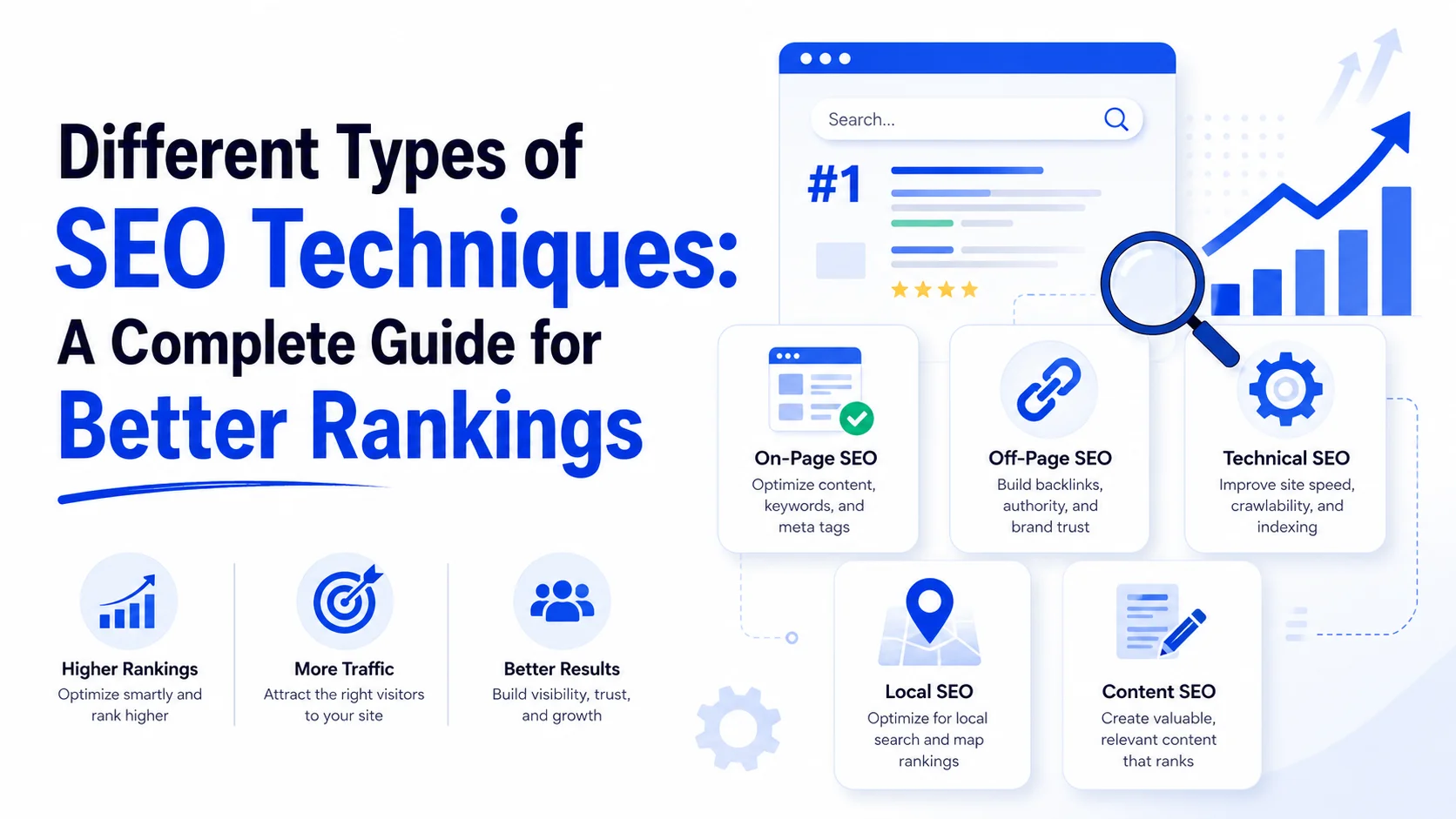
Different Types of SEO Techniques: A Complete Guide for Better Rankings
Understanding the different types of SEO is the difference between throwing tactics at a wall and building a strategy that compounds over time. This guide breaks down every major type clearly, with real-world context for businesses operating in the UAE, one of the most digitally connected markets on the planet.
Quick context: The UAE recorded 99% internet penetration going into 2026, with 95% smartphone penetration. DataReportal’s Digital 2026 UAE report places the country among the world’s most connected markets. With the UAE digital ad spend forecast to hit $2.64 billion in 2026 (Statista via Titan Digital), the competition for organic visibility has never been sharper. SEO isn’t optional here; it’s infrastructure.
What Is SEO and Why Does It Have So Many Types?
SEO, Search Engine Optimization, is the process of improving a website so it appears higher in Google and other search engine results, without paying for ads. It drives organic traffic: visitors who find you because your content answered their question, not because you outbid a competitor.
But a modern website has many moving parts. Google evaluates your content, your code, your reputation across the web, your visibility in local search, and your speed on mobile. Each “type” of SEO is really a lens on a different part of that evaluation. Master them together, and you build rankings that hold. Neglect even once,e and you leave a gap that competitors will find.
Here’s every major type, explained plainly.
11 Types of SEO Every Website Owner Should Know
1. On-Page SEO
What it is: Optimizing the content and elements on each page of your website.
On-page SEO is the foundation. It’s how you tell Google, and your reader, exactly what a page is about. Without it, search engines guess. And search engines are not good guessers.
Key on-page elements:
- Title tags and meta descriptions, the headline and summary that appear in search results
- Headings (H1, H2, H3), a structure that signals content hierarchy
- Keyword placement, using your target terms naturally in the right places (title, first paragraph, subheadings)
- Internal linking connects your pages, distributes authority and guides users
- Image alt text describing images for search engines and accessibility
- Content quality and depth, answering the search intent fully, not superficially
2. Technical SEO
What it is: Optimizing the backend structure of your website so search engines can crawl, index, and rank it effectively.
Think of technical SEO as the plumbing of your online presence. Your content might be excellent, but if Google’s bots can’t access it, read it, or trust it, you won’t rank for it.
Key technical SEO elements:
- Site speed and Core Web Vitals (LCP, CLS, INP) are Google’s page experience signals
- Mobile-friendliness, Google uses mobile-first indexing; the mobile version of your site is the primary version
- HTTPS / SSL security , a lightweight but confirmed ranking signal
- Crawlability and indexing , clean sitemap, no broken links, proper robots.txt
- Structured data / schema markup , helps Google understand what your content represents
- Duplicate content resolution , canonical tags, redirects, and clean URL structures
3. Off-Page SEO
What it is: Everything that happens outside your website to build its authority and reputation in Google’s eyes.
Google treats backlinks, other websites linking to yours, as votes of confidence. The more credible the source, the more weight the vote carries. Off-page SEO is about earning those votes systematically.
Key off-page strategies:
- Link building, acquiring backlinks from relevant, authoritative websites
- Digital PR is getting featured in publications, industry media, and news outlets
- Brand mentions, even unlinked mentions of your brand name, build authority signals
- Guest posting, contributing content to credible sites in your industry
- Forum and community participation, building presence where your audience already spends time
What to avoid: Buying links, participating in link schemes, or building large quantities of low-quality backlinks. Google’s Spam policies penalize manipulative link practices, and in the UAE’s competitive markets, a manual penalty can set a business back months.
4. Local SEO
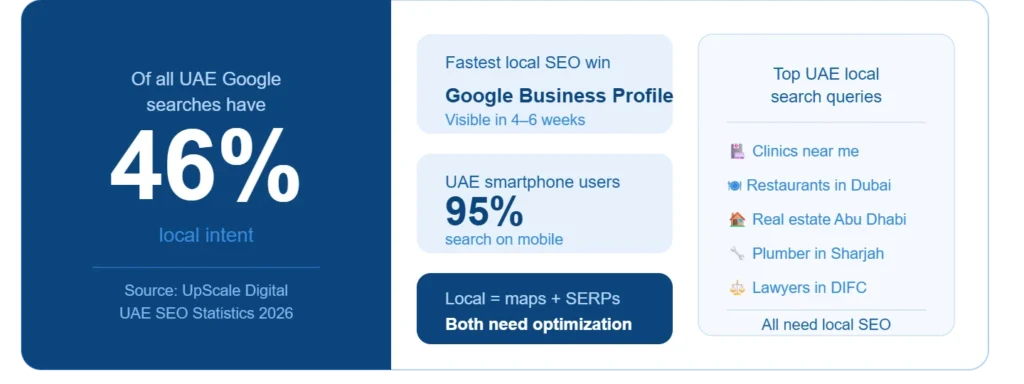
What it is: Optimizing your online presence to appear in location-based searches, “near me” queries, Google Maps results, and city-specific searches.
Local SEO is where UAE businesses can see results fastest, and where the competition is most visible. When someone in Dubai searches “dentist near DIFC” or “cleaning service in Sharjah,” local SEO determines who shows up.
Key local SEO elements:
- Google Business Profile setup, verification, photos, hours, reviews, and regular posts
- NAP consistency, your Name, Address, and Phone number match exactly across all directories
- Local keyword targeting, city and neighbourhood-specific terms in page content
- Review management quantity and quality of Google reviews significantly influence local rankings
- Local citations, listings on UAE-specific directories (Yalla, Yellow Pages UAE, Dubai Chamber)
- Localized landing pages, separate pages for each city or area you serve
5. Content SEO
What it is: Creating and structuring content specifically to rank in search results and satisfy search intent.
Content SEO sits at the intersection of on-page optimization and editorial strategy. A technically perfect page with weak content won’t rank. Strong content with poor optimization won’t either. Content SEO marries both.
Key elements:
- Search intent matching aligns content type (blog, product page, FAQ, guide) with what the searcher actually wants
- Topical authority, covering a subject deeply and broadly, not just targeting individual keywords
- Content clusters, a pillar page (broad topic) supported by cluster pages (specific subtopics), all interlinked
- Freshness, updating content regularly to maintain relevance
- E-E-A-T demonstrating Experience, Expertise, Authoritativeness, and Trustworthiness through the content itself
Search intents can be divided into four categories: informational (users seeking knowledge), navigational (users seeking a specific site), transactional (users ready to buy), and commercial (users researching before purchase). Tailoring content to each intent increases relevance and the likelihood of ranking.
6. Mobile SEO
What it is: Optimizing specifically for the experience of users on smartphones and tablets.
Mobile SEO used to be a subcategory. In 2026, it’s the default. Google indexes the mobile version of every website first; the desktop is secondary. If your mobile experience is poor, your rankings suffer regardless of how good the desktop version looks.
Key mobile SEO factors:
- Responsive design, one site that adapts to any screen, not a separate mobile version
- Tap-friendly buttons and forms, elements sized and spaced for fingers, not cursors
- Fast load times on mobile networks,s compressed images, and minimal render-blocking scripts
- Readable font sizes, no zooming required
- Minimal intrusive interstitials, pop-ups that block content on mobile, are a ranking penalty risk
7. International SEO and Multilingual SEO
What it is: Optimizing your website for users in different countries or speakers of different languages.
For a market like the UAE, home to over 200 nationalities, this type of SEO is uniquely important. A business serving both Emirati nationals and the large South Asian, Western, and Arab expat communities needs to think carefully about language and geo-targeting.
Key elements:
- Hreflang tags, telling Google which language version of a page to serve to which audience
- Country-code top-level domains (ccTLDs) or subdirectories for different markets (e.g., /en/, /ar/)
- Localised content , not just translated, but culturally adapted
- Separate keyword research per language , search behaviour differs significantly between English and Arabic queries
UAE relevance: English-Arabic dual optimisation widens reach in a diverse market. A real estate company in Dubai that ranks for English property searches but has no Arabic presence is missing a significant share of high-intent search traffic.
8. E-Commerce SEO
What it is: SEO strategies specifically designed for online stores, optimizing product pages, category pages, and the shopping experience for search.
E-commerce SEO has its own challenges: duplicate content from product variants, thin descriptions, paginated category pages, and competing with marketplaces like Amazon and Noon.ae in the UAE search results.
Key e-commerce SEO tactics:
- Optimized product titles and descriptions, unique, keyword-rich, genuinely informative
- Category page SEO, often neglected but frequently the highest-traffic pages
- Product schema markup, enabling rich results (price, availability, reviews) in search
- Internal linking between related products supports navigation and crawlability
- Review integration, user-generated content that adds fresh text and trust signals
- Faceted navigation management, preventing duplicate indexing from filter combinations
9. Voice Search SEO
What it is: Optimizing content to appear in results triggered by voice queries via Google Assistant, Siri, or smart speakers.
Voice searches are conversational and question-based. “Best Indian restaurant near me” rather than “Indian restaurant Dubai.” Content that answers natural-language questions in a direct, concise way is more likely to be read aloud as a voice answer.
Key tactics:
- FAQ-style content, questions as headings, direct answers beneath
- Featured snippet optimization: voice assistants often read the featured snippet
- Long-tail conversational keywords, matching the way people actually speak
- Local optimization, the majority of voice searches have local intent
Voice search is reshaping SEO in the UAE, with conversational queries requiring content that answers natural-language questions, and local optimization for “near me” searches in Dubai demanding precise Google Business Profiles.
10. AI SEO (Generative Engine Optimization)
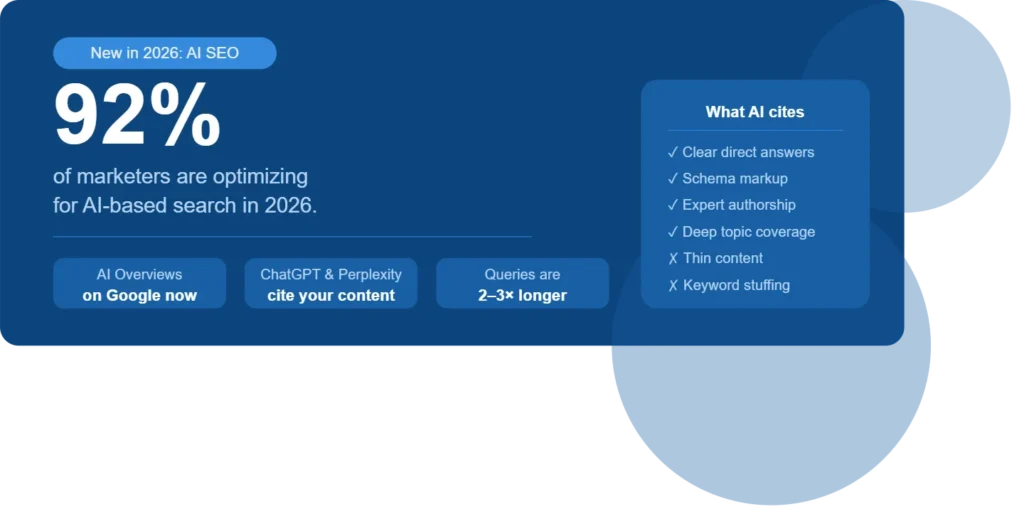
What it is: Optimizing content to appear in AI-generated search summaries, Google’s AI Overviews, ChatGPT, Perplexity, and other AI-powered answer engines.
This is the newest and fastest-evolving type of SEO in 2026. When someone asks Google a question and gets an AI-generated summary at the top of the page, that summary is drawn from sources Google’s algorithm has deemed trustworthy, authoritative, and well-structured. Getting your content into those summaries requires a different kind of optimization.
Key AI SEO tactics:
- Clear, structured answers, direct responses to specific questions, not buried in paragraphs
- Schema markup, helping AI systems understand what your content represents
- High E-E-A-T signals AI systems heavily favour content from demonstrably expert sources
- Concise, quotable passages, AI summarizers pull clean, self-contained sentences
- Comprehensive topical coverage, AI tools cite sources that cover topics deeply
While almost a quarter of all marketers have already adapted their strategies to ChatGPT, Gemini, or Claude, over 92% plan to optimize for both traditional and AI-based search systems. In the UAE, where digital adoption is among the fastest globally, this shift is already underway.
11. Technical Content Optimization: Structured Data and Schema
What it is: Adding machine-readable code to your pages so search engines understand not just the text, but what it represents.
Schema markup tells Google: “This isn’t just text about a restaurant, this is a Restaurant entity with a name, location, cuisine type, price range, and opening hours.” That understanding enables rich results: star ratings, FAQ dropdowns, event listings, product prices, all visible directly in search results.
Common schema types valuable for UAE businesses:
- LocalBusiness, for any physical location
- FAQPage for question-and-answer content
- Review / AggregateRating, for businesses with customer reviews
- Product for e-commerce pages
- Article, for blog and news content
- RealEstateListing highly relevant for Dubai’s property sector
How the Types of SEO Work Together
Each type of SEO is a layer. They don’t operate in isolation; they amplify each other.
A business with excellent content SEO but poor technical SEO has pages that Google can’t fully crawl. A business with perfect technical SEO and no off-page authority ranks below competitors with more backlinks. Local SEO without on-page optimization for location terms misses the intent signals that trigger map pack appearances.
The sequence that works for most UAE businesses starting from scratch:
- Technical SEO first, fix what’s blocking Google from finding you
- On-page SEO, optimize existing pages for the right keywords and intent
- Local SEO claim and optimize your Google Business Profile
- Content SEO, build topical authority through consistent, high-quality content
- Off-page SEO earn backlinks as your content builds a reputation worth linking to
- Voice and AI SEO, layer in newer optimization techniques as foundations solidify
Frequently Asked Questions About Types of SEO
What are the main types of SEO?
The core types are on-page SEO, off-page SEO, and technical SEO. Beyond those three foundations, there are content SEO, local SEO, mobile SEO, international SEO, e-commerce SEO, voice search SEO, and AI/generative engine optimization, each addressing a different dimension of how search engines evaluate and rank websites.
Which type of SEO should a UAE business focus on first?
For most UAE businesses, local SEO delivers the fastest visible results, particularly Google Business Profile optimization. Technical SEO is the essential foundation, and on-page SEO for location-specific keywords follows closely. The right starting point depends on your current state: a site with technical errors needs those fixed before anything else can work.
What is the difference between on-page and off-page SEO?
On-page SEO covers everything within your website, content, keywords, meta tags, internal linking, and page structure. Off-page SEO covers everything outside your website, primarily backlinks from other sites, digital PR, and brand mentions. Both are necessary; neither alone is sufficient.
Is Arabic SEO different from English SEO in the UAE?
Yes, meaningfully so. Keyword research produces different results in Arabic and English; search behaviour and phrasing differ, and content needs to be culturally adapted rather than just translated. Right-to-left text rendering also has technical implications for site structure. Bilingual SEO in the UAE requires a separate strategy for each language, not a simple translation layer.
How long does SEO take to show results in the UAE?
Technical fixes and Google Business Profile optimization can show improvements within 4–6 weeks. Content SEO and link building compound over 3–6 months. Competitive keywords in markets like Dubai real estate or legal services can take 9–12 months of consistent effort to crack. SEO is not a campaign; it’s a long-term investment that builds compounding returns.
What is AI SEO, and does it matter in 2026?
AI SEO (also called Generative Engine Optimization or GEO) is the practice of optimizing content to appear in AI-generated search answers, Google AI Overviews, ChatGPT, and Perplexity. It matters significantly in 2026 because AI summaries now appear at the top of many Google search result pages, above traditional rankings. Businesses whose content isn’t structured for AI citation are invisible in an increasingly prominent part of the search experience.
Are there types of SEO that can hurt my rankings?
Yes. Black-hat SEO techniques, keyword stuffing, buying links, cloaking, and hidden text can result in Google penalties that dramatically reduce or eliminate your rankings. In competitive UAE markets, the short-term gains from manipulative tactics are far outweighed by the risk of long-term visibility loss.