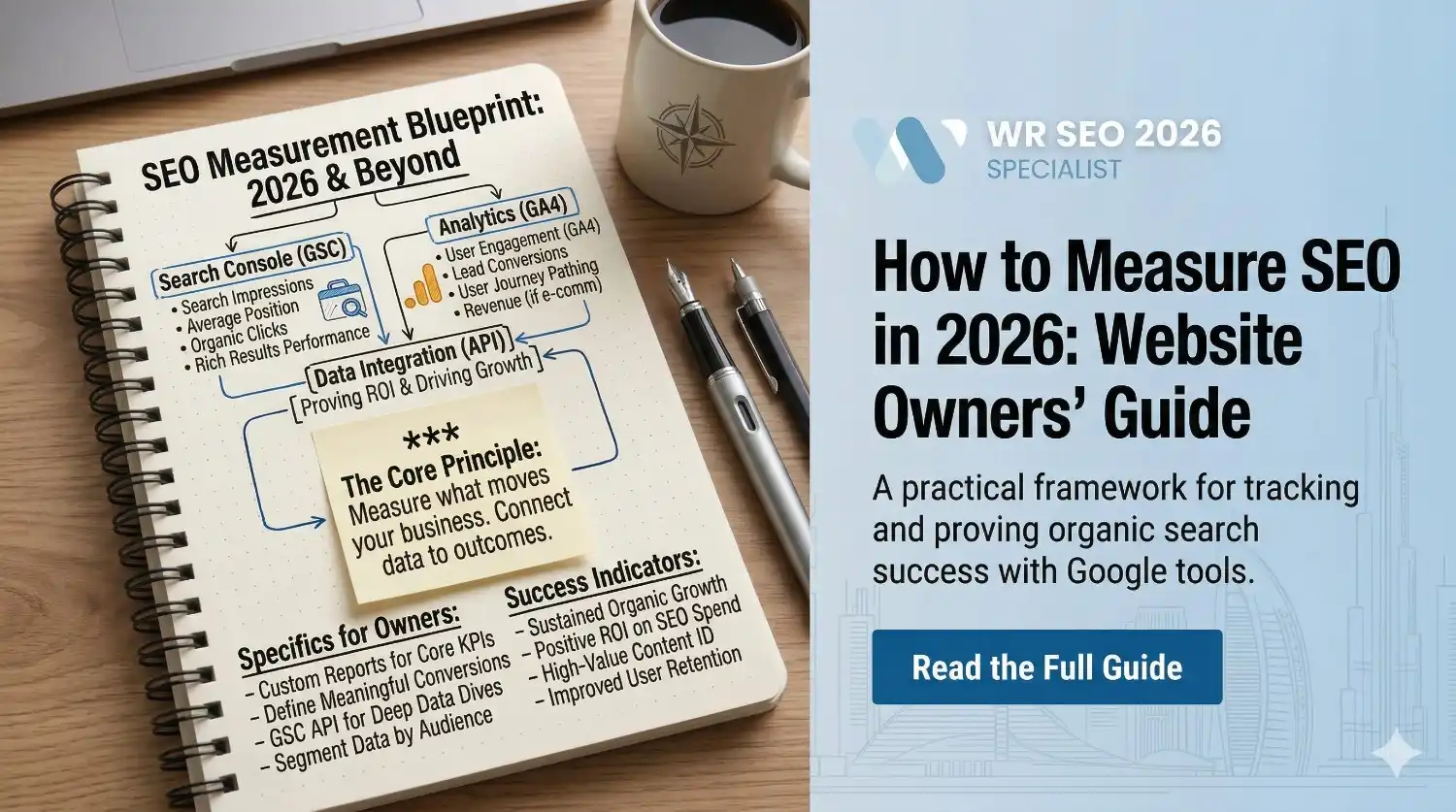
How to Measure SEO in 2026: Website Owners’ Guide
A lot of website owners are looking at reports that say things are “fine” while the business says otherwise. Traffic looks steady. Some rankings still look decent. But leads, calls, and revenue feel stuck.
That gap is not your imagination. Search changed. AI features can reduce clicks without removing your visibility, and Pew found that traditional result clicks were lower when an AI summary appeared. Google also says traffic from AI features like AI Overviews and AI Mode is included in overall Search Console web reporting, so “search traffic” now carries more meaning than it used to.
That is why this guide is not about tracking more numbers just to feel busy. It is about how to measure SEO in a way that helps you make better decisions. We are going to look at what belongs in Search Console, what belongs in GA4, what belongs in your sales data, and how to stop building a strategy around weak or misleading signals.
Before you choose better KPIs, you need to see why the old ones fail.
Why measuring SEO in 2026 requires a shift beyond clicks
Clicks still matter. They are just no longer enough.
A search can now shape a buying decision without sending a visit right away. Some searches end on the results page. Some searches push people into branded searches later. Some pages influence revenue even though they never become the last click before a sale.
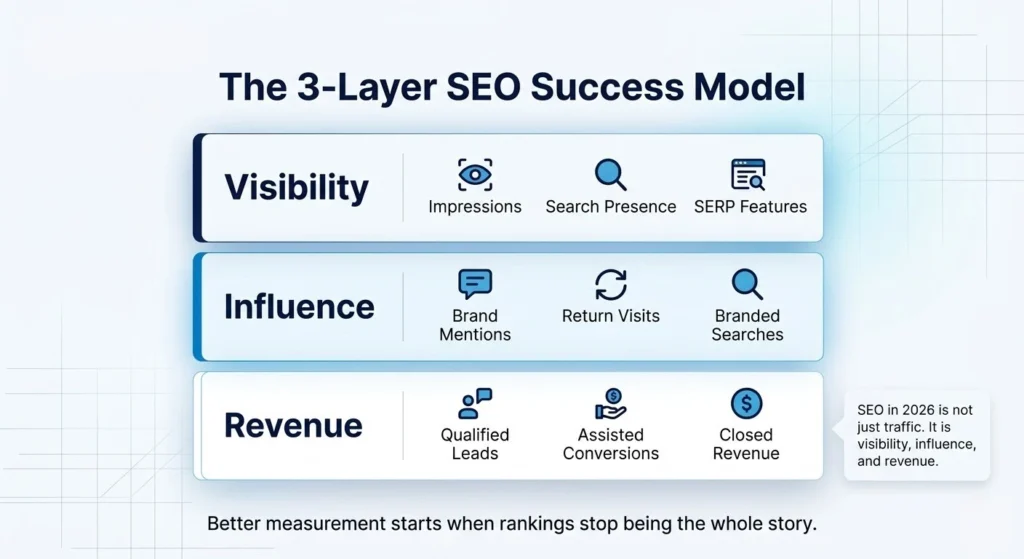
That means SEO in 2026 has to be measured across three layers: visibility, influence, and revenue.
The rise of zero-click searches and AI-driven discovery paths
Zero-click means a user gets enough information on the search page and does not visit your site. That can happen through AI summaries, People Also Ask, snippets, maps, community answers, and other rich results.
This changes reporting because traffic can fall while visibility stays strong. Discovery may happen on Google, Reddit, forums, or AI tools first, then turn into brand recall later. Google’s guidance on AI features explains that AI Overviews and AI Mode can surface relevant links, use query fan-out across related subtopics, and are counted within overall Search Console web traffic.
Why traffic can drop while leads and revenue stay stable
This is the part that confuses many owners. Fewer clicks can still lead to steady results if the lower-value visits disappear first and the stronger-intent visitors still make it through.
Sometimes, AI search strips away casual browsing and leaves behind people who already know what they want. Sometimes, better brand trust brings users back later through direct traffic or a branded search. Sometimes the website gets fewer visits but better ones.
So if sessions dip a little while qualified leads stay healthy, do not panic first. Read the full picture.
Understanding mindshare as the new SEO success indicator
Mindshare is how often your brand or topic shows up where people research.
That can show up in branded searches, mentions, AI citations, community discussions, repeat visits, or people searching for you after seeing your name elsewhere. It is not fluff. Mindshare often shows up before pipeline and revenue growth. When your brand keeps appearing in the right conversations, you are earning attention even before the click lands on your site.
Core SEO metrics every website owner must track in 2026
Think of this as the minimum dashboard. Not the giant dashboard. The minimum useful one.
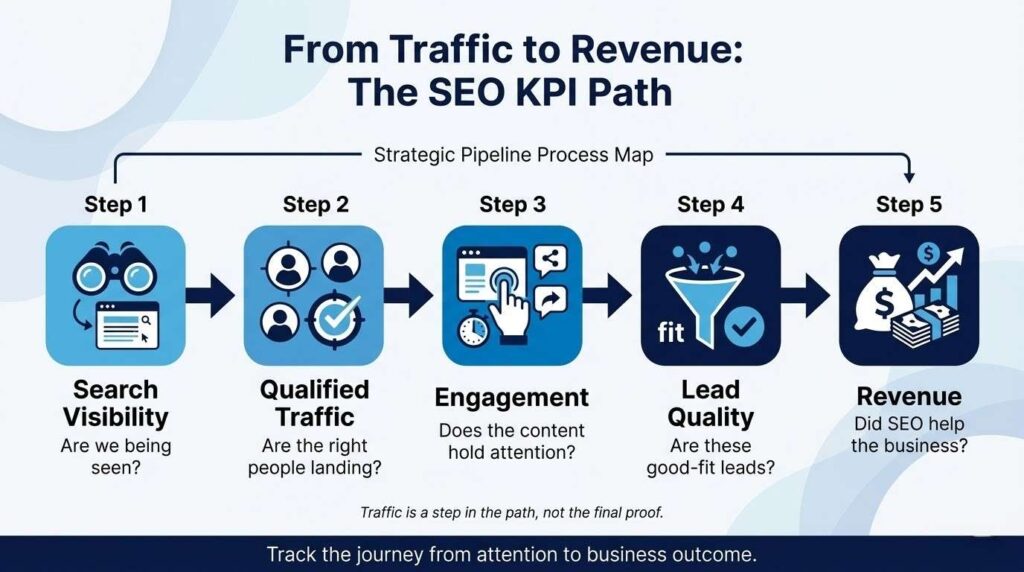
You need metrics that show whether you are being seen, whether the right people are arriving, whether they are engaging, and whether the business is gaining something real.
Organic traffic vs qualified traffic: measuring real value
Organic traffic is every unpaid visit from search. Qualified traffic is the part of that traffic that fits your business and has a real chance to become a lead, sale, or customer.
That is the difference that matters. Not every visitor is useful. Some keywords pull curiosity. Others pull buyers. You spot qualified traffic through conversion rate, time on key pages, return visits, lead quality, and whether the visitor lands on the right type of page in the first place.
Keyword visibility across SERP features and AI results
Ranking is no longer just a blue-link game. Visibility now can mean standard rankings, featured snippets, People Also Ask, local packs, AI summaries, and other result types.
So when you track keyword performance, do not ask only, “Where do we rank?” Ask, “Where do we appear, and how much attention does that appearance actually get?”
Engagement signals that reflect content quality and relevance
Engagement tells you whether the visit meant something. Did the visitor stay, scroll, interact, return, or move toward the next step?
The most useful signals here are engagement rate, scroll depth, CTA interaction, return visits, and page-level conversion behaviour. Those signals do not replace revenue, but they help confirm whether the content matched the searcher’s need.
Why click-through rate is now a secondary performance metric
CTR still matters, but it is no longer the final score.
Low CTR can mean a weak title. It can also mean the wrong page type, a SERP feature pushing your result down the screen, or a mismatch between the query and your content. So CTR works best when it sits next to impressions, search intent, and conversion data, not when it stands alone.
Measuring SEO success across visibility, influence, and revenue
This three-layer model is the cleanest way to judge SEO in 2026.
Visibility asks: are we being seen?
Influence asks: are we shaping perception and trust?
Revenue asks: is the business actually gaining from this?
That is a much better model than “rankings up or down.”
Leading indicators: visibility, impressions, and search demand
Leading indicators are early signs that movement is happening before revenue appears.
These include impressions, non-brand keyword growth, branded search growth, and shifts in search demand. They matter because they help you diagnose change early. If branded searches rise before leads rise, that may be the first sign that your content is building awareness.
Influence metrics: brand mentions, return visits, and trust signals
Influence is where SEO often gets underrated. It shows up in brand mentions, repeat organic visitors, branded searches, newsletter signups, and time spent on trust-building pages such as pricing, case studies, or About pages.
These are not “soft” because they are weak. They are “soft” because they happen earlier. They tell you whether content is shaping how people think before they are ready to buy.
Lagging metrics: conversions, revenue, and pipeline impact
Lagging metrics are the proof that arrives later. These include qualified leads, assisted conversions, closed revenue, and pipeline created.
You need them. But you should not read them without the earlier layers. Revenue is the final proof. It is not always the first clue.
How to measure SEO performance beyond website clicks
This is where many reports still fall short. They stop at the site. Your buyers do not.
People discover brands in community threads, AI summaries, forum answers, and recommendation loops long before they visit the website. That means off-site discovery is part of SEO measurement now.
Tracking brand mentions across Reddit, forums, and AI summaries
Brand mentions matter more now because people compare options in public. AI systems also often pull from public discussions and cited pages, which means a mention can shape interest before it ever sends a click.
What you want to track is mention frequency, sentiment, context, and recurring questions tied to your brand or service. If those mentions are growing, awareness may be building before your traffic chart shows it.
Identifying traffic leaks to AI overviews and community platforms
A traffic leak is when the topic still gets searched, but attention flows somewhere else first.
You can spot this through high impressions with lower clicks, rising branded searches without matching landing-page traffic, or community pages dominating the journey for your core topics. The point is not to panic. The point is to understand where search attention is going and how your brand can still benefit from being part of that path.
Using off-site visibility as an early demand signal
More mentions, more comparisons, and more category-level discussion can all signal future search demand.
This matters a lot for local businesses, emerging service categories, and B2B offers where buying cycles are longer. Sometimes the conversation grows before the traffic does.
Measuring keyword performance without obsessing over rankings
Keyword tracking still matters. The obsession does not.
Your goal is not to stare at a rank tracker all day. Your goal is to understand reach, intent fit, visibility quality, and where the next opportunity lives.
Impression share analysis: how often you appear in search results
Impression share is a simple idea: how often your pages appear for the searches that matter.
This is often more useful than isolated rank checks because it shows presence at the topic level. Segment it by topic, page type, branded queries, and non-branded queries. That is how you see whether your visibility is growing in the areas that matter most.
Click-through rate by query type: measuring content relevance to search intent
Review CTR by query type, not as one blended average.
Informational queries behave differently from commercial ones. Transactional queries behave differently from branded ones. If CTR is weak on one query type, that usually means the page is not matching the searcher’s intent or the result is not compelling enough in that SERP.
Branded vs non-branded keyword traffic: understanding your market reach
Branded traffic is traffic from people already looking for you. Non-branded traffic is traffic from people looking for a need, problem, or category.
Branded growth is useful because it often signals stronger trust. But non-branded growth is usually the better signal of market expansion. If branded traffic is the only thing rising, awareness may be improving while new reach is not.
Long-tail keyword performance: the 80/20 rule of organic traffic
Long-tail keywords are more specific searches with clearer intent.
They matter because they are often easier to win and more likely to convert. Many sites get strong business value from a wide spread of long-tail queries instead of a few giant vanity terms. So look for patterns and clusters, not just one big trophy keyword.
Query intent match: are you ranking for the right searches?
Wrong rankings are real. You can rank well and still attract the wrong visitor.
This is where you compare conversions, engagement by query theme, and landing-page fit. If a page gets clicks but no action, it may be ranking for curiosity instead of buyer intent.
Position distribution: why average position hides your real opportunities
Average position hides too much. A smarter view is to break terms into position groups: 1 to 3, 4 to 10, and page-two terms that are close to breaking through.
That is how you find almost-winning pages. And almost-winning pages are often cheaper to improve than starting from zero.
Measuring topical authority and content influence in 2026
Topical authority means your site is seen as a trusted source across a subject, not just for one page.
That matters more now because both search engines and AI systems reward connected, useful coverage. This is one of the smartest areas to measure because it helps you move from isolated page thinking to subject-level thinking.
How topic clusters expand your search presence beyond rankings
One topic cluster can hold more search real estate than one stand-alone page.
Measure how many ranking terms exist across the cluster, how many total impressions the subject earns, and whether support pages are helping the pillar page become stronger. That beats page-by-page tunnel vision because it shows how the system is working together.
Measuring content coverage instead of individual page performance
Ask a simple question: do we cover the full topic, or just one slice of it?
You can assess this through question coverage, subtopic completeness, and whether the cluster addresses multiple intent layers. This is where good SEO starts to look more like content strategy and less like page publishing.
Tracking inclusion in AI answers and knowledge panels
Inclusion in AI answers or knowledge-style surfaces can build trust even without a click.
What you want to monitor is whether your brand, your topic, or your entities keep appearing, and whether the same themes show up again and again. That is a useful influence metric, especially for brands trying to build authority in a niche.
Conversion-centric SEO: aligning marketing with business outcomes
This is the money section.
Traffic is not a strong success standard if it never turns into a pipeline. But revenue should not be used carelessly either. The smartest view is balanced: revenue is the final proof, and leading indicators help you manage the path.
Why many experts now prioritize revenue over traffic metrics
The debate is simple. Some people only care about money. Others care far too much about traffic.
The stronger position sits in the middle. Revenue is the final proof. But if you ignore leading indicators, you lose your chance to fix problems before revenue drops.
Tracking direct and assisted conversions from organic search
A direct conversion is when the organic gets the final credit. An assisted conversion is when SEO is helped earlier in the path.
Both matter. Blogs, guides, and comparison pages often look weak in last-click reports and strong in assisted-conversion views. That is one reason judging SEO only at the last touch gives a distorted picture.
Measuring lead quality instead of just lead quantity
More leads is not always better. Better leads are better.
Lead quality can be measured through close rate, sales acceptance, deal size, and time to close. If SEO sends more form fills but the sales team rejects them, the channel did not really improve.
Technical SEO health metrics website owners can’t afford to ignore
Technical metrics matter when they affect visibility, trust, and conversion. Not when they just make a report look smart.
Indexation status: how many pages Google actually knows about
If a page is not indexed, it cannot compete.
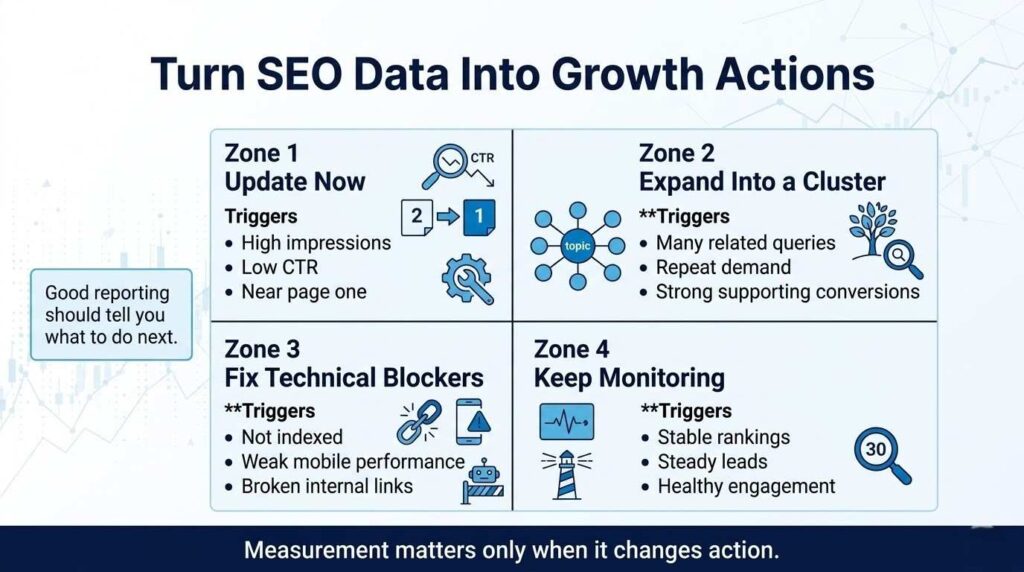
This sounds basic, but it is still one of the clearest signals of SEO health. Weak indexation often points to content quality issues, crawl problems, or poor internal linking.
Crawl errors and 404 monitoring: finding and fixing broken user experiences
Crawl errors and 404s break both discovery and trust.
Search engines waste effort on broken paths. Users hit dead ends. This is one of the most action-ready technical KPI groups because fixing it usually improves both usability and discoverability.
Core Web Vitals score: LCP, INP, and CLS impact on rankings
Core Web Vitals now focus on LCP for loading, INP for responsiveness, and CLS for visual stability. Google announced that INP replaced FID as the responsiveness metric in March 2024, so FID should now be treated as legacy context, not the current standard.
These metrics matter because they reflect whether the page feels stable and usable. A page that loads slowly, responds poorly, or shifts around on the screen leaks trust fast.
Mobile usability issues: identifying problems that block mobile traffic
Mobile friction still costs traffic and conversions. Tap targets, broken layouts, awkward forms, and poor responsive behaviour can damage performance even when the desktop looks fine.
This is not just a technical checklist. It is a customer-experience checklist.
HTTPS security and mixed content warnings: trust signal monitoring
Mixed content means a secure page still loads insecure elements. That weakens confidence and can trigger warnings or subtle trust loss before the user even reads the offer.
For many sites, trust drops faster than rankings do.
Site speed by page template: homepage vs product vs blog performance
Do not rely on one sitewide speed score. Compare templates.
Homepages, blogs, service pages, and product pages often perform differently because they carry different assets and user expectations. That is how you find the templates that are leaking revenue.
Advanced visibility metrics most website owners ignore
Modern visibility is about screen space and attention, not only rank.
Share of voice across SERP features and search real estate
Share of voice shows how much presence your brand has across the results page for a topic.
That includes snippets, local packs, AI features, video results, image results, and classic web results. A site that wins multiple surfaces may dominate attention without “ranking first” in the old sense.
Measuring pixel visibility instead of ranking position
Pixel visibility is a simple idea: where do you actually appear on the screen?
A rank-one result can still sit far below a large AI box, a map, or a snippet. So measuring screen presence is often more realistic than measuring position alone.
Tracking branded search growth as a demand indicator
More brand searches often signal rising trust, awareness, or recommendation momentum.
That is why branded-search growth can act as an early success signal before conversion growth fully shows up in the pipeline.
Engagement depth: the hidden metric behind SEO performance
Ranking gets the visit. Depth helps prove relevance.
This section matters because people often misunderstand dwell time and overstate it. Even so, real engagement still tells you whether the page did its job.
Measuring scroll depth, session quality, and content interaction
Scroll depth, CTA interaction, video plays, tool usage, and deeper page movement all help show whether the visit was meaningful.
Use them together. A long session with no action can still be weak. A short session with a key click can be strong.
Why dwell time alone is misunderstood but engagement still matters
Dwell time gets overused in SEO talk. People treat it like a secret ranking lever when it is really a rough behavior clue.
The healthier view is this: engagement matters because it helps you judge fit, clarity, and usefulness. It is not magic. It is evidence.
Identifying content that builds trust and retains users
Trust-building content often earns repeat visits, longer interaction, more branded searches later, and stronger movement into sales pages.
That is the content you want to spot, protect, and connect to money pages.
How to track SEO impact across multiple channels and touchpoints
SEO rarely works alone.
In 2026, search often supports email, direct, paid, and social traffic rather than replacing them. That is why multi-channel measurement matters.
Measuring assisted conversions in multi-channel journeys
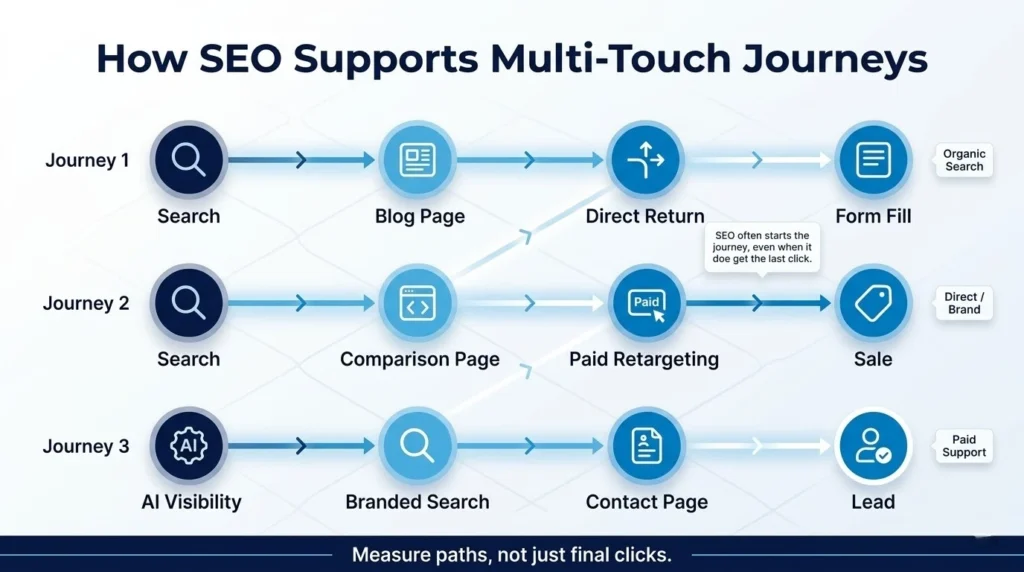
Assisted conversions show when SEO supports a conversion path, even if another channel gets the final credit.
This helps you see the real value of discovery-stage content.
Understanding SEO’s role in supporting paid and direct traffic
SEO often warms the user before they click an ad or come back directly. When that happens, the channel is still influencing the outcome, even if it does not own the last click.
That support should count in decisions.
Mapping user journeys from discovery to conversion
Common journeys might look like this: search to blog to direct return to form fill, or search to comparison page to paid retargeting to sale.
When you map those paths, SEO starts to look like a system rather than a single-session source.
Measuring SEO performance in AI search and zero-click ecosystems
Zero-click search is not the death of SEO. It is a measurement problem for people still using old reports.
Tracking visibility in AI overviews and search generative results
Visibility here means asking whether your brand, page, or topic shows up in AI-led search experiences.
That is not easy to track perfectly yet, but it still belongs in your measurement model because presence shapes demand even when clicks stay low.
Measuring citation frequency in AI-generated answers
Citation frequency is how often your content, brand, or themes get referenced across AI-generated responses.
Repeated citation matters because it builds familiarity, trust, and topic association. This is an influence KPI, not a traffic KPI.
Understanding value from searches that never result in clicks
Some searches never produce a site visit but still create value through future branded searches, direct visits, local actions, or assisted conversions.
That is why session counts alone are too narrow for modern SEO measurement.
Real-world SEO measurement framework used by experts in 2026
The strongest teams do not stare at one tool and one number. They blend visibility, behaviour, and revenue.
Combining Search Console, Analytics, and revenue data together
Search Console shows search visibility. GA4 shows user behaviour. CRM or revenue data shows business outcomes.
When you put those together, hidden value becomes visible. That is how you find topics that influence revenue even when they do not win a last-click report.
Building a unified dashboard for SEO decision making
A useful dashboard includes visibility, engagement, conversions, revenue, and alerts.
It should help you act, not impress you with size. If a dashboard does not change what your team does next, it is decoration.
Identifying which topics drive conversions despite low traffic
Some low-traffic pages quietly support valuable decisions.
These are often the most overlooked winners on a site. They may not bring huge sessions, but they help the right users convert.
Common SEO measurement mistakes that mislead website owners
A few mistakes distort strategy again and again.
Obsessing over CTR while ignoring demand and visibility trends
CTR can fool teams when demand shifts or the SERP changes shape.
That is why CTR should be read in context, not worshipped on its own.
Treating SEO and sales as separate instead of connected systems
When SEO and sales live in separate worlds, measurement weakens. Marketing celebrates traffic. Sales complains about lead quality. No one sees the full story.
Shared reporting fixes that.
Measuring page performance without context of user intent
The same numbers mean different things on different page types.
A blog, a service page, and a landing page should not all be judged the same way. Page purpose must shape KPI interpretation.
How to turn SEO data into actionable growth strategies
Data matters only when it changes action.
Identifying high-impact pages to update instead of creating new
Pages with strong impressions, weak CTR, near-page-one rankings, or visible decay are often better update targets than net-new pages.
That is where small work can create big movement.
Using data to expand winning topics into full content clusters
When one topic shows repeat demand, many related queries, and strong conversion support, it may deserve a full cluster.
That is how SEO data becomes content strategy.
Scaling content that builds authority, not just traffic
Authority scaling means building more around what already proves trust and value. That is different from publishing more pages just to inflate output.
The future of SEO measurement: from traffic to influence and trust
The best SEO measurement systems now capture both search visibility and brand influence.
Why SEO success in 2026 is about authority, not just rankings
The shift is from page-level wins to topic-level trust.
Authority lasts longer than one ranking jump because it supports multiple queries, multiple paths, and multiple conversion moments.
The role of brand trust in organic search performance
Trust shows up in higher branded demand, stronger CTR in the right moments, more repeat visits, and better conversion rates.
That is not abstract. It changes outcomes.
Preparing for a search ecosystem dominated by AI and discovery
The practical checklist is simple: track visibility beyond clicks, connect SEO to revenue, monitor trust and brand demand, and build dashboards that support decisions.
The winners will be the teams that measure influence, not just traffic.
Finally
You do not need fifty dashboards and one hundred KPIs.
You need a small, clear system that tells you whether people can find you, whether they trust what they find, and whether that attention turns into real business value.
That is how to measure SEO in 2026. Not by clinging to one number. By reading visibility, influence, and revenue together.
If you want help building that kind of scoreboard, WR SEO Specialist can help turn scattered reports into a cleaner measurement system that shows what is really growing, what is quietly leaking value, and where the next smart move should be.
FAQs
What is the most important SEO metric in 2026?
There is not one single best metric. The strongest setup combines visibility, engagement, conversions, and revenue so you can see both early signals and real business outcomes.
Why can my traffic drop while leads stay stable?
Because lower-value clicks may disappear first while stronger-intent users still convert. AI features and richer search results can also reduce casual clicks without removing discovery.
Should I still track keyword rankings?
Yes, but use rankings as context, not as the final score. Visibility by query type, intent fit, CTR, and conversions give a much clearer picture.
How do I know if SEO is helping sales?
Look at assisted conversions, lead quality, close rate, branded-search growth, and how organic visitors move through the pipeline over time.
What tools should website owners use to measure SEO properly?
At minimum, use Search Console for visibility, GA4 for behaviour, and a CRM or lead tracking system for outcomes. That combination gives you a much fuller view than any one tool alone.