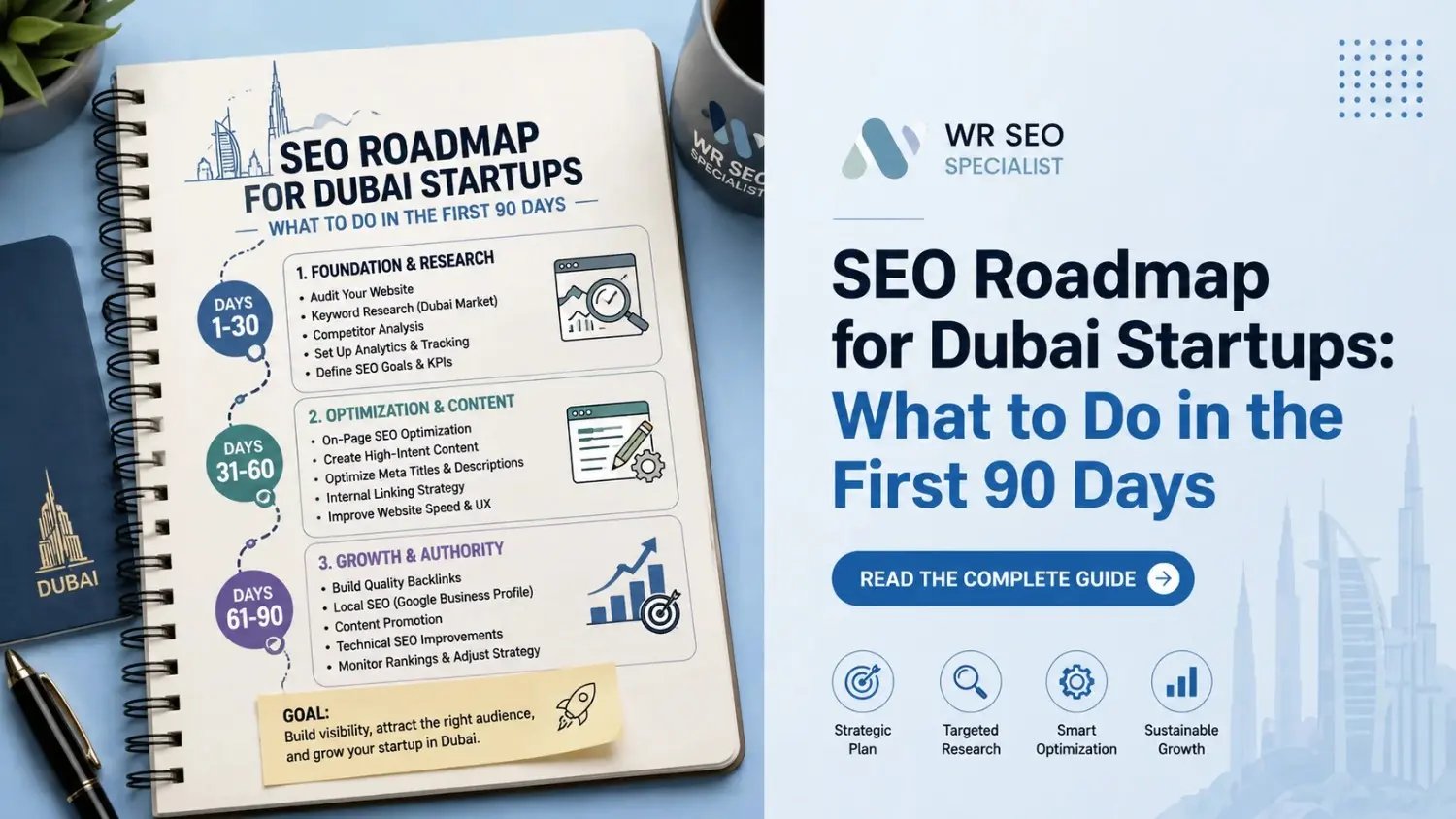
SEO Roadmap for Dubai Startups: What to Do in the First 90 Days
Launching a startup in Dubai means doing ten things at once. In the first 90 days, you are setting up the brand, getting the site live, figuring out paid channels, and trying to prove that real demand exists for what you are offering. SEO is often either rushed or left to one side until things settle down. Neither approach works.
This guide is not a generic SEO roadmap pulled from a Western market playbook. It is built around the real constraints of a Dubai startup: a lean team, limited time, a competitive local market, and the pressure to show early traction. By the end, you will know exactly what to prioritize, what to delay, and which signals actually tell you that progress is happening.
Why Dubai Startups Need a 90-Day SEO Roadmap
Most new businesses treat SEO like a shopping list. They add tasks when time allows and hope it adds up to something. It does not. A startup with limited capacity needs a focused plan that connects SEO directly to business outcomes, not just traffic numbers.
In Dubai, the stakes around early visibility are different from most markets. Local buyers and B2B decision-makers search with strong intent, often filtering by location, service type, and language. According to BrightEdge research, organic search drives over 53% of all trackable web traffic across industries. If your site is invisible during those early months, you are handing ground to competitors who were simply ready earlier. SEO is not a standalone task either. It sits inside your broader digital marketing effort and connects to your content, paid campaigns, and brand positioning. Treating it that way from the start is what separates startups that gain search traction quickly from those still waiting for results a year later.
Days 1-15: Set Up Site Data and Technical SEO
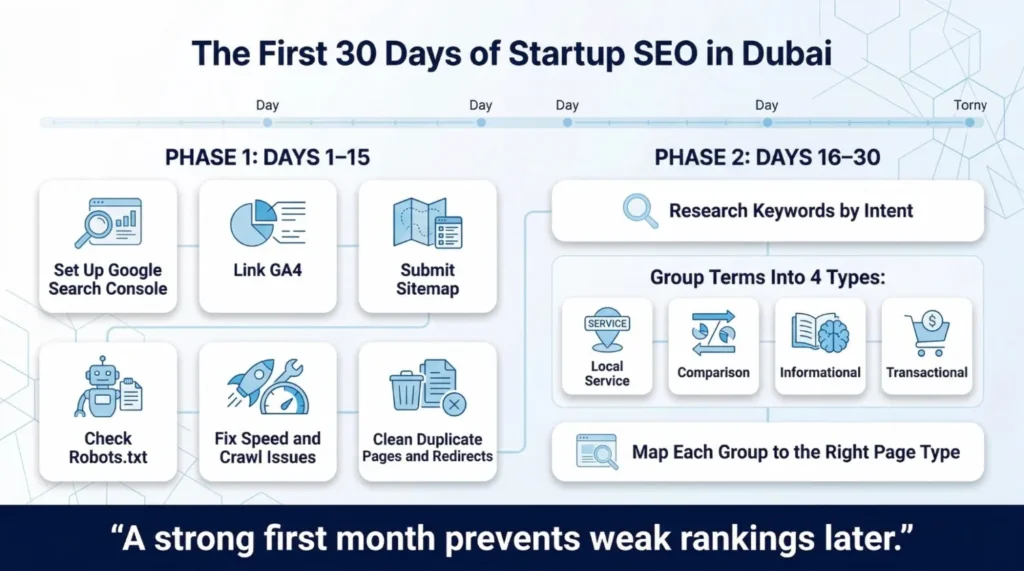
Before you publish a single blog post or optimize a single heading, get your measurement layer right. Set up Google Search Console and link it to GA4. Submit your sitemap and confirm your key pages are being indexed. Check your robots.txt to make sure nothing important is accidentally blocked.
Then run a basic technical review. Look at page speed on mobile, because a large share of Dubai searches come from smartphones. Check for broken redirect chains, duplicate page issues caused by www and non-www versions, and thin pages being crawled unnecessarily. Fix structural problems first. If the foundation is cracked, everything built on top underperforms. This phase is not glamorous, but getting it right in the first two weeks means the rest of the roadmap runs cleanly.
Days 16-30: Map Keywords to Pages That Matter
Keyword research for a startup should not be about finding every possible term in your industry. It should be about matching real user intent to the pages you actually need to build or improve. Group your target keywords into four intent categories. Local service terms are searches like “IT support company in Dubai” or “accountant Business Bay” where someone wants a nearby provider. Comparison terms are for users still evaluating options. Informational terms support content and trust-building. Transactional terms are the closest to a conversion and deserve the sharpest early focus.
Map each group to a specific page type. Local service terms go to location-specific service pages. Comparison terms might suit a service overview or a comparison guide. Transactional terms go to your core service or product pages. When keywords are mapped to the wrong page, or worse, to no page at all, search engines have nothing to rank and users land somewhere that does not answer their question. This mapping step makes every piece of work that follows more effective.
Days 31-45: Build Core Pages for Early Search Wins
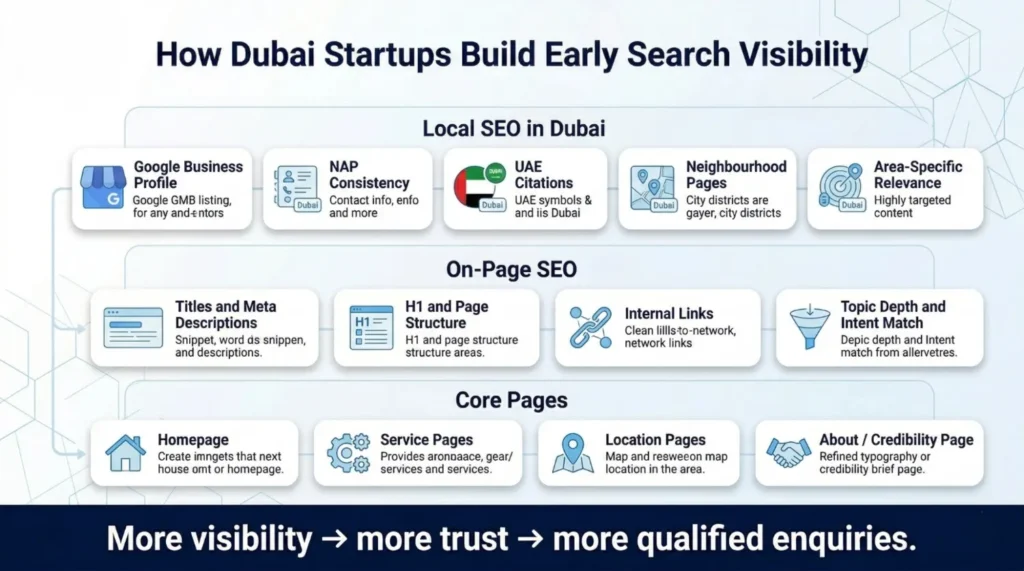
Content blogging can wait. The pages that drive early trust, traffic, and conversions are your core site pages, and they need to be strong before you publish anything supporting them. Your homepage needs to make your offer clear within seconds, use primary search terms naturally, and connect to your main service pages. Service pages need to match the search intent of buyers who are ready to enquire, not just browse.
If your startup operates across multiple Dubai areas, location-specific pages for districts like Downtown, JLT, or DIFC help you show up in searches that carry strong local intent. Your about page is a credibility signal, not an afterthought. Buyers in Dubai check it before they make contact. Build these pages for the person reading them, structure them with clear headings, and make sure they answer the real questions your target customer would type into Google.
Days 46-60: Improve On-Page SEO and User Experience
Once the core pages are live, the next step is to sharpen them. On-page SEO at this stage means making sure the right signals are clear on each page. The title tag uses the primary term naturally. The meta description gives a real reason to click. The H1 matches what the page is actually about. Internal links connect related pages in a way that makes sense to both users and search engines.
Go deeper than surface keywords. Think about the broader context of each page. A service page about web design in Dubai should naturally include terms around timelines, pricing models, and the industries you serve, not because someone told you to include them, but because a real buyer expects to find that information there. This is what builds page-level depth that search engines reward. According to Google’s guidance on ranking systems, content that serves the user completely and accurately is what performs over time, not content chasing individual terms in isolation.
Days 61-75: Grow Local SEO Visibility in Dubai
This phase is where your startup starts to build real local search presence. Start with your Google Business Profile. Claim it, complete every section, choose the right categories, and upload real photos of your team, office, or work. An incomplete profile is a missed opportunity that competitors will happily take advantage of.
NAP consistency matters more than most startup teams realize. Your business name, address, and phone number need to match exactly across your website, your GBP, and every directory where you are listed. Inconsistencies reduce the trust signals your local listing sends. Build citations in relevant UAE directories, and if your startup serves specific neighbourhoods or free zones, create pages that speak directly to those areas. For a full picture of what this work involves in a Dubai context, the Local SEO services in Dubai page covers GBP optimization, citations, area-specific content, and local keyword targeting in a way that maps closely to what early-stage businesses here actually need.
Research from Google confirms that 76% of people who conduct a local search on their smartphone visit a related business within 24 hours. Getting your local presence right in this phase is not optional. It is what turns search visibility into real footfall and enquiries.
Days 76-90: Publish Content and Track Real Results
By now, your technical setup is clean, your core pages are strong, and your local presence is growing. This is the right time to add supporting content, not a flood of blog posts, but a small cluster of focused articles that answer the real questions your target buyers ask before they decide to work with someone.
Think in topic clusters. A startup offering HR consultancy in Dubai might publish three or four articles around employment contract requirements, visa processes for new hires, and the differences between free zone and mainland employment rules. Each article links back to the relevant service page. This is how topical authority starts to build, and it is how you generate the kind of search visibility that converts. For a clear picture of what realistic early traction looks like in UAE search conditions, the guide on how to get fast SEO results in UAE is worth reading alongside this roadmap.
Which SEO Metrics Matter Most in the First 90 Days
Raw traffic numbers can be misleading in the early months. Fifty daily sessions that bounce immediately tell you nothing useful. Here is what to actually track:
- Indexed pages: Are your core pages being found and indexed correctly?
- Impressions and clicks: Are target pages appearing in results for the right queries?
- Click-through rate: Are your titles compelling enough to earn a click when you appear?
- Branded search lift: Are people searching for your company name? This signals growing recognition.
- Local actions on GBP: Calls, direction requests, and website clicks from your Business Profile are meaningful early indicators.
Assisted conversions: Did organic search play a role in a lead or sale, even if it was not the final touchpoint?
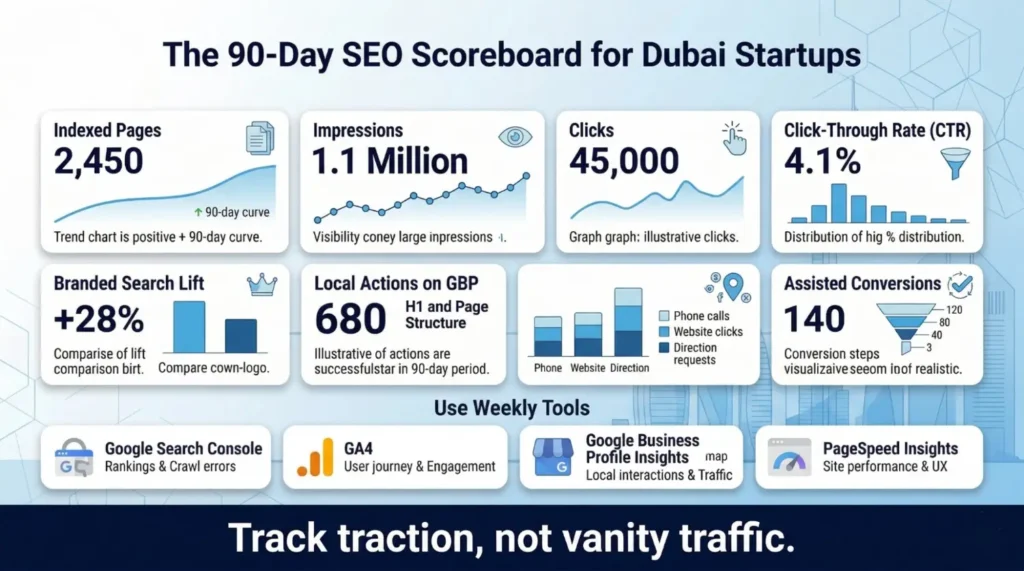
Use Google Search Console and GA4 as your primary tools. They are free, accurate, and give you the page-level data you need without any added cost in the first quarter.
Free SEO Tools for Lean Startup Teams
You do not need a full-stack paid SEO platform in your first 90 days. Google Search Console gives you indexing data, query performance, and page-level impressions. Google Business Profile insights show how people are finding your local listing and what actions they are taking. PageSpeed Insights shows exactly where your site is losing performance on mobile. For keyword and SERP research, Google’s own autocomplete, People Also Ask results, and related searches give you a real signal without a subscription. Use these tools weekly. They provide the feedback loop you need to catch problems early and confirm that the work you are doing is moving in the right direction.
Common SEO Mistakes That Slow Early Growth
Several patterns keep coming up when startup SEO stalls in the first quarter. Targeting broad, high-volume keywords too early means competing against established brands with years of authority, almost always without result. Publishing blog content before the core service pages are built means that supporting content has nothing strong to link back to. Weak technical setup, missing sitemaps, slow mobile load times, and unindexed pages mean the work above the surface has no foundation to stand on. Measuring total sessions instead of query-level impressions and conversions leads to decisions based on noise rather than the real signal. And hiring an SEO agency before the startup has a clear brief and a baseline to measure against is one of the most common ways to waste a first-quarter budget.
Local SEO for Free Zone and Mainland Startups
The local SEO approach depends partly on how the business is registered. Free zone companies often cannot serve clients directly within the UAE mainland, which affects which location signals and service areas make sense to build. Mainland businesses can target a broader geographic range and should build out district-level pages where search volume supports it. Service-area businesses operating across multiple Dubai neighbourhoods should list those areas clearly and create separate pages where the intent is strong enough. Google’s guidance on improving local ranking is clear that relevance, distance, and prominence are the three factors that determine local visibility, and all three can be worked on from day one, regardless of business structure.
When to Hire an SEO Specialist or Agency
In the first 30 days, most founders can handle technical setup and keyword mapping with the right guidance. Between days 30 and 60, if the team is stretched or the strategy feels unclear, bringing in an SEO specialist for a focused engagement, not a full retainer, can accelerate the core page work significantly. By day 60, if organic impressions are growing and early clicks are coming through, that is the point where a longer relationship with an SEO expert or agency starts to make financial sense. What you need from any provider is transparency: clear reporting, a documented approach, and work tied to your actual business goals, not generic monthly tasks.
Final 90-Day SEO Roadmap Strategy for Startups
The full action sequence in order: fix technical SEO covering indexing, speed, structure, and tracking; map keywords by intent to the right page types; build core pages for home, services, locations, and credibility; improve on-page SEO across titles, headings, depth, and internal links; strengthen local visibility through GBP, NAP consistency, citations, and area pages; publish focused supporting content once the foundation is solid; track indexed pages, impressions, clicks, local actions, and assisted conversions throughout.
Good startup SEO is not about doing everything. It is about doing the right things in the right order, with enough focus to see real movement before the first quarter ends. According to Google’s content guidelines, the sites that perform well consistently are the ones that were built for the reader first. If you want a team that understands both the pace of startup growth and the specific conditions of the Dubai search market, WR SEO Specialist works with early-stage businesses to build SEO strategies that move fast without cutting corners.
Frequently Asked Questions
1. What should a Dubai startup do for SEO in the first 90 days?
Start with technical setup, keyword mapping, and core page optimization before anything else. Local visibility through Google Business Profile should come in weeks six to eight. Supporting content comes last. The order of steps matters more than how fast you move through them.
2. How long does SEO take to show results for a new startup?
Impressions and early clicks can appear within four to six weeks if technical setup is correct and core pages are indexed. Ranking consistently for competitive terms typically takes three to six months. The 90-day roadmap builds the foundation that makes faster growth achievable, not immediate shortcuts.
3. Should a startup focus on local SEO or content SEO first?
For most Dubai startups, local SEO comes first. If you serve a physical area or operate from a Dubai office, local search visibility produces faster and more relevant traffic than broad content SEO. Content supports local SEO, but core pages and GBP optimization come before blogging.
4. What are the most important SEO essentials in month one?
Google Search Console setup, sitemap submission, mobile speed review, and crawlability checks. These are the basics that everything else depends on. Getting them right in the first two weeks prevents significant problems down the road.
5. Which SEO metrics matter most in the first 90 days?
Indexed pages, impressions per target query, click-through rate, branded search volume, and local actions from Google Business Profile. These show whether your pages are being found, whether they are relevant, and whether they are generating real business interest.
6. Do Dubai startups need Google Business Profile early?
Yes, and setting it up in the first two weeks is worth the time. Even if the profile does not generate calls immediately, completing it accurately builds the foundation for local ranking as reviews and profile activity grow over the following months.
7. Can free SEO tools support a startup SEO roadmap?
Completely. Google Search Console, Google Business Profile insights, and PageSpeed Insights cover most of what a startup needs in the first 90 days. Paid tools become more useful once you have baseline data and a clear sense of where the real gaps are.