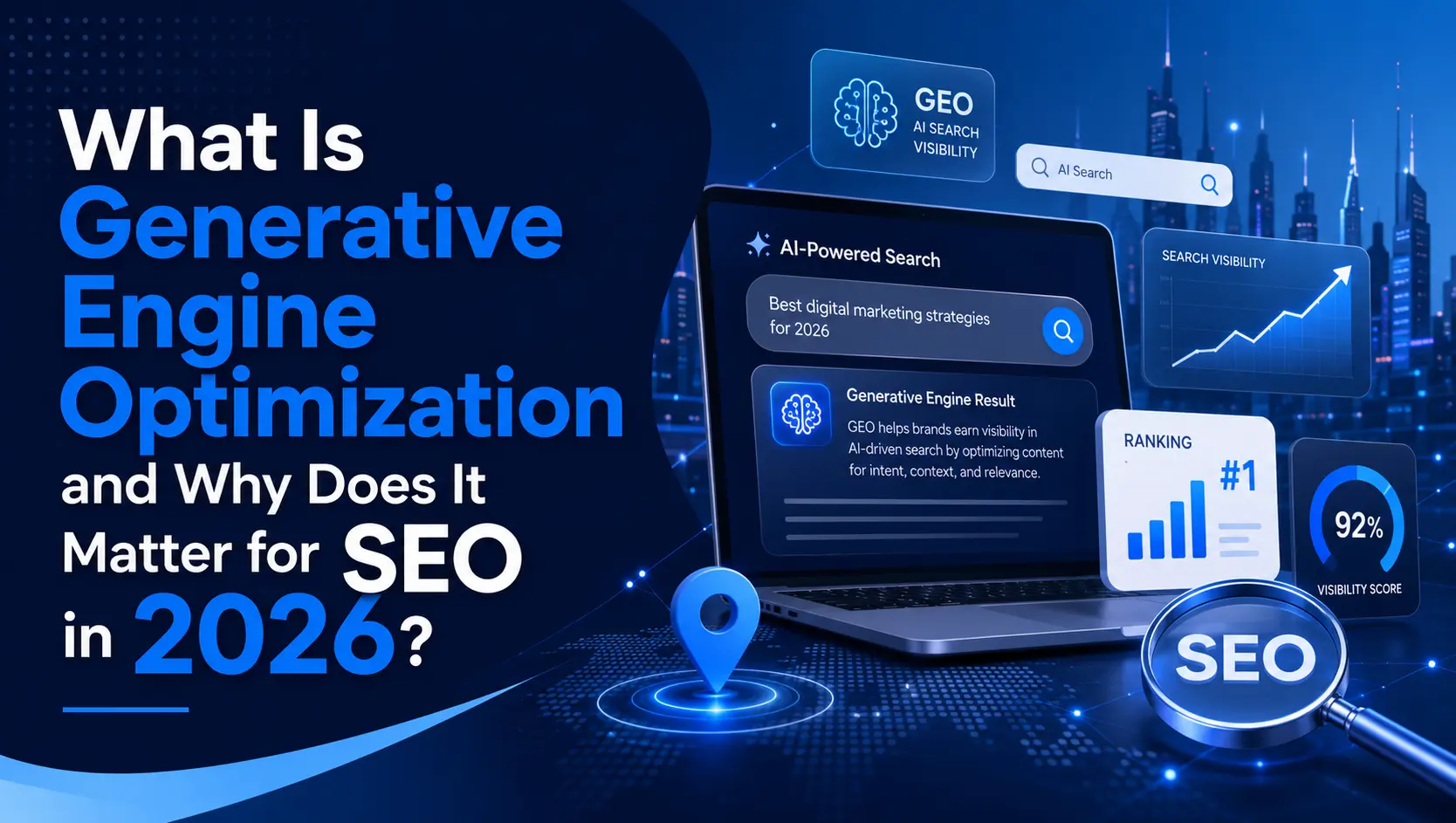
What Is Generative Engine Optimization and Why Does It Matter for SEO in 2026?
Generative Engine Optimization (GEO) is the practice of structuring your content so that AI-powered search tools, like Google AI Overviews, ChatGPT, and Perplexity, cite your website in the answers they generate for users.
“SEO is focused on earning a visit, while GEO is focused on earning a place in the answer. Being named and accurately characterized is, of course, the best way to be represented in a query.”
Wendi Lu, Chief Marketing Officer at Martinsen Global, Forbes Communications Council (Forbes, February 2026)
That single shift in definition carries enormous consequences for every business, marketer, and content creator operating online in 2026. Traditional SEO earned you a ranked link. GEO earns you a mention, a citation inside an answer that millions of users read without ever clicking away. The rules have changed.
This guide explains exactly what GEO is, why it matters right now, and what you can do about it.
The Search Landscape Has Fundamentally Changed
For nearly three decades, getting found online meant ranking on the first page of Google. Users typed short keywords, scanned a list of blue links, and clicked through to websites. That model worked, and it worked well, until it didn’t.
The numbers tell the story clearly:
- Gartner predicted in February 2024 that traditional search engine volume will drop 25% by 2026, with search marketing losing market share to AI chatbots and virtual agents. (Gartner, 2024)
- By May 2025, 69% of news-related Google searches ended with zero clicks to any website, up from 56% just one year earlier, according to Similarweb’s zero-click research.
- As of mid-2025, approximately 5.6% of all U.S. searches were conducted using AI-powered LLMs as the primary tool, according to the Wall Street Journal.
- AI referral traffic to U.S. retail sites surged 693% year-over-year during the 2025 holiday season. (Adobe Digital Insights, January 2026)
- Over 1.5 billion monthly users now interact with Google’s AI Overviews.
The click-based web isn’t dead. But it is shrinking, fast. And the traffic that remains is increasingly flowing through AI-generated answers, not ranked lists of links.
What Is Generative Engine Optimization (GEO)?
Generative Engine Optimization is the discipline of optimizing your content to appear as a cited, trusted source inside AI-generated responses. Instead of chasing a position in a ranked list, you are competing to be the source an AI draws from when it synthesizes an answer.
The term was formally coined and academically validated by researchers at Princeton University, IIT Delhi, Georgia Tech, and the Allen Institute for AI in a peer-reviewed paper presented at the ACM SIGKDD Conference on Knowledge Discovery and Data Mining (KDD 2024). Their research, the first large-scale academic study of its kind, tested content strategies across 10,000 queries and found that specific GEO techniques could boost visibility in AI-generated responses by up to 40%. (Aggarwal et al., ACM KDD 2024)
The key insight from the Princeton study: adding statistics improved AI citation rates by 41%, including quotations boosted visibility by 28%, and lower-ranked pages that cited external authoritative sources saw up to 115% improvement in AI visibility. In other words, the tactics that make content more credible to humans also make it more citable to AI.
GEO vs. Traditional SEO: The Core Differences
| Factor | Traditional SEO | Generative Engine Optimization (GEO) |
|---|---|---|
| Goal | Rank in a list of links | Be cited in an AI answer |
| Success metric | Click-through rate (CTR) | Citation frequency |
| Query type | Short keywords (3–4 words avg.) | Conversational questions (23 words avg.) |
| Primary signals | Backlinks, keywords, authority | Credibility, specificity, original data |
| Visibility location | SERP position 1–10 | Inside synthesized AI responses |
The average ChatGPT prompt is 23 words long, compared to 3 to 4 words for a traditional Google search. That structural difference alone changes how content must be written.
Why GEO Matters So Much in 2026
1. AI-Referred Traffic Converts Far Better
This is the stat that should stop any marketer in their tracks: visitors arriving from AI-generated citations convert at 4.4x the rate of traditional organic search visitors, according to ConvertMate’s benchmark study of 12,500+ queries across 8,000 domains (March 2026). A separate analysis found that AI-referred visitors convert at 14.2% on average, versus 2.8% for Google organic traffic.
These are not casual browsers. When a user asks ChatGPT “which CRM is best for a 50-person team?” and your brand is cited in the answer, that user is already close to a decision. They are not at the top of the funnel, they are at the bottom.
2. AI Overviews Now Appear on Millions of Queries and Most Citations Come from Outside the Top 10
According to Conductor’s analysis of 21.9 million queries, AI Overviews now appear in 25.11% of all Google searches, up from 13.14% in March 2025. More importantly: 83% of AI Overview citations come from pages that do not rank in the organic top 10. (ConvertMate, 2026)
That is a complete reversal of traditional SEO logic. GEO is a genuine leveling-of-the-playing-field opportunity, smaller or newer sites that create credible, specific, data-rich content can outcompete established domains for AI citation even when they cannot outrank them in search results.
3. Zero-Click Search Has Crossed a Threshold
In 2025, 58.5% of U.S. searches ended without any click to an external website. When AI Mode is active, 93% of search sessions end without a website visit. This is no longer a fringe behavior, it is the default for millions of people. Your click-through rate from traditional rankings is being structurally compressed.
The implication is unavoidable: if your content is not appearing in AI-generated answers, you are becoming invisible to a rapidly growing share of your potential audience.
4. McKinsey Research Confirms the Buyer Behavior Shift
A McKinsey study from 2025 estimated that 44% of consumers now use AI as their primary information source for purchasing decisions. For B2B, the shift is even more dramatic 90% of B2B buyers now integrate generative AI at some point in their buying journey. (Walker Sands, 2025)
What Google Says About GEO (The Official Position)
It’s worth being direct about Google’s stance, because it matters for how you prioritize.
Google’s Search Central documentation, updated in June 2026, officially acknowledges GEO and AEO as terms used to describe optimization for AI search experiences. However, Google’s position is clear: “From Google Search’s perspective, optimizing for generative AI search is optimizing for the search experience, and thus still SEO.” (Google Search Central, June 2026)
Google explicitly states that its AI features, including AI Overviews and AI Mode, are powered by the same core ranking and quality systems as traditional Search. They use Retrieval-Augmented Generation (RAG), meaning they pull from the same indexed web pages that Google has always evaluated.
What Google says you do NOT need to do for GEO:
- Create llms.txt files or special AI markup
- “Chunk” your content into small pieces
- Rewrite content specifically for AI systems
- Seek inauthentic “mentions” across blogs or forums
What Google says does matter:
- Unique, non-commodity content with a genuine point of view
- Technical crawlability, if Google can’t index it, AI can’t cite it
- Clear structure, organized paragraphs, headings that guide readers
- High-quality images and video where appropriate
- Content that satisfies users, not just algorithms
This alignment between GEO and good SEO is the most important practical takeaway from Google’s official guidance.
How to Optimize for Generative Engines: A Practical Framework
Structure Your Content to Answer Conversational Questions
AI engines process full-sentence questions, not short keywords. Structure your pages around the kinds of questions users actually ask, who, what, why, how, when. Use clear H2 and H3 headings that directly mirror common query patterns.
Lead with Original Data, Statistics, and Named Sources
The Princeton research found statistics are the single most powerful GEO signal improving AI citation rates by 41%. AI systems are trained to synthesize credible, verifiable information. Pages that include:
- Original research or proprietary data
- Named studies with author and institution attribution
- Specific numbers (percentages, dollar figures, timeframes)
- Quotes attributed to real, named experts
…are structurally more likely to be cited than pages that paraphrase general knowledge without attribution.
Build Topical Depth, Not Just Keyword Density
83% of AI Overview citations come from pages outside the organic top 10. What those pages tend to have in common is genuine topical depth, they answer the full question, not just the surface-level keyword. According to ConvertMate’s 2026 benchmark, pages above 20,000 characters receive 4.3x more AI citations than shorter pages on the same topic.
This does not mean padding your content with filler. It means covering adjacent questions, adding context, addressing objections, and providing the kind of complete answer a knowledgeable human expert would give.
Maintain Technical Crawlability
This is the often-overlooked foundation of GEO. According to Google’s official AI optimization guide, a page must be indexed and eligible to appear in Google Search with a snippet in order to be eligible for AI Overviews. No index, no citation.
Technical GEO checklist:
- Confirm pages are indexed via Google Search Console
- Ensure robots.txt is not blocking AI crawlers (Googlebot, GPTBot, ClaudeBot, PerplexityBot)
- Check Core Web Vitals, slow pages are less likely to be retrieved
- Eliminate duplicate content that dilutes crawl authority
- Use semantic, readable HTML structure
The One Thing Most GEO Guides Don’t Tell You: The “Bland Tax”
Here is something the majority of GEO content leaves out, and it is directly relevant to your strategy.
The Princeton researchers who defined GEO also acknowledged a parallel risk: AI homogenization. When every piece of content follows the same optimization tactics, adding statistics, citing sources, using authoritative language, generative engines begin collapsing it all into composite answers that reference no single source.
The practical implication: generic content that follows every GEO tactic will still lose to specific content that follows the same tactics. If your page sounds like it could have been written by anyone (or any AI), it offers no distinct citation value.
The antidote is what some researchers call escaping the “Bland Tax”, creating content that is not just authoritative and structured, but distinctively and irreplaceably authoritative.
That means first-person experience, proprietary data, named expert quotes, case-specific examples, and opinions that take a clear position. AI systems are increasingly rewarding content that is uniquely yours, and cannot be approximated by a synthesis of everything else on the internet.
Is Traditional SEO Dead?
No. And it is important to be honest about this.
Google remains, by volume, vastly larger than any AI search tool. Google search is estimated to be 373 times larger than ChatGPT search by query volume (WordStream, 2026). AI chatbots and virtual agents currently represent approximately 3% of total information search traffic (. The Gartner 25% decline prediction is a scenario model, not a certainty, and even a 25% decline still leaves the world’s most dominant search index handling the overwhelming majority of queries.
The right framework in 2026 is a hybrid SEO + GEO strategy:
- Traditional SEO remains the foundation, it feeds the same index that AI Overviews draw from
- GEO tactics layer on top, ensuring your content is structured, specific, and credible enough to be synthesized and cited
- Together, they maximize visibility across both traditional and AI-mediated search experiences
Only 28% of marketers are currently trained in GEO, while 57% of professionals say they require AI training. The gap between urgency and readiness is your competitive opportunity.
Frequently Asked Questions
What is the difference between GEO and AEO?
GEO (Generative Engine Optimization) and AEO (Answer Engine Optimization) are closely related and often used interchangeably. GEO is the term defined by academic research and tends to refer specifically to optimization for AI-powered generative search tools. AEO is a broader term sometimes used to include featured snippets and voice search. In practice, the optimization tactics for both overlap significantly.
Does GEO replace SEO?
No. According to Google’s own Search Central documentation (June 2026), optimizing for generative AI search is still fundamentally SEO. The same core practices, crawlability, helpful content, strong technical structure, underpin both. GEO extends and refines traditional SEO rather than replacing it.
How do I know if my content is being cited by AI tools?
Test your key queries directly in ChatGPT, Perplexity, and Google AI Overviews. Note which sources are cited. Tools like BrightEdge, Semrush, and emerging GEO monitoring platforms are also building AI citation tracking into their dashboards.
Do I need to create a llms.txt file for GEO? A
ccording to Google’s official guidance, no, you do not need to create llms.txt files or any special AI markup to appear in Google’s AI features. Some marketers still recommend llms.txt for non-Google AI tools as a way of communicating content structure, but it is not required by any major AI search platform.
How long does GEO take to show results?
GEO visibility tends to respond faster than traditional SEO ranking changes, because it is citation-based rather than position-based. Updated content can begin appearing in AI-generated responses within days of being re-indexed. That said, building consistent AI citation authority is a medium-to-long-term process.