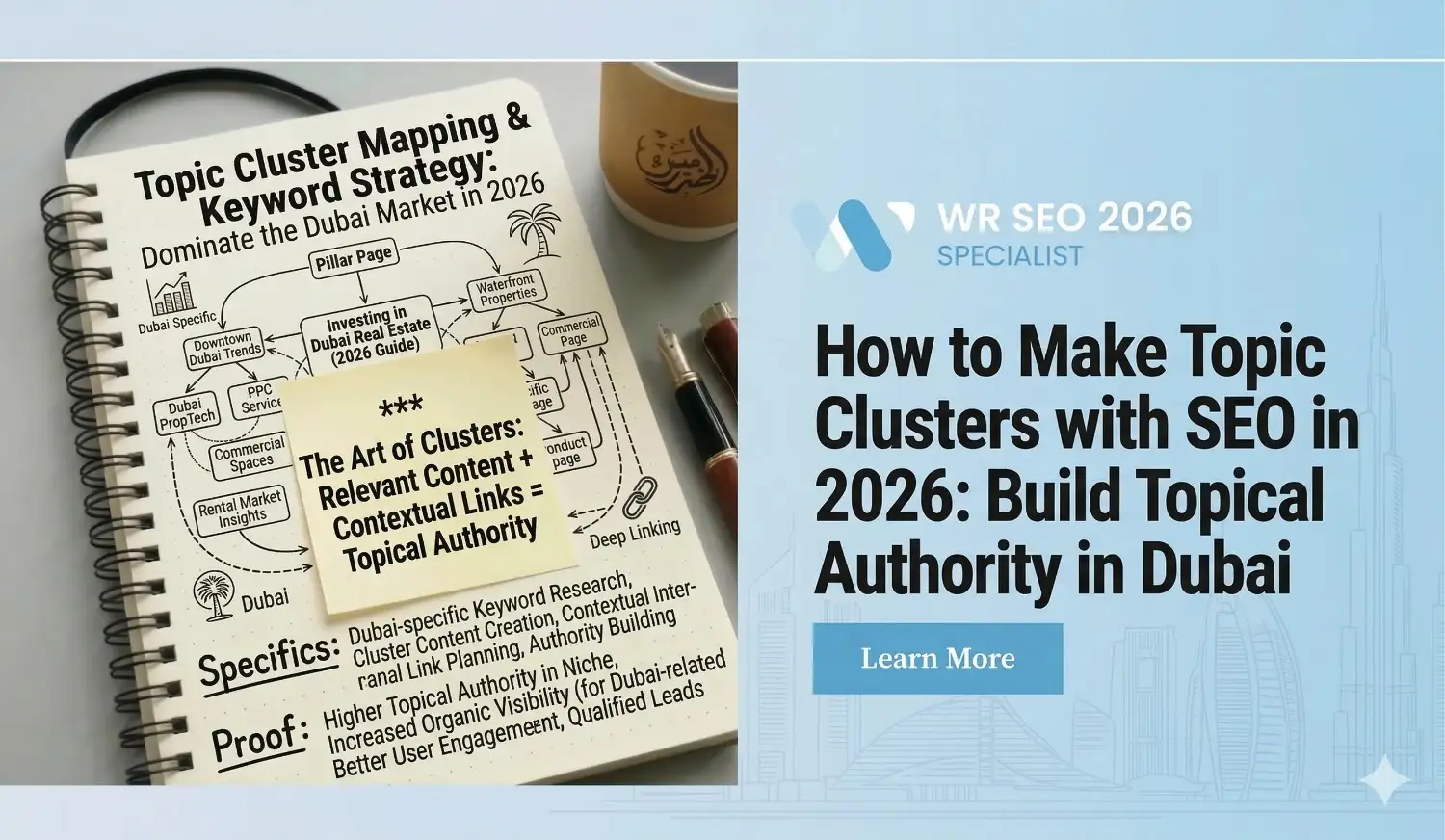
How to Make Topic Clusters with SEO in 2026: Build Topical Authority in Dubai
A lot of businesses keep publishing blog after blog and still wonder why rankings barely move. The problem is often not effort. The problem is that the content is scattered.
Search engines have become much better at judging whether a site covers a subject deeply, not just whether one page repeats a keyword. In the UAE, that matters even more because digital use is extremely high. DataReportal reports 11.3 million internet users in the UAE, with internet penetration at 99.0 percent in late 2025. That means Dubai businesses are competing in a very crowded online space.
This guide shows you how to turn loose ideas into a connected topic cluster system that builds trust, rankings, and leads. You will learn what topic clusters are, why they matter now, and how businesses in Dubai can use them to build stronger visibility than competitors who still publish random one-off posts.
Why Topic Clusters Matter More For SEO in 2026
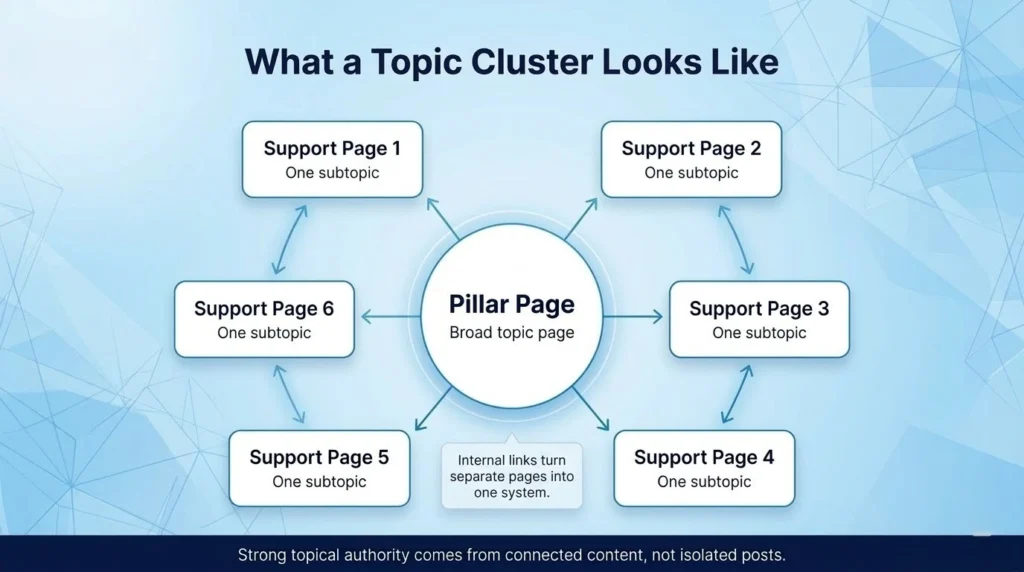
A topic cluster is a pillar page plus related supporting pages connected through smart internal links.
That matters now because isolated pages feel weaker, while connected content feels more complete. Search engines can understand the full subject better when your pages support each other instead of sitting alone. The goal is not to publish more blogs. The goal is to build better topic coverage.
How modern search rewards topic depth over loose keywords
Modern search systems reward content that is helpful, reliable, and built for people. Google says its ranking systems are designed to prioritize helpful, reliable information created to benefit people, not pages created mainly to manipulate rankings.
In simple terms, one page can answer one question. A cluster can answer the whole topic around that question. That creates a stronger signal of topical authority over time.
Why one-off blog posts are losing power over time
The old habit was simple: pick one keyword, write one post, publish it, then move on.
That approach breaks down because pages start competing with each other, users do not know where to click next, and the site feels thin even when it has many posts. A stronger model is a content ecosystem where pages support one another and build a full topic map around one bigger theme.
Why Dubai businesses need stronger content systems now
Dubai is crowded, fast, and highly competitive. Buyers compare many options before they act. They often move from learning to comparing to contacting in a short time. A site with a clear cluster system helps them move through that journey without getting lost.
Understanding The Simple Structure Behind Topic Clusters
Every strong cluster has three core parts: a pillar page, supporting cluster articles, and internal links.
The strength does not come from one page alone. It comes from how these pages work together.
What a pillar page is and why it leads the whole cluster
A pillar page is a broad, central page that covers the main topic.
Its job is to introduce the topic, organize the subtopics, and point readers toward deeper pages. If your pillar page is “Local SEO in Dubai,” your support pages might cover Google Business Profile, local citations, review strategy, and local landing pages.
What makes a supporting cluster page useful and rankable
A support page should not repeat the pillar page. It should answer one subtopic clearly, go deeper than the pillar page, and link back naturally.
Each support page needs a clear job. It should answer one question well and move the reader toward the next useful page.
How internal links turn separate pages into one system
Internal links are what make a cluster feel connected instead of scattered.
The ideal flow is simple. The pillar page links to the main support pages. Support pages link back to the pillar page. Related support pages link to one another when that next step helps. Google says it uses links as a signal for relevance and to find new pages to crawl, and it recommends clear anchor text so people and Google can understand the destination page.
How Search Intent Should Shape Your Topic Clusters
Search intent is what the person wants right now.
That matters before you write because intent decides the page type, the angle, and the next step. A cluster works best when it covers the full path, not just the first question.
Mapping informational, commercial, and transactional intent
Informational intent means the person wants to learn. Commercial intent means they want to compare. Transactional intent means they want to act.
In a healthy cluster, informational pages usually sit near the top, commercial pages help in the middle, and transactional pages connect to service pages or money pages.
Understanding search behaviour in tough markets like Dubai
In competitive markets like Dubai, people often search, compare, and contact fast. Some pages need to be educated. Some need to compare options. Some need to push action. Local modifiers, urgency, and brand trust all shape this journey.
Turning intent data into better cluster topic ideas
You can pull intent clues from Search Console, search results, customer questions, sales calls, and paid search terms. Then sort those ideas into pillar topics, support articles, comparison pages, and conversion pages.
That simple sorting step keeps the cluster useful and prevents random publishing.
How To Find Pillar Topics That Can Carry Real Authority
Not every keyword deserves a pillar page.
A good pillar topic usually has broad demand, many related subtopics, long-term usefulness, and clear relevance to your business.
Using keyword gaps to uncover strong pillar opportunities
Keyword gap analysis means finding topics that competitors cover that you do not.
The goal is not to copy them. The goal is spotting broad topics with enough room for support pages. That is how you uncover cluster opportunities instead of single-page ideas.
Choosing evergreen topics that can support many pages
Evergreen topics stay useful for a long time. They make strong pillars because they can support multiple support pages and are worth updating.
In Dubai or the UAE, examples might include VAT registration, local SEO for service businesses, e-commerce product page SEO, or family law process content.
Balancing search volume with real authority potential
A big search volume number is not enough. You also need relevance, intent fit, cluster depth, and business value.
The real question is simple: can this topic support a full content system, or only one page?
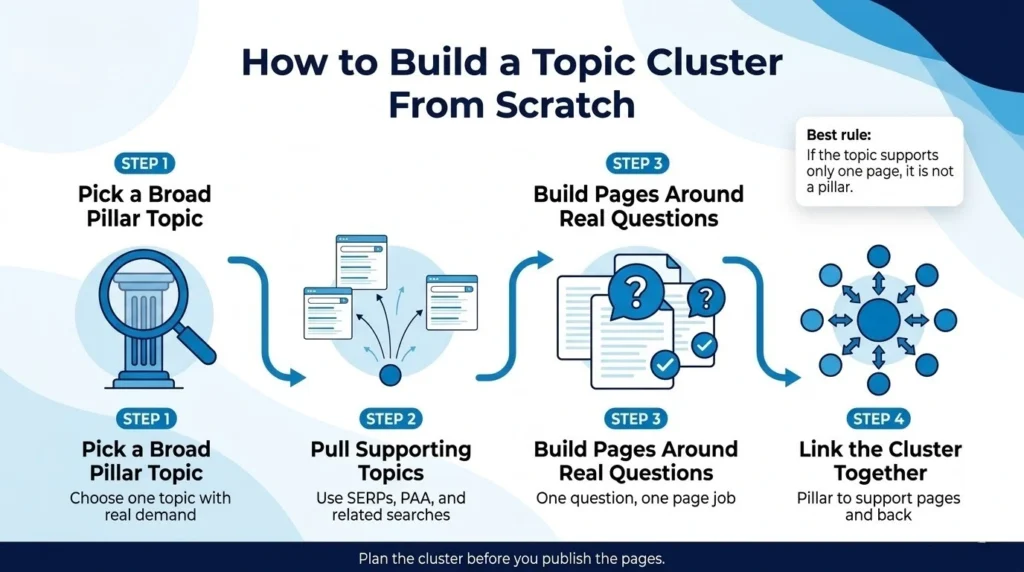
A Step-By-Step Process For Building a Topic Cluster
This is the practical part. Each step builds on the last one so the cluster feels planned, not random.
Step 1: Pick a broad pillar topic with real demand
Start with one broad search theme, not a tiny keyword.
A good checkpoint is this: if the topic can only support one article, it is probably not a pillar. Strong pillar topics usually have many related questions, several intent layers, and clear business relevance.
Step 2: Pull supporting topics from the search results
Search results are a clue map. Use People Also Ask, related searches, autocomplete, and competitor subheadings to find support topics.
Do not copy them word for word. Turn them into subtopics that fit your audience and your business.
Step 3: Build pages around real user questions and pain points
Good cluster pages answer real questions, not just target terms.
Use support chats, sales calls, FAQs, search tools, and forums to find the questions people actually ask. Then keep page planning simple: one question, one page job, one useful next step.
Step 4: Build the internal linking system that holds it together
The linking pattern should stay clear. Pillar to every major support page. Support pages back to the pillar. Related support pages linked laterally when helpful.
Use descriptive anchor text. Do not overload pages with links that do not help the reader.
Semantic SEO and Entity Mapping For Stronger Topic Clusters
Semantic SEO means helping search engines understand topic relationships, not just repeated words.
This is where clusters get stronger and more complete.
How search engines use entities to connect related topics
Entities are things like people, places, brands, services, products, and topics.
When your content clearly connects related entities, the cluster feels more coherent. That helps search engines see clearer relationships across pages.
How entity SEO can make a cluster more relevant
You can strengthen a cluster by naturally mentioning related services, places, brands, categories, and subtopics. Use consistent language across the cluster so the pages feel connected, not stitched together.
Natural topic depth is helpful. Robotic repetition is not.
Which tools help uncover semantic topic relationships
Use Google suggestions, People Also Ask, keyword tools, entity or NLP helpers, and competitor content maps. Record repeated subtopics, related entities, and missing angles. That will help shape your topic map before you publish.
Why Content Depth Beats Random Content Volume Now
Publishing many weak posts does not equal authority.
Why 50 random blog posts rarely build real authority
Random posts often create scattered topics, weak links, repeated intent, and no clear pillar. The site may look busy, but it does not feel trustworthy or complete.
How depth and context build stronger authority signals
Depth means answering the topic fully, covering the useful subtopics, adding examples, and linking to the next helpful pages. That gives both users and search engines a clearer signal that your site understands the subject.
How to cover a topic fully without rambling
Complete does not mean long for no reason. It means the main question is answered, the key subtopics are covered, comparisons are included when helpful, and the next step is clear.
Better Internal Linking Strategies For Topic Cluster SEO
Weak internal linking can ruin a good content plan.
How the hub-and-spoke model works in simple terms
The pillar page acts as the hub. The support pages act as the spokes.
This model works because it creates structure, keeps the topic centred, and helps users move naturally from broad understanding to deeper answers.
Contextual links that reinforce topic relationships
Contextual links are often the strongest because they appear inside relevant content.
Place them after defining a subtopic, before a useful comparison, or where the next click clearly helps. Do not stuff them into every paragraph.
How anchor text helps support cluster relevance
Anchor text is the clickable text in the link.
Descriptive anchor text gives better signals than vague wording. “VAT registration requirements” is much stronger than “click here.”
How To Build Topic Clusters That Win Local Search In Dubai
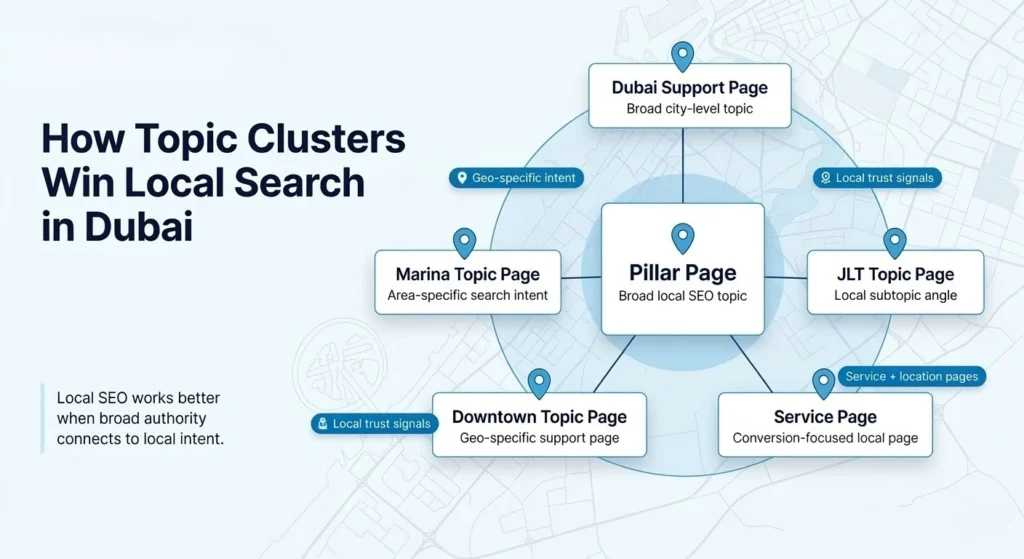
Local cluster SEO should connect broad authority with local search intent.
How to target geo-specific search intent in the UAE market
Geo-specific intent includes modifiers like Dubai, Abu Dhabi, Sharjah, Marina, JLT, or Downtown. These can shape support topics, location pages, and examples.
Local pages should still be useful. They should not be copied with only a city name changed.
How to localize content without losing wider SEO value
Local content can still contribute to broader SEO value when the core topic is strong. Add local examples, local FAQs, local laws, and regional proof points. That adds relevance without weakening quality.
How local SEO and topic clusters work better together
A simple model works well: One broad pillar page, local support pages for regional needs, and service pages for conversion.
For example, a pillar page on local SEO for clinics can support pages on reviews, clinic schema, Dubai clinic SEO, Google Business Profile, and appointment-page SEO.
How AI Tools and Search Data Reveal Hidden Cluster Ideas
AI can speed up idea discovery, but it should support human planning, not replace it.
How to mine People Also Ask for support topics
People Also Ask often reveals objections, follow-up questions, and side topics. These can become support pages or FAQ sections.
How AI tools can speed up topic coverage research
AI tools can help summarize themes, cluster subtopics, surface related questions, and organize research notes. Those are good uses.
What you should avoid is publishing filler pages at scale just because a tool can produce them quickly.
How to find micro-topics competitors keep missing
Micro-topics are smaller subtopics inside a larger theme. You can find them in forums, support chats, niche comments, People Also Ask, and low-competition gaps in the search results.
These smaller pages often make a cluster feel complete.
How To Measure If Your Topic Cluster Strategy Is Working
Success is not only one page ranking. It is the whole cluster getting stronger.
How to track keyword growth across the whole cluster
Track how many keywords the cluster ranks for, how those terms spread across support pages, and how the pillar page grows in visibility. That tells you whether the system is expanding.
How to measure the impact of internal links on rankings
Compare before and after internal link updates. Look for better crawling, stronger rankings, and more movement to linked pages. This is one of the easiest ways to see if the cluster is becoming easier to understand.
How to spot the pages driving the most organic growth
Some support pages will outperform the rest. When that happens, improve them, add stronger internal links, and connect them to money pages so they help the business, not just traffic numbers.
Common Mistakes That Stop Topic Clusters From Ranking
Many clusters fail for the same reasons.
Building a pillar page with no real supporting depth
A pillar page alone is not a cluster. It needs useful support pages with clear subtopics.
Weak internal links that fail to connect the cluster
Pages may exist, but if they barely link, the system feels broken. Build clear pillar-to-cluster paths and useful contextual links.
Targeting overlapping keywords instead of distinct subtopics
If too many pages try to do the same job, the cluster becomes muddy. Give each page one clear topic and one clear intent before you publish.
How To Scale Topic Clusters For Long-Term Growth
Clusters are not one-time projects. They are living systems.
How to grow a cluster with new search trends
Watch for new questions, new SERP patterns, new local demand, and industry changes. Add pages carefully so the cluster grows without losing structure.
Why pillar pages need updates to stay authoritative
Pillar pages age faster than many support pages. Update links, stats, examples, FAQs, and local references so the page keeps its authority signal.
How multiple clusters can help own an entire niche
One website can build several clusters around one industry. For an SEO brand, that could mean local SEO, technical SEO, on-page SEO, and content SEO. Together, those clusters expand authority across the niche.
What Topic Clusters May Look Like In AI-Driven Search Next
AI search does not replace the need for structure. It increases the value of the structure.
Google says the same fundamental SEO best practices still matter for AI features in Search, and there are no extra requirements to appear in AI Overviews or AI Mode. It also explains that AI features may use a query fan-out process across subtopics and data sources, which makes well-structured, connected content especially useful.
How AI search systems read topic authority differently
AI search experiences can handle longer, more detailed, and follow-up questions better than old-style short queries. That favours connected content systems over scattered posts.
Why structured content systems are likely to win in 2026
Structure, clarity, and relationship signals are becoming more important, not less. A strong cluster improves depth, discoverability, internal movement, and the next step for the reader.
How to prepare your content strategy for AI-powered results
Build people-first content. Connect related pages clearly. Answer real questions fully. Keep your clusters updated. Avoid scaled filler content. The future still rewards useful content with strong structure.
In Short
Random publishing makes a site look busy. A connected cluster system makes a site look useful.
That is the difference. When your pillar page, support pages, internal links, and local intent all work together, your content stops acting like separate files and starts acting like a system.
If you want that system built the right way, WR SEO Specialist can help turn scattered ideas into a clear cluster plan that supports topical authority, builds a stronger topic map, and gives your business in Dubai a better shot at steady organic growth.
FAQs
What is a topic cluster in simple terms?
It is one main page supported by several related pages, all linked together to cover a subject more completely.
How many cluster pages should one pillar page have?
There is no fixed number. Start with the strongest subtopics first, then add more as the topic grows.
Can a small business use topic clusters?
Yes. In fact, small businesses often benefit more because clusters help them organize content around the services they actually want to sell.
What is the difference between a pillar page and a blog post?
A pillar page covers the broad topic and organizes the subject. A blog post usually covers one smaller question or angle inside that topic.
How long does it take for a topic cluster to show results?
It depends on the niche, competition, and quality of the pages. But clusters usually work best as a steady system, not a quick trick.