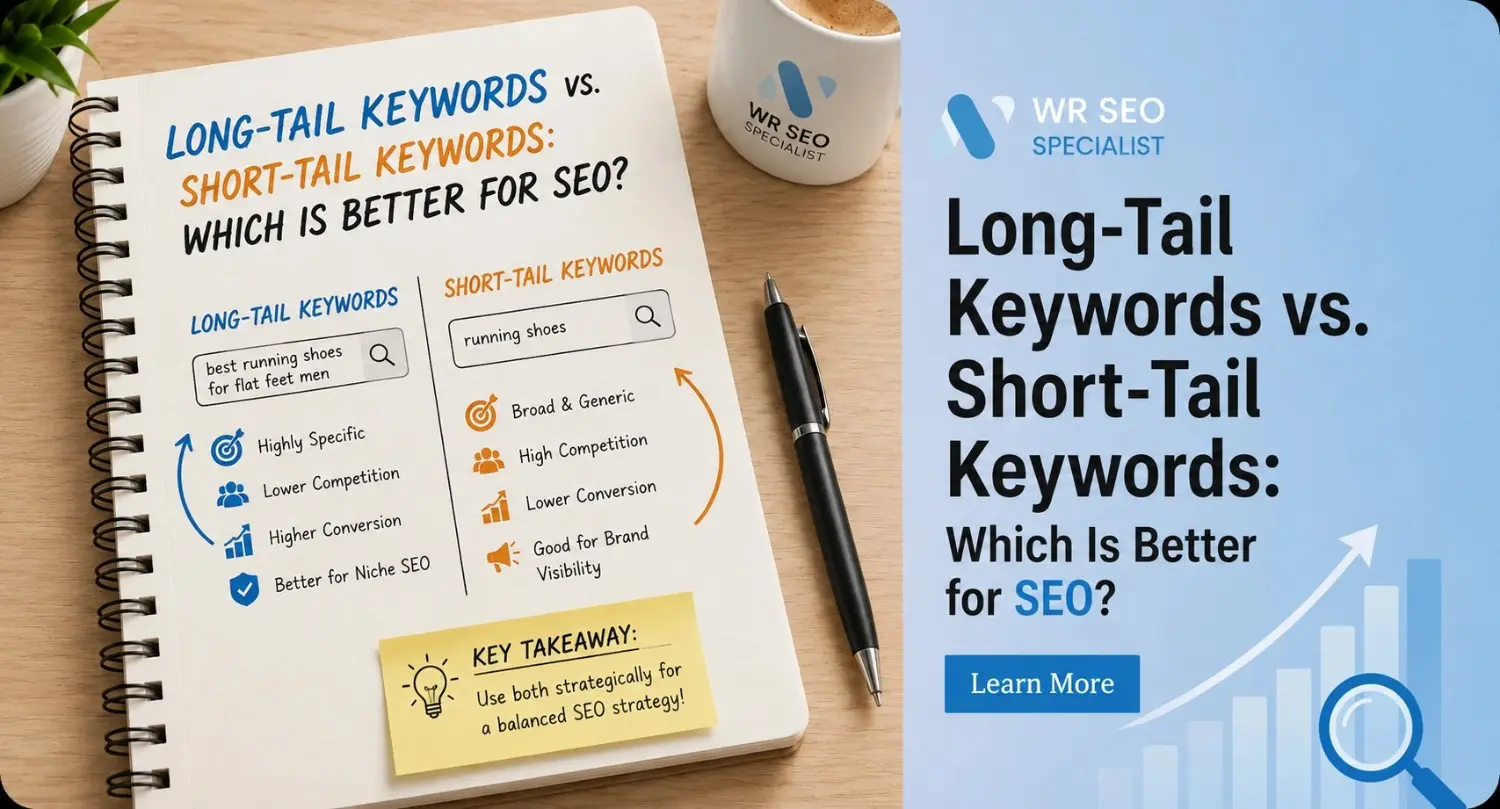
Long-Tail Keywords vs. Short-Tail Keywords: Which Is Better for SEO?
Long tail keywords are usually better for SEO when you want targeted traffic, easier rankings, and better conversions. Short-tail keywords are better when you want broad visibility and brand awareness.
Think of it like fishing.
A short-tail keyword is throwing a huge net into the ocean and hoping something useful shows up.
A long-tail keyword is using the right bait, at the right spot, for the exact fish you want.
Both can work. But if your website is not already a giant brand, long tail keywords are usually the smarter place to start.
Some key facts:
- Over 91 % of all search queries are long‑tail terms. That’s right, most searches aren’t for broad keywords at all.
- 92 % of keywords get 10 or fewer searches per month, meaning the vast majority of search demand sits in the long tail.
- In Ahrefs’ U.S. database, there are only 31,000 head keywords with search volumes above 100k, while 3.8 billion keywords have fewer than 10 searches per month. In other words, the “tail” of low‑volume phrases is enormous.
- Long‑tail keywords usually have lower competition and are easier to rank for. Because fewer sites target them, smaller businesses have a fighting chance.
- They often deliver higher conversion rates because searchers are closer to making a decision.
What Are Long Tail Keywords?
Long tail keywords are specific search phrases people use when they know exactly what they want.
They are usually longer, more detailed, and closer to real human questions.
Examples:
- best SEO agency for small business in Canada
- how to improve local SEO for a dental clinic
- affordable website design for startups
- best accounting software for small business owners
These keywords may not bring massive traffic individually, but the visitors they bring are usually more serious.
Someone searching “SEO” may just be curious.
Someone searching “best SEO specialist for local business in Mississauga” is probably comparing options and closer to taking action.
That is why long tail keywords are so useful for SEO.
What Are Short-Tail Keywords?
Short-tail keywords are broad search terms, usually one or two words.
Examples:
- SEO
- marketing
- backlinks
- website design
- digital marketing
These keywords usually have more search volume, but they are also harder to rank for.
Why?
Because everyone wants them.
Trying to rank for “SEO” as a new or small website is like trying to get front-row seats at a Drake concert five minutes before the show starts. Possible? Maybe. Realistic? Not really.
Short-tail keywords can bring a lot of visitors, but the intent is not always clear.
For example, someone searching “website design” could mean:
- They want to hire a website designer.
- They want to learn website design.
- They want website design inspiration.
- They want free website templates.
- They clicked by accident while eating chips.
That is the problem. The keyword is broad, so the intent is messy.
Long Tail and Short Tail Keyword: The Main Difference
The biggest difference between long tail and short tail keyword targeting is intent.
Short-tail keywords are broad.
Long-tail keywords are specific.
Here is the simple breakdown:
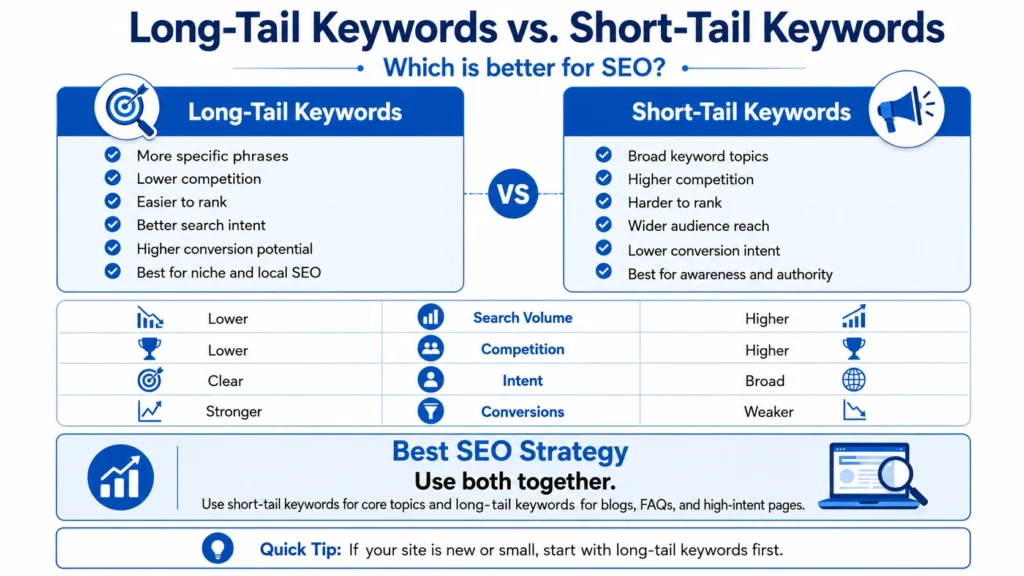
Difference Between Long Tail and Short Tail Keywords in SEO
The difference between long tail and short tail keywords in SEO comes down to how people search and how hard it is to rank.
A short-tail keyword targets a broad topic.
Example:
digital marketing
A long-tail keyword targets a specific need inside that topic.
Example:
digital marketing services for restaurants in Toronto
See the difference?
The first keyword is a big umbrella.
The second keyword is a person standing under that umbrella asking for exactly what they need.
For SEO, that matters because Google wants to show the most helpful result for the user’s intent. The more specific your content is, the easier it is to match that intent.
Why Long Tail Keywords Are Better for Most Websites
For most small businesses, service providers, local companies, and newer websites, long tail keywords are usually the better SEO choice.
Here’s why.
1. They Are Easier to Rank For
Short-tail keywords are crowded. Big brands, high-authority websites, and old domains usually dominate them.
Long tail keywords give you a better chance because fewer websites are targeting the exact same phrase.
Instead of fighting everyone for “SEO agency,” you can target:
- SEO agency for small businesses in Canada
- local SEO specialist for service businesses
- SEO consultant for dental clinics
- affordable SEO services for startups
These are more specific and much easier to build useful content around.
2. They Bring Better Quality Traffic
Traffic is nice, but traffic that does nothing is just website decoration.
Long tail keywords attract people with clearer intent. They know what they are looking for. That means they are more likely to click, read, inquire, book, buy, or fill out a form.
For example:
“shoes” = browsing
“best waterproof hiking shoes for winter in Canada” = ready to compare and buy
That is the power of long tail keywords.
3. They Help You Understand Your Audience
Long tail keywords show what your audience is actually thinking.
They reveal problems, questions, fears, and buying intent.
For example, someone searching:
“why is my website not ranking on Google”
is not just looking for a definition. They have a problem. They are probably frustrated. Maybe they already hired someone. Maybe their cousin “did SEO” once and now everything is broken.
That keyword gives you direction for helpful content.
You can write a blog that answers the issue, explains common mistakes, and naturally introduces your service.
4. They Work Better for Local SEO
For local businesses, long tail keywords are gold.
Instead of targeting:
plumber
A local business should target:
emergency plumber in Mississauga
commercial plumber in Toronto
affordable plumbing repair in Brampton
These searches are more realistic and more likely to turn into leads.
Local SEO is not about ranking everywhere. It is about ranking where your actual customers are.
5. They Support AI Search and Voice Search
People are searching more conversationally now.
They ask Google, Siri, Alexa, ChatGPT, and other AI tools full questions.
Examples:
- What is the best SEO strategy for a small business?
- How do I find long tail keywords for my website?
- Which keywords should I target first for SEO?
These are long tail searches.
So if your content answers these questions clearly, you improve your chances of showing up in search results, featured snippets, and AI-generated answers.
Are Short-Tail Keywords Still Useful?
Yes, short-tail keywords still matter.
They are useful for:
- Building topic authority
- Creating main service pages
- Structuring your website
- Supporting brand awareness
- Planning content clusters
For example, “SEO” can be your broad topic.
Then you create long-tail content around it:
- What is SEO and how does it work?
- How long does SEO take for a small business?
- Local SEO vs traditional SEO
- SEO checklist for new websites
- How to choose an SEO specialist
The short-tail keyword becomes the main topic. The long-tail keywords become the supporting content.
That is how you build a strong SEO structure.
The Best SEO Strategy: Use Both Together
The best strategy is not long tail vs short tail keywords.
The best strategy is long tail + short tail keywords.
Here is how to use both:
Step 1: Choose a Short-Tail Main Topic
Pick your broad topic.
Example:
SEO
This is your main category or pillar topic.
Step 2: Find Long Tail Keyword Variations
Now find more specific keyword ideas.
Examples:
- how to improve SEO for a small business
- best SEO strategy for local companies
- how to rank higher on Google Maps
- SEO tips for service-based businesses
- how to choose an SEO agency
Step 3: Create Content Around Each Intent
Each long-tail keyword should answer a specific question or solve a specific problem.
Do not stuff keywords like it is 2012. Google is smarter now. Readers are smarter too. Also, keyword stuffing makes your content sound like a broken robot trying to sell insurance.
Write naturally.
Step 4: Link Everything Together
Connect your long-tail blogs to your main service page.
Example:
A blog on “how to improve local SEO for small business” should internally link to your Local SEO Services page.
This helps users and search engines understand your website structure.
Step 5: Keep Updating Your Content
SEO is not a one-time task.
Refresh your keywords, update old blogs, add new FAQs, improve internal links, and make your content more helpful over time.
Google likes useful content. Users like useful content. Everyone wins.
Examples of Long Tail Keywords for SEO
Here are some examples across different industries.
For an SEO Business
- local SEO services for small businesses
- how to rank a business on Google Maps
- SEO specialist for Canadian companies
- how to find long tail keywords for SEO
- best SEO strategy for service-based businesses
For a Website Design Company
- affordable website design for startups
- website design for accounting firms
- WordPress website developer in Canada
- how much does a business website cost
- best website design for local service businesses
For an Accounting Firm
- corporate tax accountant for small business
- bookkeeping services for startups in Canada
- how to register for GST/HST
- tax filing help for business owners
- best accountant for incorporated business
For a Restaurant Marketing Agency
- social media marketing for restaurants
- how to get more restaurant bookings
- restaurant SEO services near me
- Google Business Profile tips for restaurants
- food photography marketing ideas
These are more specific than broad keywords, and they connect directly to buyer intent.
Common Mistakes to Avoid
Mistake 1: Only Chasing High-Volume Keywords
High volume looks exciting, but it can waste time if the keyword is too broad or too competitive.
A keyword with fewer searches but stronger intent can bring better leads than a big keyword that attracts random visitors.
Do not chase traffic for ego. Chase traffic that can turn into business.
Mistake 2: Ignoring Search Intent
Search intent means understanding what the user wants.
For example:
“SEO meaning” = wants a definition
“SEO services near me” = wants to hire someone
“SEO pricing Canada” = comparing cost
“best SEO specialist” = comparing providers
Each keyword needs a different type of content.
Mistake 3: Creating Thin Content for Every Keyword
Do not create 50 weak pages for 50 similar keywords.
Instead, group similar long-tail keywords into one strong page when they share the same intent.
For example, these can likely fit into one article:
- long tail keywords seo
- difference between long tail and short tail keywords in seo
- short tail and long tail keywords
- long tail and short tail keyword
One helpful page is better than five boring pages that say the same thing with slightly different wording.
Mistake 4: Forgetting Internal Links
If you create blogs but never link them to your service pages, you are leaving SEO value on the table.
Internal links help users move through your site and help Google understand which pages matter most.
Mistake 5: Writing for Search Engines Only
Yes, keywords matter.
But people read your content. Not just Google bots wearing tiny glasses.
Make your content useful, clear, and easy to read. Add examples. Explain terms simply. Make it feel like a human wrote it.
So, Which Is Better for SEO?
Long tail keywords are better for most SEO strategies because they are more specific, easier to rank for, and more likely to attract users who are ready to take action.
Short-tail keywords are still useful for broad visibility and building authority, but they are harder to rank for and usually bring less qualified traffic.
The smartest approach is to use short-tail keywords as your main topics and long-tail keywords as your traffic and conversion builders.
In simple words:
Short-tail keywords build the map.
Long-tail keywords bring the people.
And ideally, those people become leads, customers, clients, or at least newsletter subscribers who do not unsubscribe immediately. Small wins matter.
Final Thoughts
If your website is new, local, niche, or competing against bigger brands, start with long tail keywords.
They help you rank faster, answer real questions, and attract people who already know what they want.
Once your site gains authority, you can slowly target broader short-tail keywords too.
For a strong SEO plan, do not pick one side forever. Use both.
Long-tail keywords get you practical results. Short-tail keywords help you build wider visibility over time.
That is the real SEO sweet spot.