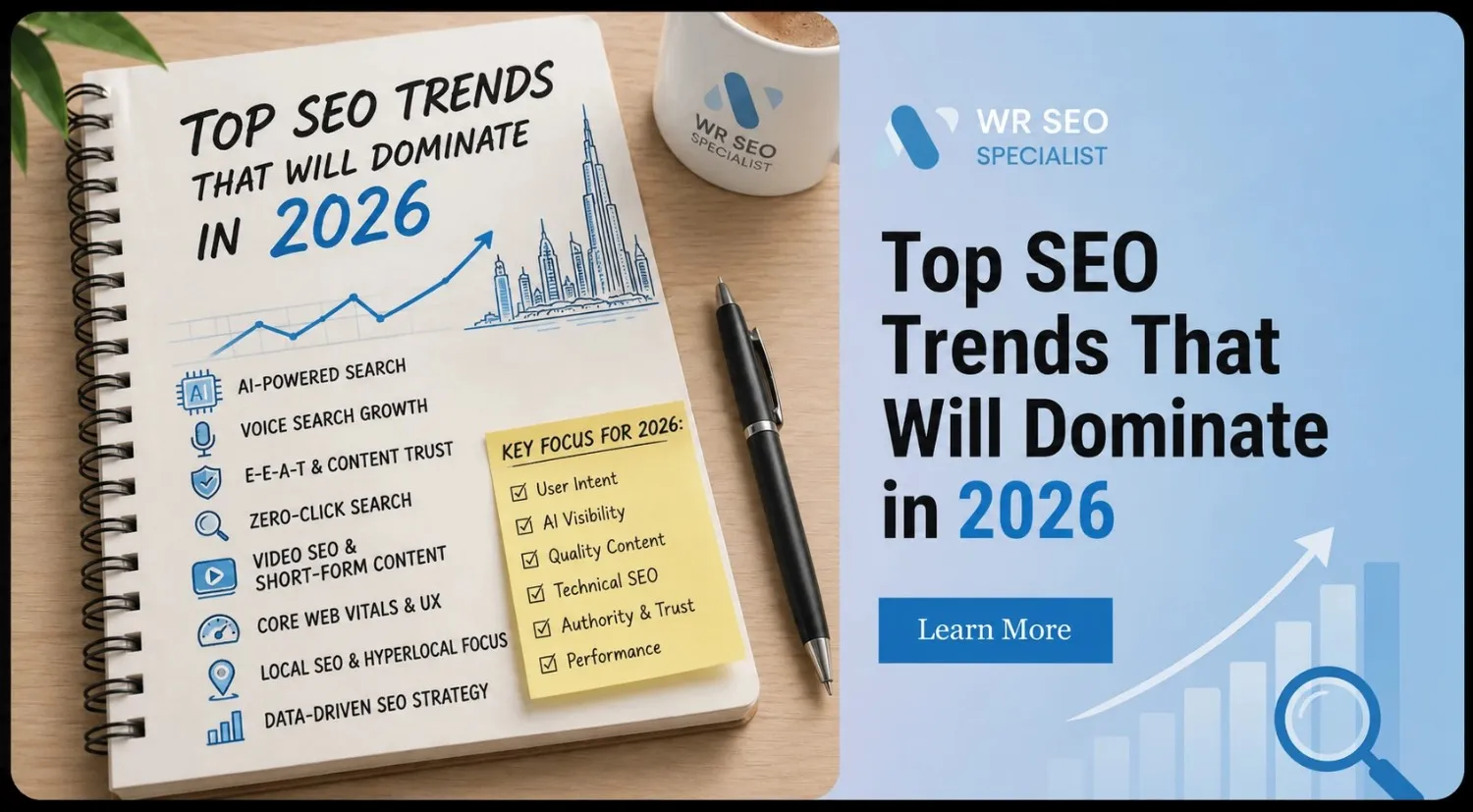
Top SEO Trends That Will Dominate in 2026
Imagine you own a small clothing brand. Last year, your blog posts and product pages appeared on page one for many searches. Today, you check Google and see something very different. Answers are no longer rows of blue links. They include AI‑generated summaries, videos, images, local packs and review snippets. Some buyers ask their voice assistant for a “comfy hoodie,” get a spoken answer and never click any result. Others watch a short video review on social media before comparing brands. Your rankings might still be good, yet traffic and enquiries drop because people get answers without visiting your site.This guide shows why search visibility in 2026 goes beyond ranking pages. Modern SEO trends cover Google, AI‑powered results, local search, visual and voice search, content quality, site speed, brand demand and user experience. We’ll unpack each trend and provide clear actions any business can follow. Throughout the guide, you’ll notice helpful links, including a deep dive on topic clusters with SEO in 2026 – a concept you’ll return to later – and other internal resources.
Why SEO Trends in 2026 Focus on Visibility and Demand Growth
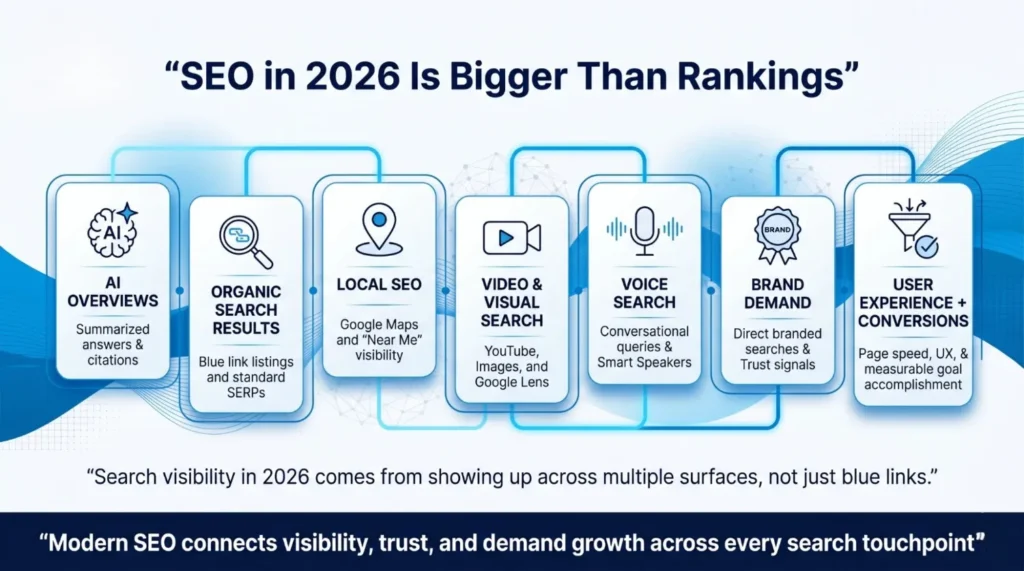
Search optimization used to be mostly about ranking for keywords. In 2026, ranking is just the starting point. Algorithms now blend AI answers, videos, images, reviews, local packs and shopping carousels to satisfy a question in one view. According to a recent analysis, around 60% of searches end without a click on any website, and on mobile, that share jumps to 77 %. This means impressions can be deep even as visits drop.
So the biggest trend in SEO is the shift from traffic‑only metrics to full search visibility. Brands need to show up across many surfaces: AI Overviews, Google Maps, “People also ask” boxes, social snippets and voice answers. Organic visitors remain valuable, but they are only part of the funnel. A successful strategy also builds brand demand. When users see your name repeatedly – in AI citations, review snippets, videos and local results – they remember it. Later, they may search directly for your brand or choose you over a competitor. Thus, SEO must connect to wider marketing goals like reputation, trust and sales growth rather than chasing traffic alone.
How AI Overviews Change Search Results and Traffic for Users
Google’s AI Overviews and AI Mode provide synthesized answers for complex queries. They pull information from multiple sources and link to supporting pages. Google clarifies that the same fundamental SEO best practices apply; no special tags or schemas are required to appear in these AI features. AI Overviews aim to help people grasp a topic quickly and then explore deeper via links. When a page is indexed and meets basic technical requirements, it can be chosen as a supporting link.
From a user’s perspective, AI summaries mean they often get an answer without scrolling. This reduces click‑through rates but does not erase SEO. Pages still need to be clear, trustworthy and easy to cite. Use headings that reflect questions readers ask, write concise summaries and cite sources where appropriate. Since AI features surface diverse links and “fan out” to gather information, content that covers related subtopics thoroughly is more likely to appear. If you want your content to support AI Overviews, focus on people‑first writing and meet core technical requirements. Importantly, when users do click from AI Overviews, those visits tend to be higher quality because the query has been qualified.
Why Brand Demand Shapes SEO Strategy and Search Results Fast
Another trend is the rise of brand‑centric searches. People now often read an AI answer, see multiple names and then search directly for a brand that stands out. They may type “SEO audit” today but search “YourBrand SEO audit” tomorrow if you delivered useful information. Brand demand helps in several ways:
- Higher click‑through rates: Users who know your name are more likely to click your result among many.
- Improved rankings: Search engines use brand signals like navigational searches and repeat visits as signs of trust.
- Better conversion: People who intentionally search for your brand have already moved through the awareness stage and are closer to buying or enquiring.
To increase brand demand, integrate marketing and SEO. Produce authoritative content, earn mentions on reputable sites, engage with communities and encourage customers to leave reviews. Make sure your brand name appears in titles, snippets and structured data. A strong brand reduces reliance on fragile keyword rankings and insulates you from algorithm shifts.
How People‑First Content Wins Search Visibility in 2026
Content created solely to manipulate rankings no longer works. Google’s guidelines state that its ranking systems prioritize helpful, reliable information created to benefit people. They advise creators to ensure their pages provide original research, comprehensive descriptions and clear sourcing. Content should answer user intent quickly and leave readers feeling satisfied.
In practice, this means avoiding copied advice. Share real examples from your business or industry. Offer insights that reflect first‑hand experience. Use simple language and break down complex ideas into short paragraphs so that even an 8th‑grader can understand. When referencing facts, cite sources to build trust. Resist the urge to stuff keywords; instead, cover topics thoroughly. Always review content for clarity, tone and factual accuracy before publishing.
Why Topic Clusters Beat Random Content Marketing in 2026
Publishing random blogs without a unifying plan leaves content isolated. Search engines now value topical authority: the depth and connection of related articles on a subject. Topic clusters use a pillar page that addresses a broad idea and multiple supporting pages that explore subtopics. Internal links connect each supporting page back to the pillar, guiding both users and crawlers.
For example, a pillar page about “search engine optimization” may link to supporting pages on keyword research, technical audits and content promotion. This structure helps search engines understand how pages relate, encourages better indexing and improves ranking for clusters of terms. A scattered approach, by contrast, struggles to build trust.
To learn how to create clusters step by step, check the guide on topic clusters with SEO in 2026. Later in the article, we will revisit this concept to show how clusters support AI summaries and brand recall.
How Zero‑Click Searches Build Brand Recall Before Clicks
Zero‑click searches occur when the user’s query is answered directly on the result page. Research shows that about 60 % of searches end without a click, and this climbs to 77 % on mobile. AI Overviews appeared in around 13.14 % of queries in early 2026. This can feel discouraging if you measure success solely by sessions. However, zero‑click visibility still benefits brands.
When your content appears in an AI summary, a featured snippet or a “People also ask” box, users learn your name even without visiting. This exposure can lead to later navigational searches or social engagements. Featured snippets are particularly important for voice answers: almost 40.7 % of voice search responses come from featured snippets. To leverage zero‑click exposure:
- Use concise summaries at the start of each page to increase the chance of snippet selection.
- Structure content with question‑and‑answer headings.
- Add relevant structured data to help search engines understand your page.
- Track impressions, not just clicks. A rise in branded search volume or direct traffic can indicate that zero‑click visibility is driving interest.
Why Technical SEO Still Powers Search Engines and AI Results
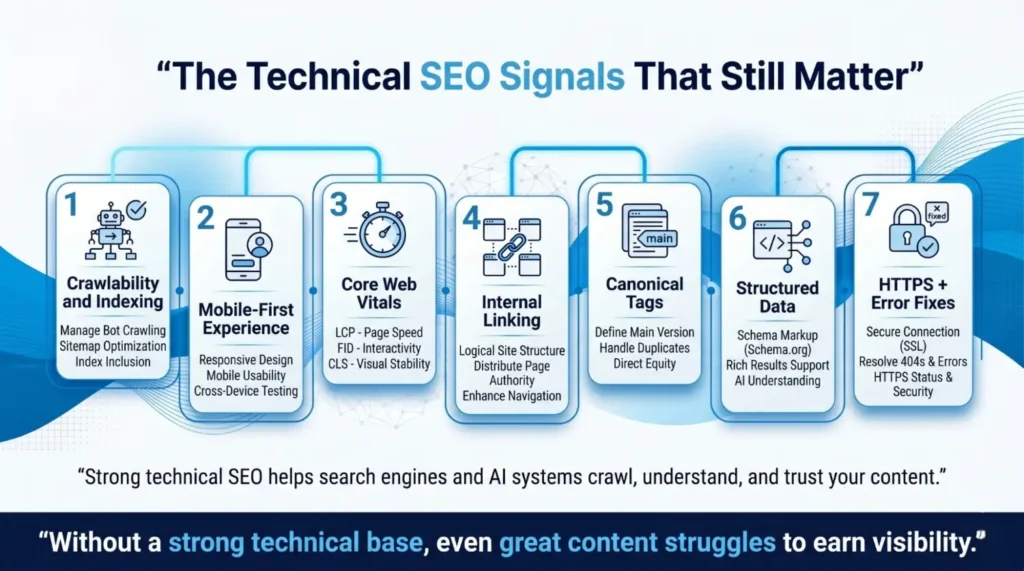
Behind every visible page lies a technical foundation. If search engines cannot crawl, index and understand your site, no amount of great content will help. Key technical priorities in 2026 include:
- Crawlability and indexing: Allow crawlers in your robots.txt file and fix any blockers. Submit XML sitemaps.
- Mobile‑first indexing: Ensure your mobile experience is complete and matches desktop content. Over 50 % of searches occur on smartphones.
- Site speed and Core Web Vitals: Google recommends keeping Largest Contentful Paint (LCP) under 2.5 seconds, Interaction to Next Paint (INP) under 200 ms and Cumulative Layout Shift (CLS) under 0.1. These metrics measure loading speed, interactivity and visual stability.
- Internal linking and canonicals: Link related pages together, especially within your topic clusters. Use canonical tags to handle duplicate content.
- Structured data: Add schema markup to describe products, reviews, FAQs and events. This helps AI features pick up your content.
- Error management: Fix broken links and avoid orphan pages. Redirect outdated URLs to relevant content.
- Security: Use HTTPS and maintain updated certificates.
Technical SEO may seem invisible, but it directly influences how search engines and AI systems interpret your pages. A technically sound site is more likely to be selected for AI summaries, featured snippets and local results.
How Local SEO Rewards Reviews, Relevance and Real Proof
Local search is becoming increasingly proof‑based. When people search for a nearby service, they want evidence that the business is trustworthy. Recent surveys show that 97 % of consumers read online reviews before choosing a local business, and 41 % “always” read reviews when browsing. Consumers now use an average of six review sites during their research. Only about 5 % of businesses respond to their reviews, even though 89 % of consumers expect a response. These numbers highlight the gap between customer expectations and business actions.
To succeed in local SEO in 2026:
- Optimize your Google Business Profile: Provide accurate business hours, contact information, services and photos.
- Collect and respond to reviews: Encourage satisfied customers to leave feedback, reply promptly and politely to positive and negative comments, and avoid templated responses. Recent reviews carry more weight – around 73 % of consumers only trust reviews left in the last month.
- Create city‑specific pages: If you serve different areas, build dedicated pages for each location with unique content, customer stories and maps.
- Earn local links and mentions: Collaborate with local organizations, sponsor events or contribute to community blogs to get relevant backlinks.
- Use real photos and videos: Show your team, store and projects to build trust.
- Ensure NAP consistency: Your Name, Address and Phone number must be consistent across directories and your website.
Local SEO isn’t just adding a city name to a keyword. It is about proving that your business is reliable and valued in that area.
Why Visual Search and Video Build User Experience for Brands
Humans process images faster than text, which is why visual content is so powerful. Visual search tools like Google Lens let people identify products, landmarks or plants using a photo instead of typing. On social platforms, short videos and reels influence buying decisions. Real faces and demonstrations create trust.
Videos can explain services quickly. A two‑minute video showing how your product works can answer questions better than a 1,000‑word post. Images with descriptive alt text improve accessibility and help search engines understand your content. Optimizing pictures for size and quality supports Core Web Vitals. Structured data for video and image content helps them appear in search results and AI features.
Visual content also supports zero‑click searches. A high‑quality image or video snippet may appear directly on the results page, encouraging people to recall your brand even if they don’t click. Investing in photography, explainer videos and consistent branding across images will improve user experience and build confidence.
How AI Tools Support SEO Strategy With Human Expert Insights
AI tools can speed up many SEO tasks: generating keyword ideas, clustering topics, checking technical issues and summarizing reports. They can help you organize research, build outlines and identify gaps. However, AI is only a tool. It cannot replace human understanding of your audience, business goals or nuance.
Use AI to draft content briefs, group keywords into clusters and check for broken links or duplicate content. Then bring in human expertise to refine the tone, add examples and ensure the information is accurate. Human review ensures that content remains authentic and aligns with brand voice. By combining AI efficiency with human creativity and judgment, you can scale SEO efforts without sacrificing quality.
Which SEO Metrics Matter for Traffic, Leads and Revenue Now
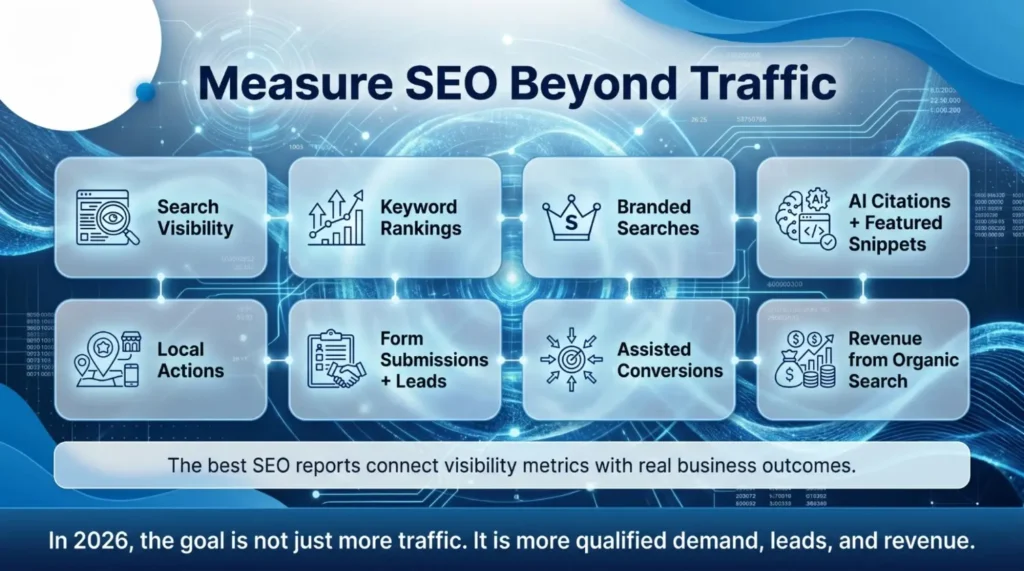
As the search landscape changes, you need a broader set of metrics to measure success. Traffic alone is too narrow. Consider the following indicators:
- Search visibility: Impressions across organic results, AI Overviews, snippets and local packs.
- Rankings: Positions for priority keywords, but interpreted alongside zero‑click behaviour.
- Branded searches: Growth in searches containing your brand name is a sign of demand and awareness.
- AI citations and featured snippet visibility: Whether your pages are cited in AI summaries or occupy the snippet position.
- Local actions: Calls, directions and messages from your Google Business Profile.
- Form submissions and sign‑ups: Leads generated from organic sessions.
- Assisted conversions: Sales attributed to organic touchpoints in multi‑channel conversion paths.
- Revenue: Actual income derived from organic search – the ultimate measure of success.
- Content engagement: Time on page, scroll depth and interactions.
- Qualified leads: Quality of enquiries, not just quantity.
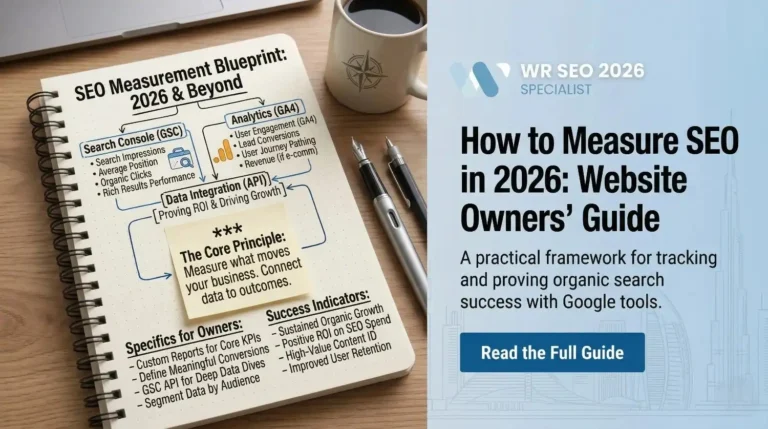
Measure these metrics using Search Console, Google Analytics and other tools. Look for correlations between visibility and business outcomes rather than focusing on raw traffic numbers.
Conclusion – Preparing for the Future of Search
Search in 2026 feels different because it is different. The explosion of AI‑generated answers, visual and voice search, local review signals and brand‑centric behaviour means that traditional keyword rankings are just one piece of a larger puzzle. Winning in this environment requires building a technically sound site, producing people‑first content, grouping related topics into clusters, earning local trust with reviews and visual proof, and nurturing brand demand.
As you adjust your SEO strategy, remember that visibility across all search surfaces matters more than raw traffic. Measure success through a broad lens that ties impressions and citations to leads and revenue. And never forget the human element: authentic stories and helpful information will always resonate more than spammy tricks.
If you’re ready to navigate these changes and want expert help, consider working with WR SEO Specialist. They focus on holistic search strategies that combine technical audits, content planning, local optimization and brand development. With the right partner, your business can thrive in the evolving search landscape and turn visibility into lasting growth.
FAQs About SEO Trends, AI Search and Search Visibility Tips
What are the SEO trends in 2026?
The key trends include AI‑generated summaries in search, a high rate of zero‑click searches, an increasing share of voice and visual search, focus on topic clusters, emphasis on Core Web Vitals and mobile experience, integration of local reviews and proof, and a shift toward brand demand rather than keyword stuffing. SEO now touches technical performance, content quality, multimedia, local relevance and brand building.
What are the current trends in SEO?
Current trends align closely with the 2026 picture: search engines use AI to provide direct answers, video and image results populate the page, voice assistants handle about 31 % of searches, and smart speaker adoption drives local queries. People demand fast pages and helpful, original content, while brands must watch metrics beyond rankings.
Is SEO outdated in 2026?
No. SEO has evolved, but is far from obsolete. Core practices like ensuring crawlability, optimizing page speed, creating valuable content and building reputable links remain essential. The difference is that SEO now also covers AI features, social snippets, local proof and brand storytelling. It requires a holistic approach that connects content with user experience and business goals.
Can ChatGPT do SEO?
Tools like ChatGPT can assist with SEO tasks such as brainstorming keywords, outlining content or generating meta descriptions. However, they should not replace human expertise. AI lacks the context, nuance and real‑world examples needed to build trust. Use AI tools to support your workflow, but rely on human insight for strategy, writing, editing and relationship building.
Will AI replace SEO?
AI will transform SEO but not replace it. AI systems help deliver quick answers and organize information, but they still rely on high‑quality web content. SEO practitioners must adapt by ensuring their content is accessible to AI systems, building topic clusters, maintaining technical health and focusing on user value. AI may handle routine tasks, but human creativity, empathy and strategic thinking remain irreplaceable.
Can I do SEO myself?
Yes, small businesses can handle basic SEO tasks such as optimizing titles, creating helpful content, improving page speed and managing local listings. Free tools like Google Search Console and PageSpeed Insights provide guidance. However, as competition intensifies and AI features expand, many companies choose to work with specialists who can create a comprehensive strategy.
How do you stay updated on SEO trends?
Follow reliable sources such as Google Search Central’s blog, industry publications, forums and reputable SEO analysts. Attend webinars and conferences. Test changes on your own site and use analytics to see what works. Join communities where professionals share insights. Staying updated helps you adapt to algorithm changes and emerging technologies.