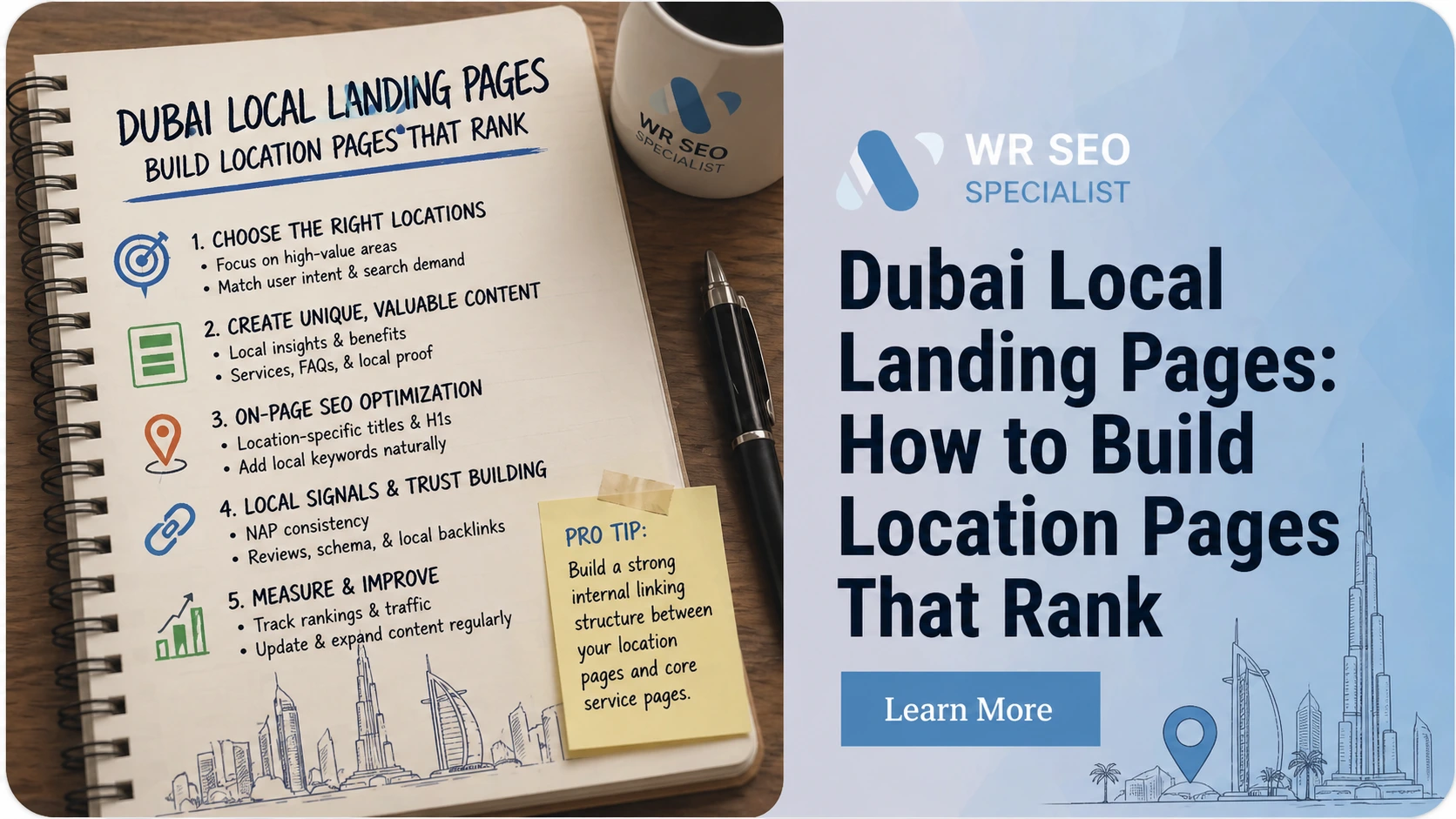
Dubai Local Landing Pages: How to Build Location Pages That Rank
Two things happen constantly with Dubai businesses online. The first: a company builds one general “Services in Dubai” page, adds a few keywords, and expects it to pull in enquiries from across the city. The second: someone builds thirty area pages in a weekend by copying the same template and swapping in a new neighbourhood name on each one. Neither approach works. One is too broad to rank for anything specific. The other looks exactly like what Google’s own guidelines describe as a doorway page, and those get penalized, not rewarded.
The reality of local search in Dubai is more detailed than most businesses give it credit for. People do not just search for “plumber Dubai.” They search for a plumber in Jumeirah, a cleaning company near Business Bay, or a dental clinic in Dubai Marina. Knowing this is what separates a useful page from a forgettable one. Well-built Dubai local landing pages are not about copying and pasting your city page fifteen times. They are about building individual pages that actually prove your business serves a specific area, with real proof, real structure, and a real reason for someone to call.
This guide covers the full process: when to create location pages, how to choose the right areas, what to put on each page, and how to measure whether the work is paying off.
Why Dubai Location Pages Still Matter in 2026
Local intent in Dubai has not weakened. If anything, the way people search has become more area-specific as the city grows and as neighbourhoods develop their own commercial identities. Someone living in Al Barsha trusts a service provider in Al Barsha more than one with a generic city-wide address. Someone working in DIFC wants a nearby lunch spot or accountant, not one that is technically within Dubai but requires a 40-minute commute. That trust and convenience factor is what makes location-specific pages worth building.
According to BrightLocal’s 2024 Local Consumer Review Survey, 98% of consumers used the internet to find a local business in the past year. In a city as digitally active as Dubai, that number reflects how often buying decisions begin with a Google search tied to a specific location. When your page appears in that search with content that speaks directly to the area the person is in, the likelihood of a click, and a call, goes up considerably.
When One Dubai Page Is Not Enough to Rank
A single Dubai city page can rank for broad queries. But broad queries rarely convert. The buyer who types “cleaning company Dubai” is browsing. The buyer who types “cleaning company Dubai Marina” is much closer to picking up the phone. Those are two different levels of intent, and they need two different pages to serve them properly.
Dubai functions less like one city and more like a collection of micro-markets. Dubai Marina, Business Bay, Jumeirah, Deira, Mirdif, Al Barsha, and Downtown all carry their own commercial character, their own price expectations, and their own search behaviour. A legal firm that works across all of these areas but only has one Dubai service page is missing the conversions that come from neighbourhood-level intent. Building separate landing pages for each neighbourhood is how service businesses move from general visibility to genuinely useful local presence.
That said, more pages are only better when they are built correctly. A dozen thin pages will not outperform one strong city page. The deciding factor is always whether each new page adds something real for the people who land on it.
How to Choose Areas Worth Their Own Pages
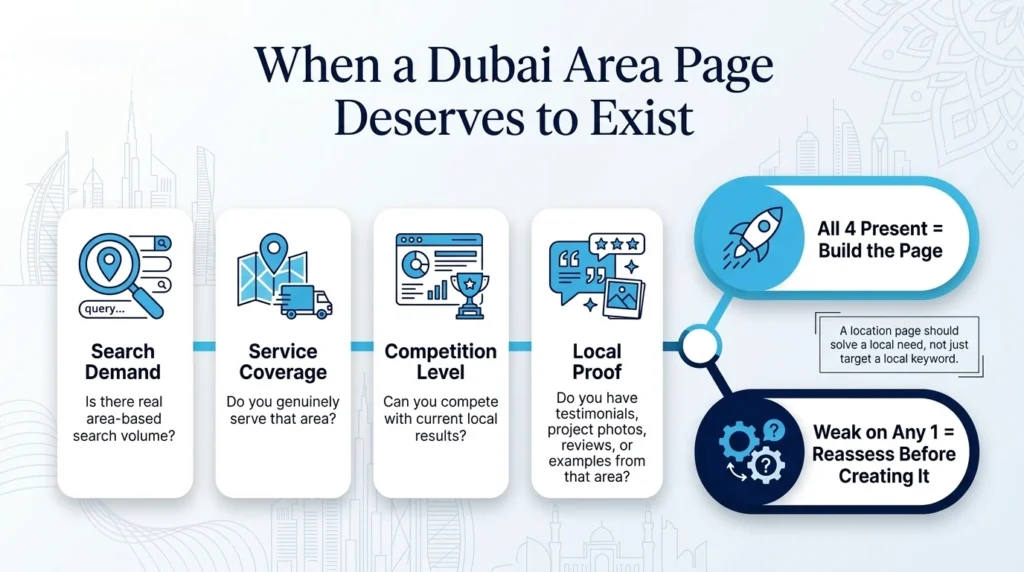
Not every Dubai neighbourhood deserves its own page. Before you build anything, run four checks. First, demand: is there real search volume for your service tied to this area? Use keyword research tools to confirm that people are actively searching this combination before you spend time creating a page for it. Second, service coverage: do you genuinely serve this area and do you have the capacity to handle enquiries from it? A page that generates leads you cannot fulfil is worse than no page at all.
Third, competition: check who already ranks for this service in this area. If the top three results are established local businesses with strong review profiles and local proof, you need more than a basic page to compete. You need a reason to be chosen over them. Fourth, proof: do you have anything area-specific to put on the page, a project completed there, a client based there, a testimonial from someone in that neighbourhood? A page built on real local proof will always outperform one that is assembled from generic service descriptions. If all four checks come back positive, the area is worth its own page.
What Makes a Dubai Page Worth Ranking
Google’s measure of a useful page comes down to one question: does this page genuinely help the person who lands on it? For a Dubai location page, that means the content needs to go well beyond naming the area. It needs to explain what specific services you offer there, why a customer in that area should choose you, and what it looks like when you actually do the work nearby.
A page is worth ranking when it answers the questions someone in that neighbourhood would have. Can you get to me quickly? Do you know the area? Have you worked here before? What do other local customers say about you? Pages that answer these questions clearly and honestly with actual evidence are the pages that earn rankings. Pages that just mention the area name several times in the copy while saying nothing specific about it are the pages that stay invisible.
How to Add Real Local Proof to Each Page
Local proof is what separates a page that converts from one that merely exists. For a Dubai location page, proof means something specific and verifiable, not just “we serve this area.” Think about what you can actually put on the page that shows a real connection to that neighbourhood.
Project photos taken in that area tell the reader more than any amount of written description. A testimonial from a client who lives or works in Jumeirah carries far more weight on a Jumeirah service page than a generic five-star comment with no location context. If you completed a renovation in Business Bay, show the before and after with a brief description of the building type and what the client needed. If your team regularly works in a specific district, mention the buildings or developments you have visited. These small specifics are what make a page feel like it belongs in that area rather than just mentioning it.
How to Avoid Thin or Doorway Style Pages
Google’s guidance on this is not ambiguous. Google’s doorway page policy describes doorway pages as those created purely to funnel search traffic to another destination, with little to no unique value for the visitor. Pages that are nearly identical to one another with only the location name changed sit firmly in that category. They are a risk worth taking seriously, not just because Google may penalize them, but because they genuinely do not serve anyone.
The test is simple. If you removed the area name from two of your location pages, would the pages read identically? If yes, they are not location pages. They are clones. The fix is not rewriting the same template more carefully. The fix is treating each area page as its own distinct page with its own local content, its own proof section, and its own reason to exist. That takes more time, but it produces pages that actually rank and convert rather than sitting in a grey area waiting to be filtered out.
What to Include Above the Fold for Conversions
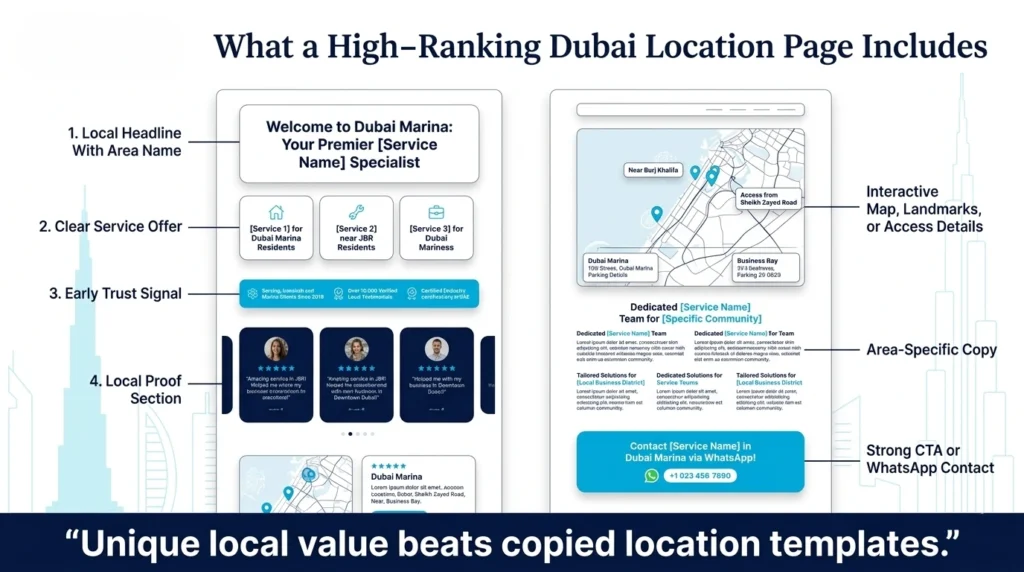
The section a visitor sees before scrolling needs to do a lot of work fast. Most people decide within a few seconds whether a page is worth their attention. For a Dubai location page, that first screen should show the area name in the headline so the visitor immediately knows this page is for them. It should state what you do clearly and specifically, not just your company name, but your service and the area it covers.
A trust signal placed early makes a real difference. This could be a star rating, the number of completed jobs nearby, a recognizable logo from a client or accreditation, or a short line from a local customer review. Below that, a clear call to action, a phone number, a contact form, or a WhatsApp link, should be visible without scrolling. In Dubai, WhatsApp contact links consistently perform well as CTAs because they match the way people prefer to get in touch. Everything in that first screen should work together to say: you are in the right place, we serve your area, and contacting us is easy.
How to Use Maps, Landmarks, and Access Details
Dubai residents navigate by landmarks more than street addresses. Metro stations, major towers, shopping centres, and well-known intersections are how people orient themselves. Including these reference points on your location page makes it practically useful, which is exactly the kind of detail that increases the time a visitor spends on the page and the likelihood they follow through with a contact.
If you have a physical office or showroom, embed a Google Map so the visitor can see exactly where you are relative to them. If you work across the area rather than from one location, mention the parts of the neighbourhood you cover most often and why. Include parking information if it is relevant, and note if your team can visit the client rather than requiring them to come to you. These details feel small, but they answer questions that would otherwise make someone hesitate before getting in touch.
How to Write Copy That Feels Local, Not Swapped
The most common failing in Dubai location page copy is that it reads like a template. Every line could apply to any city in the world. “We provide professional services in the “area”. Our team is committed to quality and customer satisfaction.” That kind of writing tells the reader nothing that would make them choose you over anyone else on the page.
Writing that feels local means referencing real things about the area. Not in an awkward, forced way, but naturally, the way a business that has genuinely worked in a neighbourhood would talk about it. Mention the type of properties you typically work in for that area. Reference a known development or commercial district if your service is relevant to it. Use the language your customers in that area use when they describe their problem. If a cleaning company knows that most of its Al Barsha clients are in apartment buildings rather than villas, that detail belongs in the copy because it shows genuine area knowledge. That specificity is what makes a page feel written for the reader rather than produced for a search engine.
How GBP, Citations, and Pages Work Together
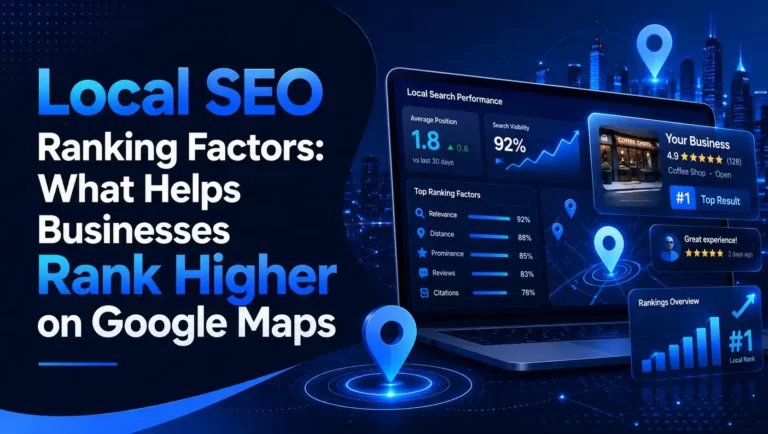
Your location pages do not operate in isolation. They work best when they are part of a consistent local presence that includes your Google Business Profile and your citation listings across the web. According to Google’s local ranking guidance, relevance, distance, and prominence are the three factors that determine local search rankings, and all three are influenced by how well your digital presence is aligned across your GBP, your citations, and your website.
When your location page, your GBP listing, and your citation entries all carry the same business name, phone number, address, and service description, Google reads that consistency as a reliability signal. When they conflict, different phone numbers, varied business names, or mismatched addresses, it creates doubt in the system and weakens your ranking for that area. Working with experienced local SEO services in Dubai ensures your pages and your wider local presence are genuinely aligned rather than just individually optimized.
How to Link Dubai Pages Without Cannibalizing
Internal linking for location pages needs a clear structure or you end up with pages competing against each other for the same terms. The standard approach is to have one main Dubai service page, the parent, that outlines your service at city level and links down to each individual area page. Each area page links back up to the parent and across to closely related service pages where the connection makes sense.
Avoid linking all your area pages to each other in a flat structure without a parent page to anchor them. That arrangement makes it hard for Google to understand which page you want to rank for which query. The parent page signals city-level intent. The child pages signal neighbourhood-level intent. Each serves a different searcher at a different stage of their decision, and the internal link structure should reflect that clearly.
How to Measure If Your Location Pages Work
Measuring location page performance means tracking the right numbers. Page views alone tell you very little. What you need to know is whether the page is generating real customer actions.
- Rankings by area: track where your page appears for the specific neighbourhood query, not just the broad city-level term.
- Qualified leads: are the enquiries coming from people who match the service area and the audience you built the page for?
- Calls and form fills: both are direct conversion signals that tell you the page is convincing people to act.
- GBP clicks from the page: if you link to your GBP from the location page, track how many visitors follow that path.
- Engagement: time on page, scroll depth, and bounce rate tell you whether the content is holding attention or losing it immediately.
Check these numbers monthly. If rankings are improving but calls are not, the page structure or CTA needs attention. If calls are coming in but rankings are low, the content depth and backlink support for the page need to be strengthened.
Dubai Location Page Mistakes to Fix Fast
- Duplicate copy: identical content across multiple area pages will not rank. Each page needs genuinely distinct content.
- Fake local signals: mentioning an area name repeatedly without any real local proof does not create trust with Google or the reader.
- Weak CTAs: vague calls to action like “contact us” outperformed every time by specific ones like “call our Dubai Marina team today.”
- No proof: a location page without local testimonials, photos, or project examples is just a service description with an area name attached.
- Poor internal links: area pages that are not connected to a parent service page or to related pages lose ranking strength quickly.
- No clear service angle: the page must tell the visitor exactly what you offer in that area and why you are the right choice, not just confirm you operate there.
A Simple Build Process for Dubai Area Pages
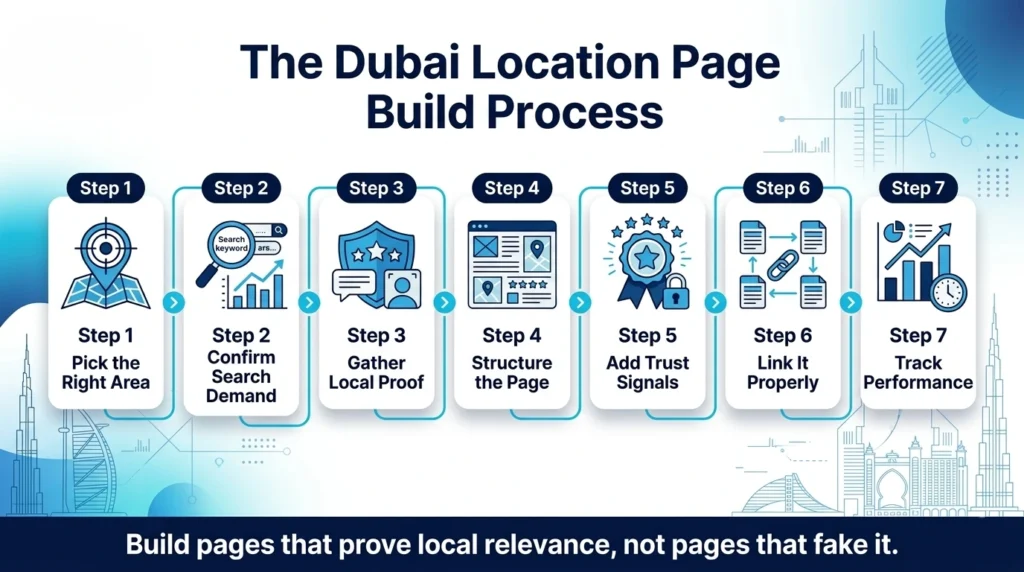
Here is the full process in order:
- Pick the right area: confirm search demand, service coverage, and competitive opportunity before building anything.
- Confirm demand: verify real keyword volume for your service plus the area name using a reliable SEO tool.
- Gather local proof: collect area-specific testimonials, project photos, and any relevant local details before writing.
- Structure the page: plan the headline, service sections, proof section, FAQ, and CTA before writing a single line of copy.
- Add trust signals: place reviews, ratings, project counts, or accreditations where they will be seen immediately.
- Link it properly: connect the new page to its parent service page and from any relevant existing pages on the site.
- Track performance: set up your measurement from day one so you know within sixty to ninety days whether the page is doing what it should.
Final Verdict on Dubai Local Landing Pages
A well-built Dubai local landing page is one of the most consistent lead sources a service business can have. But it only works when the page was built to genuinely represent that area, with real proof, real service detail, and content that answers the questions someone in that neighbourhood would actually ask. Every shortcut in this process produces a page that looks like a location page from the outside but performs like a doorway page from the inside.
The businesses ranking at the top of neighbourhood-level searches in Dubai are there because someone took the time to understand what a person in that area actually needs before opening a document and writing. That care shows in the page, and it shows in the rankings.
If building location pages at this level of quality is something your team needs support with, WR SEO Specialist works with Dubai businesses to build location-focused SEO strategies that produce real enquiries, not just impressions. From page structure through to local citation alignment, they cover the full picture.
Frequently Asked Questions
1. Do local landing pages still work in 2026?
Yes, they absolutely do, when built properly. The pages that have lost visibility are the ones built as thin templates with no real local content. Pages built with genuine area-specific proof, clear service descriptions, and consistent local signals continue to rank and generate leads in 2026. The standard for what counts as a useful location page has risen, but so has the opportunity for businesses that meet it.
2. Should I create pages for every area in Dubai?
No. Build pages only for areas where you have confirmed search demand, genuine service coverage, and local proof to support the content. A page for an area you cannot support with real evidence will not rank and will not convert even if it does appear. Quality over quantity is the rule here. Five well-built area pages will consistently outperform twenty thin ones.
3. What makes a location page different from a doorway page?
A doorway page exists purely to capture search traffic and offers nothing unique to the visitor. A real location page offers specific, area-relevant content that helps the reader understand what you do in that neighbourhood, why you are qualified to serve them there, and what past work you have done nearby. The practical test: if you read the page without the area name, does it say anything that could not apply to every other city page on the site? If the answer is no, the page is a doorway page regardless of how it was intended.
4. How do I make Dubai area pages unique?
Use genuine local details. Add testimonials from customers based in that area. Include photos of projects completed there. Reference actual buildings, developments, or landmarks in the area that are relevant to your service. Write the copy around the specific type of customer or property common in that neighbourhood. Each of these elements creates uniqueness that a template cannot replicate, and each one reinforces to both the reader and Google that your page belongs in that area.
5. Can local landing pages help Google Business Profile rankings?
Yes, indirectly but meaningfully. When your location page and your GBP listing share the same consistent business details and both point to the same area, it reinforces your local relevance in Google’s understanding of your business. Your website supports your GBP by providing additional trusted signals about where you operate and what you offer. The more aligned these assets are, page, GBP, and citations, the stronger your local presence becomes across all three.